How to caluculate the pressure immediately downstream of a sudden expansion

Click For Summary
SUMMARY

The discussion focuses on calculating the pressure immediately downstream of a sudden expansion in a fluid flow scenario, specifically involving water with a kinematic viscosity of 1E-6 m²/s. The user outlines their approach using energy balance equations, accounting for minor and distributed losses, but seeks clarification on determining the pressure. A suggestion is made to apply the Bernoulli equation, although the user notes the presence of friction complicates this approach. References to "Transport Phenomena" by Bird, Stewart, and Lightfoot are provided for further insights on friction coefficients.

PREREQUISITES
  • Understanding of fluid dynamics principles
  • Familiarity with the Bernoulli equation
  • Knowledge of energy balance equations in fluid mechanics
  • Experience with calculating minor and distributed losses in flow systems
NEXT STEPS
  • Study the application of the Bernoulli equation in real-world scenarios
  • Research friction coefficient calculations for various flow geometries
  • Explore energy balance methods in fluid flow analysis
  • Review "Transport Phenomena" by Bird, Stewart, and Lightfoot for advanced fluid dynamics concepts
USEFUL FOR

Fluid mechanics students, engineers involved in hydraulic design, and professionals analyzing pressure changes in fluid systems will benefit from this discussion.

Amaelle
Messages
309
Reaction score
54
Homework Statement
Finding a pressure right downstream a sudden expansion ( the picture of the exercice is joined to the solution attempt)
Relevant Equations
Energy balance equation
Good day All
Here is the first ligne of the exercice that might not be visible
As shown in figure , water (kinematic viscosity of water v=1E-6 m2s-1)flows out of a reservoir with a sharp entrance at A.

My questions is how to compute the pressure pn right down stream the sudden expansion
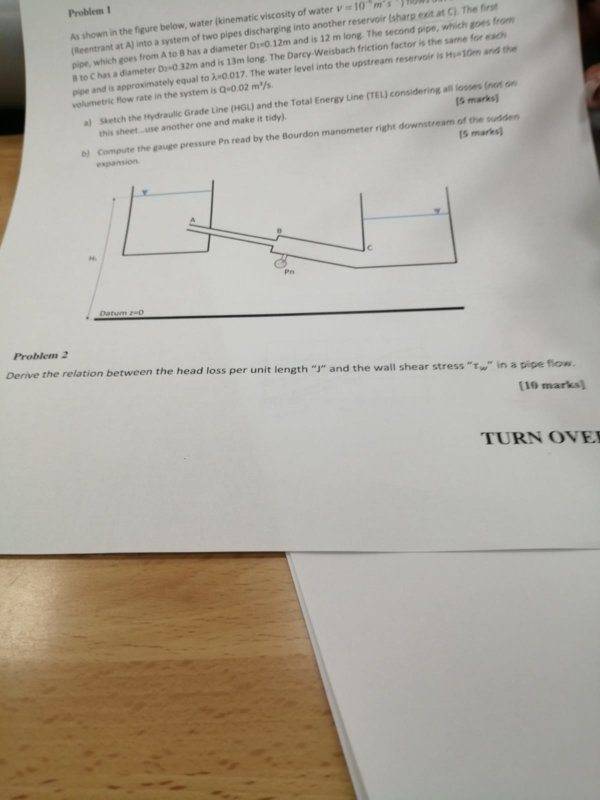
IMG-20200206-WA0001 (1).jpg


My attempt:
after calculating the velocity V1 in the first pipline we know that
H pipe1 right down stream=Total energy H1 (of the first reservoir)-minor losses
H pipe2 right down stream =H pipe1-minor losses -distributed losses ((easy to calulate))

But still i have no idea how to find the pressure?
Many thanks in advance!
best regards
 
Physics news on Phys.org
Amaelle said:
Homework Statement:: Finding a pressure right downstream a sudden expansion ( the picture of the exercice is joined to the solution attempt)
Relevant Equations:: Energy balance equation

Good day All
Here is the first ligne of the exercice that might not be visible
As shown in figure , water (kinematic viscosity of water v=1E-6 m2s-1)flows out of a reservoir with a sharp entrance at A.

My questions is how to compute the pressure pn right down stream the sudden expansionView attachment 260039


My attempt:
after calculating the velocity V1 in the first pipline we know that
H pipe1 right down stream=Total energy H1 (of the first reservoir)-minor losses
H pipe2 right down stream =H pipe1-minor losses -distributed losses ((easy to calulate))

But still i have no idea how to find the pressure?
Many thanks in advance!
best regards
As a first approximation, why not just use the Bernoulli equation?
 
Thanks a lot but we have frictions so we can only use energy balance but still let's consider that we can do it how are you going to handle it?
 
Amaelle said:
Thanks a lot but we have frictions so we can only use energy balance but still let's consider that we can do it how are you going to handle it?
Transport Phenomena by Bird, Stewart, and Lightfoot, and other texts have analytic expressions for friction coefficients to use in flow geometries like this.
 
  • Like
Likes   Reactions: Lnewqban
thanks a lot!
 

Similar threads

Replies
3
Views
2K
  • · Replies 1 ·
Replies
1
Views
3K
Replies
2
Views
2K
Replies
1
Views
3K
Replies
33
Views
5K
  • · Replies 8 ·
Replies
8
Views
4K
  • · Replies 1 ·
Replies
1
Views
10K
  • · Replies 4 ·
Replies
4
Views
9K