How to check the condition of coil in the relay?

Click For Summary

Discussion Overview

The discussion revolves around the condition of a relay coil in the context of using the relay for rapid on-off switching to produce voltage bursts. Participants explore the observed voltage behavior during switching and potential reasons for changes in voltage readings, focusing on the relay's coil and contacts.

Discussion Character

  • Technical explanation
  • Debate/contested
  • Experimental/applied

Main Points Raised

  • One participant reports measuring a voltage of ~120V during fast switching initially but now only measures ~10V, questioning whether the coil is faulty.
  • Another participant challenges the measurement method, suggesting that measuring between the coil and the NO terminal is inappropriate as it does not complete a circuit correctly.
  • A different participant speculates that the high voltage peak might be higher than measured and suggests that the relay contacts may be wearing out, affecting the voltage generation.
  • Concerns are raised about potential damage to the coil insulation due to high voltage spikes, leading to short-circuited turns in the coil and reduced inductance.
  • Some participants propose protective measures for the coil, such as using a flyback diode or a gas discharge tube to limit high voltage spikes.

Areas of Agreement / Disagreement

Participants express differing views on the cause of the voltage changes and the appropriateness of measurement techniques. There is no consensus on the exact reasons for the observed behavior or the condition of the relay coil.

Contextual Notes

Participants note that the relay's performance may be affected by wear and tear, and there are unresolved questions about the measurement techniques and the impact of switching frequency on the observed voltages.

Nikhil N
Messages
80
Reaction score
2
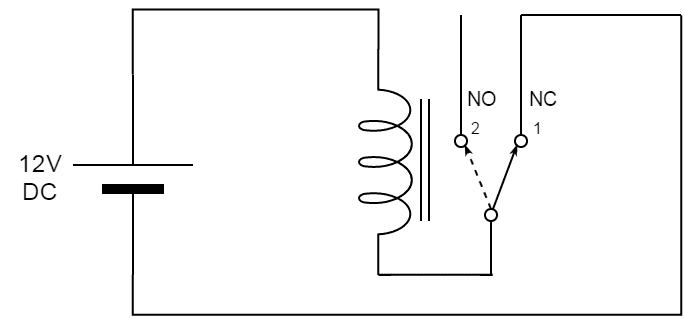
I am using the relay as chatter. That is I am continuously on-off the relay to produce bursts. I am using 12V DC relay. I got voltage upto ~120V while it is switching very fast initially. Now I am not getting high voltage while switching. I am getting only ~10V. What may be the reason? Is it problem of coil inside the relay?
relay.png

I am measuring the voltage between the point of coil where +ve of battery is connected and the NO terminal.
 
Engineering news on Phys.org
Nikhil N said:
I am measuring the voltage between the point of coil where +ve of battery is connected and the NO terminal.

As you have drawn it, the NO terminal is not part of a closed circuit. It makes no sense to measure there. That forces the circuit to be completed through the voltmeter. That's not how voltmeters are supposed to work.When switching from NC to NO, current is being forced to zero. That can cause a high voltage at the switch common and, sparking between the circuit and NC terminal.

You also don't measure the switching frequency. How many times per second is it switching?

Frankly, given all that, I don't know what the heck you are measuring.
 
  • Like
Likes   Reactions: davenn
Nikhil N said:
I got voltage upto ~120V while it is switching very fast initially.
Your equipment is not up to the task. The peak of that voltage is most likely far higher.

anorlunda said:
Frankly, given all that, I don't know what the heck you are measuring.
I think the switch is landing on the 'no' terminal before the arc extinguished, so ~ the voltage peak might be measurable there (but not with a common multimeter I think)

At that point the 12V coil has quite a voltage overload. I think some turn failures are likely to happen.

Any method to check a transformer for turn failures would be more or less OK if the switch of the relay is temporarily fixed.
 
  • Like
Likes   Reactions: anorlunda
Outside of the issues pointed out above... for a basic, unsealed relay in particular, this type of activity is very hard on the relay contacts. When they were new the contacts may have been making a very "clean" break when opening, as they have worn out, the opening of the contacts is a little slower, lowering the di/dt that creates the high voltage. - just a theory, would need to look at this on a scope and compare to a new relay.
 
Nikhil N said:
Now I am not getting high voltage while switching.
When the contact was opened, the high voltage spike produced by the inductor damaged the coil insulation. There are now a number of short circuited turns in the coil. It no longer has much inductance because it has shorted turns.

If you want to protect a coil you can use a flyback diode.
You can limit the high voltage to about 100 volts with a gas discharge tube such as a neon lamp.
 
  • Like
Likes   Reactions: jim hardy

Similar threads

  • · Replies 5 ·
Replies
5
Views
2K
  • · Replies 4 ·
Replies
4
Views
2K
Replies
8
Views
9K
Replies
37
Views
7K
  • · Replies 31 ·
2
Replies
31
Views
5K
  • · Replies 5 ·
Replies
5
Views
5K
Replies
12
Views
3K
Replies
10
Views
2K
Replies
17
Views
3K
  • · Replies 25 ·
Replies
25
Views
6K