How to Derive Thévenin's Equivalent Circuit from Nodes a and b?

Click For Summary

Discussion Overview

The discussion revolves around deriving Thévenin's equivalent circuit from nodes a and b, focusing on circuit analysis techniques such as nodal and mesh analysis. Participants explore the calculations and relationships between voltages and currents in the circuit.

Discussion Character

  • Technical explanation
  • Mathematical reasoning
  • Homework-related

Main Points Raised

  • One participant describes their attempt to derive Thévenin's equivalent circuit and expresses confusion over their nodal analysis results, particularly regarding the voltage at node V2 being 0V.
  • Another participant explains that V2 is 0V due to the current source shorting the 5Ω resistor and provides a superposition analysis to support this conclusion.
  • A participant questions the assumptions made in nodal analysis regarding which node has a higher voltage when writing equations, seeking clarification on how to approach such situations.
  • Another participant responds that it is not necessary to know which node has a higher voltage and suggests assuming one node has a higher voltage for analysis purposes.
  • A later reply emphasizes the importance of consistency in calculations and suggests redrawing the circuit to clarify relationships between nodes and branches.

Areas of Agreement / Disagreement

Participants express differing views on the calculations and assumptions made in the analysis. There is no consensus on the correctness of the nodal and mesh analysis results, and the discussion remains unresolved regarding the implications of the voltage at node V2.

Contextual Notes

Participants note potential errors in calculations and inconsistencies between different analysis methods, but do not resolve these issues. The discussion highlights the complexity of circuit analysis and the need for careful consideration of assumptions.

An1MuS
Messages
38
Reaction score
0
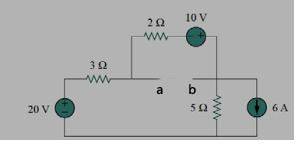
As seen from a and b.
tC3DW.jpg


My teacher did the norton's equivalent in the class, and now for studying purposes i was trying to get to the Thévenin's one. However it seems my equations are somehow wrong, and i can't figure out why.

The Eq resistance is 8||2, which is 1.6 ohms.

I tried to apply Nodal analysis first
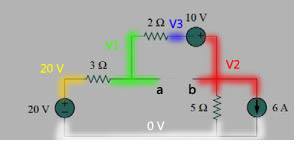
WNqBl.jpg


so,
for node V1: \frac{20-V_1}{3}=\frac{V_1-V_3}{2}
for node V2: \frac{V_1-V_3}{2}=6+\frac{V_2-0}{5}=
The relationship between two voltages is also known, which is V_2=V_3+10

which gives V1=2 ; V2=0 ; V3=-10.

V1-V2 should indeed be 2, because from my teachers resolution, Vab = 2V. I don't get is how can V2 be 0? Then there can't be another voltage drop when it reaches the ground (0V)

Also, then i tried mesh analysis:
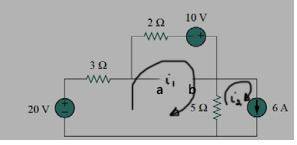
UKA3A.jpg


For mesh 120+10=3I_1+2I_1+5(I_1+I_2)
For mesh 2 0=5(I_2-I_1)+v
I_2=6

Where v is the voltage drop across the current source.

It gives I1 = 6 and v (which is equal to the V2 of the nodal analysis) = 0 again.
 
Engineering news on Phys.org
My answer is that :
V2 is 0V because 6A current source short 5Ω resistor.
Also notice that (20V + 10V) / ( 3Ω + 2Ω ) = 6A

So from superposition point of view we have this situation

attachment.php?attachmentid=46116&stc=1&d=1334158488.png


V2' = 30*R2/(R1 +R2) = 15V

And

V2'' = - (6A * 5/(10)) * 5 = - 15V

and V2 = V2' + V2'' = 15 + (- 15V) = 0V
 

Attachments

  • 12.PNG
    12.PNG
    6.8 KB · Views: 559
Last edited:
Thanks :) it means the current source is just discharging current. Like i had a current source between two Earth connections.

Another question:

In nodal analysis, when calculating a current entering / leaving a node we do \frac{V_x-V_y}{R} where V_x > V_y My question is: what if we don't know which of the two nodes has higher voltage when writting the equations? Or should it always be possible to know ?
 
An1MuS said:
Another question:

In nodal analysis, when calculating a current entering / leaving a node we do \frac{V_x-V_y}{R} where V_x > V_y My question is: what if we don't know which of the two nodes has higher voltage when writting the equations? Or should it always be possible to know ?
You don't need to know which of the two nodes has higher voltage.
All you need to do is assume that one of a voltage nodes has a higher voltage than the other node. And you can treat all nodes individually and assume that the node your currently examining has higher voltage.

For example for this circuit

attachment.php?attachmentid=46151&stc=1&d=1334238395.png


We can assume Vin > Va > Vout

And we can write nodal equation

\frac{(Vin-Va)}{R1}=\frac{Va}{R3}+\frac{(Va-Vout)}{R2}

\frac{(Va-Vout)}{R2}=\frac{Vout}{R4}

Or we can assume when we examining Va node that Va has the highest voltage.
And this means that all current flow-out (leave) from the Va node.

\frac{(Va-Vin)}{R1}+\frac{Va}{R3}+\frac{(Va-Vout)}{R2} = 0

And the same think we can do for Vout

\frac{(Vout-Va)}{R2}+\frac{Vout}{R4} = 0

Simply I assume that all the current leaving the node. If so this means that the voltage at this node has to be be the highest.

http://www.wolframalpha.com/input/?...+++(A+-+B)/100+=+0+,+B/100+++(B+-+A)/100+=+0+
 

Attachments

  • 1213.PNG
    1213.PNG
    1.4 KB · Views: 550
Last edited:


Hello,

Thévenin's Equivalent Circuit is a useful concept in circuit analysis that allows us to simplify complex circuits into a single voltage source and a single resistance. It is based on the principle that any linear circuit can be represented by an equivalent circuit with a single voltage source and a single resistance.

In your case, it seems that there may be some errors in your calculations. The equivalent resistance between nodes a and b is indeed 1.6 ohms, as you have correctly calculated. However, your nodal analysis and mesh analysis equations do not seem to be consistent with each other.

In nodal analysis, the voltage at node V2 should be equal to the voltage at node V3 plus 10V, as you have correctly stated. However, in your mesh analysis, you have set the voltage at node V2 to be equal to 0V. This may be the reason for the discrepancy in your results.

I would recommend double-checking your equations and making sure that they are consistent. It may also be helpful to redraw the circuit and label all the nodes and branches to make it easier to track the voltages and currents.

I hope this helps and good luck with your studies! Remember, Thévenin's Equivalent Circuit is a powerful tool in circuit analysis, so keep practicing and you will get the hang of it.
 

Similar threads

Replies
20
Views
4K
  • · Replies 2 ·
Replies
2
Views
2K
  • · Replies 3 ·
Replies
3
Views
2K
  • · Replies 2 ·
Replies
2
Views
2K
  • · Replies 2 ·
Replies
2
Views
2K
  • · Replies 6 ·
Replies
6
Views
3K
  • · Replies 13 ·
Replies
13
Views
1K
Replies
1
Views
2K
  • · Replies 1 ·
Replies
1
Views
2K
  • · Replies 15 ·
Replies
15
Views
2K