How to determine direction of forces?

  • Thread starter Thread starter sherrellbc
  • Start date Start date
  • Tags Tags
    Direction Forces
Click For Summary
The discussion revolves around understanding the direction of forces in a structural system. The user initially misinterprets the direction of forces, believing that a cable pulls upward while the structure pulls downward, indicating equilibrium. However, clarification reveals that the vector DB is not a force but a position vector, which is crucial for determining the correct direction of the force. The user realizes that normalizing the position vector and multiplying it by the force magnitude provides the correct force components. Ultimately, the key takeaway is that accurately defining the line of action (LOA) of the associated force is essential for proper analysis.
sherrellbc
Messages
83
Reaction score
0
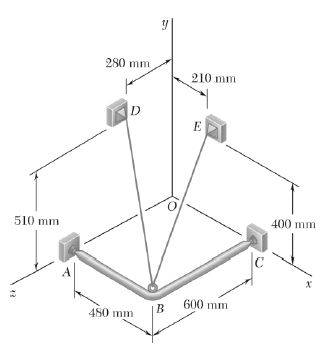
I am consistently getting this wrong. To me, in the picture below, it would make sense that the structure would be pulling downward, and the cable BD would be pulling upward - thus the system is in equilibrium.
AC3kld0.jpg


However, the solution to this problem show the force being applied downward onto the structure:

KgDAn1w.jpg


What is the trick?
 
Physics news on Phys.org
DB is not a force. It is measured in mm, so it must be the position vector of point B w.r.t. point D.

B = (480, 0, 600) mm
D = (0, 510, 280) mm

DB = (480, -510, 320) mm
 
I was using the sense of the line to determine the position vector, as you mentioned. I know that DB is not a vector, but if you normalize DB and then multiply the resulting vector by the magnitude of the F along that cable then you effectively have deduced the components of the force.

My problem is that, knowing the force should be from B -> D, I took D-B and got the opposite of what you have shown: DB = (-480, 510, -320).

Given two points, the way you subtract (D-B or B-D) does not matter for the magnitude of the line, but to get an accurate sense of the line you cannot do this action arbitrarily - as I have seen.

I see now though, that the definition of the line is nothing more than determining the LOA of the associated force.
 
In sci-fi when an author is talking about space travellers or describing the movement of galaxies they will say something like “movement in space only means anything in relation to another object”. Examples of this would be, a space ship moving away from earth at 100 km/s, or 2 galaxies moving towards each other at one light year per century. I think it would make it easier to describe movement in space if we had three axis that we all agree on and we used 0 km/s relative to the speed of...

Similar threads

  • · Replies 49 ·
2
Replies
49
Views
4K
  • · Replies 5 ·
Replies
5
Views
2K
  • · Replies 9 ·
Replies
9
Views
2K
Replies
6
Views
2K
  • · Replies 6 ·
Replies
6
Views
3K
Replies
6
Views
2K
Replies
5
Views
5K
  • · Replies 6 ·
Replies
6
Views
3K
  • · Replies 11 ·
Replies
11
Views
2K
Replies
39
Views
2K