Discussion Overview
The discussion revolves around how to distinguish between resistors in series and in parallel within electrical circuits. Participants explore methods for simplifying circuits and calculating equivalent resistances, with specific examples provided for clarification.
Discussion Character
- Technical explanation
- Debate/contested
- Mathematical reasoning
Main Points Raised
- Some participants propose that resistors are in parallel if both ends are connected to the same nodes, while they are in series if they are connected in a single path without other connections.
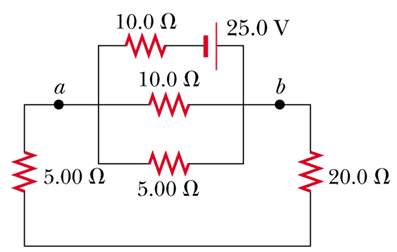
- One participant explains that the first circuit can be simplified by first combining the 20 Ohm and 5 Ohm resistors in series, then connecting the resulting 25 Ohm resistor in parallel with the 10 Ohm and another 5 Ohm resistor.
- Another participant questions why the 10 Ohm resistor in series with the voltage source is not in parallel with the other resistors, seeking clarification on the node connections.
- There is a discussion about the effective resistance of the middle 10 Ohm resistor, which is argued to be in parallel with the 5 Ohm resistor below it, affecting the overall resistance calculation.
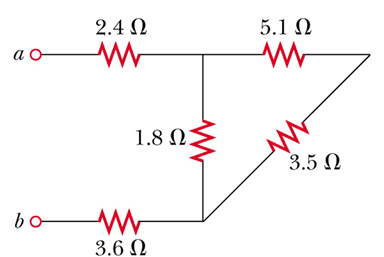
- Some participants note that certain resistor arrangements cannot be easily analyzed into series and parallel combinations, suggesting that experience plays a role in recognizing these configurations.
Areas of Agreement / Disagreement
Participants express differing views on the classification of certain resistors as being in series or parallel, particularly regarding the connections and effective resistances involved. The discussion remains unresolved with multiple competing interpretations of the circuit configurations.
Contextual Notes
Some participants highlight that there are arrangements of resistors which cannot be simplified into series and parallel combinations, indicating limitations in the methods discussed. Additionally, the effective resistance of certain configurations is debated, with no consensus reached on the calculations.