How to draw AC equivalent circuit of CE amplifier?

Click For Summary
SUMMARY

The discussion focuses on the AC equivalent circuit of a Common Emitter (CE) amplifier, emphasizing that the emitter resistor (Re) is omitted in the AC equivalent diagram due to the presence of a bypass capacitor (CE) that acts as a short circuit at operating frequencies. This simplification allows the emitter node to be grounded for AC analysis. Additionally, the discussion highlights the importance of using a small-signal equivalent model for the transistor, such as h-parameters or y-parameters, and notes that while the emitter resistor stabilizes the DC operating point, it reduces the amplifier's gain, which is mathematically represented as Gain = RC/RE. The addition of the bypass capacitor improves AC gain without affecting DC biasing.

PREREQUISITES
  • Understanding of Common Emitter amplifier configuration
  • Knowledge of AC and DC analysis in electronic circuits
  • Familiarity with small-signal equivalent models (h-parameters, y-parameters)
  • Basic concepts of feedback in amplifier design
NEXT STEPS
  • Study the impact of bypass capacitors on AC gain in amplifier circuits
  • Learn about small-signal analysis techniques for transistors
  • Explore the role of feedback in stabilizing amplifier performance
  • Investigate the effects of emitter resistors on gain and stability in CE amplifiers
USEFUL FOR

Electronics students, circuit designers, and engineers involved in amplifier design and analysis, particularly those focusing on Common Emitter configurations and small-signal modeling.

abhijath
Messages
4
Reaction score
0
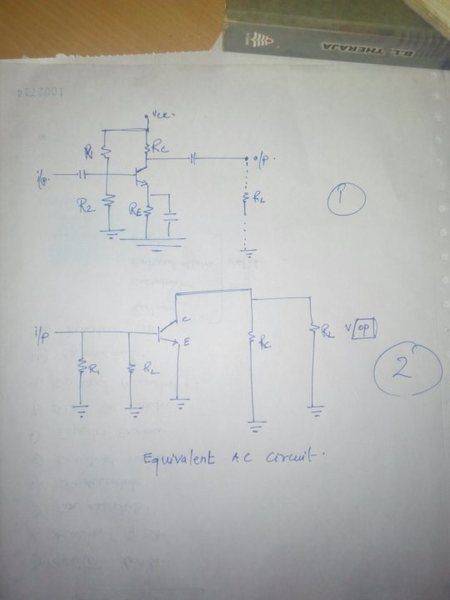
in the attached diagram its seen that while drawing AC equivalent of the common emitter circuit, Re is not taken in, the AC equivalent diagram no.2. why?
IMG_20160228_210715.jpg
 
Engineering news on Phys.org
We simplify assume that CE capacitor ( the capacitor connected across Re resistor) is large enough (very small Xc) so that we can treat him as a "short circuit".
 
  • Like
Likes   Reactions: CWatters
It is the only purpose of the capacitor CE across RE to ground the emitter node for the operating frequency range.
Therefore, in the ac equivalent diagram the emitter node is grounded (ac wise).
In addition, please note that in such an equivalent diagram it is common practice also to replace the transistor by its small-signal equivalent model (h-parameters or y-parameters).
 
The emitter resistor provides feedback that helps stabilise the DC operating point of the transistor. For example if the collector emitter current were to increase for some reason then the emitter resistor causes the emitter voltage to rise. That in turn reduces VBE which reduces the collector emitter current again.

However a side effect of the emitter resistor is to reduce the gain...

Gain = RC/RE

Adding that capacitor doesn't effect the DC biasing but improves the AC gain.

There is quite a good explanation of that here..

http://www.electronics-tutorials.ws/amplifier/emitter-resistance.html
 
I agree, of course, to CWatter´s explanation.
However, I don`t agree to his recommendation (link).
This link is not very serious and the contributions contain many errors and wrong explanations.
Example: The above link contains the sentence:
"Now if the supply voltage Vcc increases, the transistors collector current Ic also increases for a given load resistance"
I think, everybody will agree that this "explanation" shows that the author does not know how a transitor really works.
 
But it does. As VCC increases the base bias voltage increases. That increases the voltage across the emitter resistor and hence the collector current also increases.
 
CWatters said:
But it does. As VCC increases the base bias voltage increases. That increases the voltage across the emitter resistor and hence the collector current also increases.
(Typo?)

I am not sure if this was the idea of the author. The most important reason for RE-feedback is to reduce the influence of tolerances (passive parts and primarily uncertainty of beta).
 

Similar threads

  • · Replies 3 ·
Replies
3
Views
3K
  • · Replies 1 ·
Replies
1
Views
2K
Replies
13
Views
3K
  • · Replies 2 ·
Replies
2
Views
1K
  • · Replies 6 ·
Replies
6
Views
5K
  • · Replies 27 ·
Replies
27
Views
2K
  • · Replies 25 ·
Replies
25
Views
3K
  • · Replies 10 ·
Replies
10
Views
4K
  • · Replies 26 ·
Replies
26
Views
4K
  • · Replies 6 ·
Replies
6
Views
3K