How to estimate transfer function given a transmissibility plot?

Click For Summary
To estimate the transfer function from a transmissibility plot, start by recognizing that the transfer function is defined as the output over input. Given the assumption of phase behavior, with 0 degrees at low frequencies and -180 degrees at high frequencies, the plot indicates a low-pass filter characteristic with a pole at 0.5 Hz. The damping ratio is likely greater than 1, influenced by the peak's height, which can be calculated for accuracy. Additionally, a bump at 3.5 Hz should be incorporated into the transfer function analysis. Utilizing Bode plots can help approximate the data and derive the corresponding transfer function effectively.
annas425
Messages
16
Reaction score
0
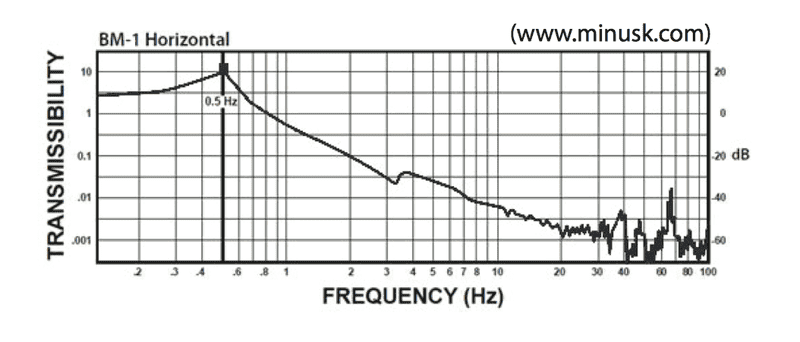
How would I estimate the transfer function for transmissibility given this plot:
1gol1v.png


I am told that the data does not include phase information, but assume that the phase is 0 deg at low frequency and -180 deg at high frequency. I must provide a brief rationale for each component of the transfer function. Ignore the measurement noise at frequencies larger than 10 Hz. Keep in mind the frequency units; transmissibility in dB is given on the rightside y-axis.

Thank you so much in advance! I really am struggling with this.

All I know is that {transfer function} = {output} / {input}. I do not know how to get a transfer function, just given a transmissibility vs. frequency graph.
 
Physics news on Phys.org
so from low freq to 10 hz it looks like a low pass filter. there will be a pole at 0.5 hz. the pole will have a damping ratio higher than 1 due to the large Q you see there. There are ways to calculate what the damping ratio is due to how high that peak gets.
you also nee to incorporate the bump at 3.5 Hz. I'll let you try to figure that out

give me your attempt
 
Review your notes or textbook on Bode plots. The basic idea is to approximate the plotted data by straight line segments, and then write down the transfer function that corresponds to the approximation. See www.ece.utah.edu/~ee3110/bodeplot.pdf.
 
I would assume real poles and zeros (no complex-conjugate poles) using Bode plots as the basis for determining the transfer function.
 

Similar threads

  • · Replies 2 ·
Replies
2
Views
2K
  • · Replies 3 ·
Replies
3
Views
2K
  • · Replies 4 ·
Replies
4
Views
2K
  • · Replies 3 ·
Replies
3
Views
2K
  • · Replies 16 ·
Replies
16
Views
2K
  • · Replies 8 ·
Replies
8
Views
3K
  • · Replies 6 ·
Replies
6
Views
2K
Replies
6
Views
4K
  • · Replies 3 ·
Replies
3
Views
2K
  • · Replies 1 ·
Replies
1
Views
4K