How to find gravity using general relativity?

Click For Summary

Discussion Overview

The discussion revolves around how to determine the gravitational effects of everyday objects, such as mirrors, glass, trees, and houses, using the principles of general relativity. Participants explore the nature of gravity, its relationship to spacetime curvature, and the applicability of general relativity versus Newtonian gravity in various contexts.

Discussion Character

  • Exploratory
  • Technical explanation
  • Debate/contested

Main Points Raised

  • Some participants question what is meant by "the gravity of an object," suggesting a need for clarification on gravitational force versus spacetime curvature.
  • It is proposed that every object, including everyday items, exerts gravity and produces spacetime curvature, although the effect is typically negligible for small masses.
  • One participant asserts that light follows a straight path in curved spacetime, which leads to the appearance of bending, particularly in the context of massive objects like the sun.
  • There is a discussion about whether the bending of light through materials like glass or water is due to their gravitational effects, with some arguing it is due to electromagnetic properties instead.
  • Participants mention that while ordinary objects can produce measurable spacetime curvature, the effects are extremely small and not detectable with current technology.
  • One participant references the Cavendish experiment as evidence that even small masses can produce measurable gravitational effects, though these are not noticeable in everyday life.
  • Another participant suggests that for practical purposes, Newtonian gravity is sufficient for everyday objects, while general relativity becomes important at larger scales, such as in astronomical contexts.
  • Technical details regarding the use of Einstein Field Equations and metrics in general relativity are mentioned, along with references to specific resolutions and papers that discuss these concepts.

Areas of Agreement / Disagreement

The discussion contains multiple competing views regarding the nature of gravity, the applicability of general relativity versus Newtonian gravity, and the effects of small masses on spacetime curvature. There is no consensus on the best approach to determine the gravitational effects of everyday objects.

Contextual Notes

Participants express uncertainty about the measurable effects of gravity from small objects and the conditions under which general relativity should be applied versus Newtonian gravity. The discussion includes references to specific experiments and theoretical frameworks without resolving the complexities involved.

Christian Grey
Messages
23
Reaction score
0
How to find gravity of an object, like mirror,glass,tree,house etc using general relativity? Because every object exerts gravity.
 
Physics news on Phys.org
Christian Grey said:
How to find gravity of an object

What exactly do you mean by "the gravity of an object"?
 
Like Earth exerts a gravity on an object, objects like glass,mirror,tree etc should also exert gravity on other objects.
 
Christian Grey said:
Like Earth exerts a gravity on an object, objects like glass,mirror,tree etc should also exert gravity on other objects.
"Gravity" is a curvature of space-time. It isn't "exerted". I think you mean gravitational force.

Use this equation:

u6l3c3.gif
 
russ_watters said:
"Gravity" is a curvature of space-time. It isn't "exerted". I think you mean gravitational force.

If the objects are stationary with respect to each other, you can use this equation:
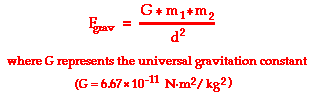
u6l3c3.gif
As light is bent by the gravitation of the sun, If I am in a room, there are different objects,can path of light also be effected by those objects like that are common in everyday life, like trees, houses etc.
 
Christian Grey said:
As light is bent by the gravitation of the sun...
Not exactly: light follows a straight path in space that is curved, which makes it appear to us to curve.
If I am in a room, there are different objects,can path of light also be effected by those objects like that are common in everyday life, like trees, houses etc.
Technically yes, but for small objects that are nearby, the effect would be far too small to be measurable. It's barely measurable for the sun!
 
russ_watters said:
Not exactly: light follows a straight path in space that is curved, which makes it appear to us to curve.

Technically yes, but for small objects that are nearby, the effect would be far too small to be measurable. It's barely measurable for the sun!

So can it be said that refraction(bending of light) of light through a glass, water etc is due to gravitation of glass,water?
 
Christian Grey said:
So can it be said that refraction(bending of light) of light through a glass, water etc is due to gravitation of glass,water?
No, for the reason I gave.
 
  • #10
Christian Grey said:
can it be said that refraction(bending of light) of light through a glass, water etc is due to gravitation of glass,water?

No, it's due to the electromagnetic properties of the glass or the water (specifically their refractive index). It has nothing to do with their gravity, which, as russ_watters pointed out, is much, much too weak to bend light measurably.

Christian Grey said:
every object exerts gravity.

This is true in principle--in GR we would put it, as others have pointed out, that every object produces spacetime curvature. But how much spacetime curvature an object produces depends on how massive it is (actually it's more complicated than that, but for ordinary objects this approximation will do). Ordinary objects like mirrors, trees, houses, etc. have much, much, much too little mass to produce measurable spacetime curvature. It takes an object the size of a planet or star or larger to do that.
 
  • #11
PeterDonis said:
Ordinary objects like mirrors, trees, houses, etc. have much, much, much too little mass to produce measurable spacetime curvature.
*Ahem*: https://en.wikipedia.org/wiki/Cavendish_experiment :rolleyes:
Those spheres where order 100 kg and clearly produced measurable spacetime curvature. Of course, it is not noticeable in everyday life, but it is measurable.
 
  • #12
Orodruin said:
Those spheres where order 100 kg and clearly produced measurable spacetime curvature.

Yes, good point; sensitive enough equipment can detect some gravitational effects of ordinary objects. But only some of them. Detecting, for example, the bending of light passing a 100 kg sphere is far beyond our current capabilities.
 
  • Like
Likes   Reactions: russ_watters
  • #13
However, the difference between the predictions of Newton's law of gravitation and Einstein's general relativity, for an experiment on the scale of Cavendish's, are so tiny as to be unmeasureable, as far as I know.
 
  • #14
Christian Grey said:
How to find gravity of an object, like mirror,glass,tree,house etc using general relativity? Because every object exerts gravity.

As others have said, the short answer is "don't bother, just use Newtonian gravity, it's good enough for that purpose".

If you want to move up a bit in scale, and ask how astronomers figure out gravity in the solar system, then to get the best accuracy you DO need to include the effects of general relativity. Furthermore, people have actually done so, because it's an important problem, so you can look up the results of their work. The details get extremely technical, but I'll mention that the output of all the work is a possibly unfamiliar object known as a metric, and it's coverd by something called the IAU 2000 resolutions.

If you want to see the end result, take a look at http://syrte.obspm.fr/IAU_resolutions/Resol-UAI.htm. It's not particularly friendly as written. I recall seeing some papers that purport to "explain" them, but unless you have more background than I think, the explanations won't be significantly less opaque than the IAU resoutions themselves.

Just to make life more interesting, I was just reading that there is some talk about "extending" the IAU metric, see http://adsabs.harvard.edu/abs/2012mgm..conf..722M for instance.
 

Similar threads

  • · Replies 10 ·
Replies
10
Views
1K
  • · Replies 3 ·
Replies
3
Views
1K
  • · Replies 27 ·
Replies
27
Views
3K
  • · Replies 8 ·
Replies
8
Views
2K
  • · Replies 15 ·
Replies
15
Views
3K
  • · Replies 15 ·
Replies
15
Views
2K
  • · Replies 1 ·
Replies
1
Views
1K
  • · Replies 55 ·
2
Replies
55
Views
5K
  • · Replies 33 ·
2
Replies
33
Views
3K
  • · Replies 7 ·
Replies
7
Views
2K