How to find power and voltage using the mesh current method?

5 replies · 3K views · last reply
stipan_relix
Messages
16
Reaction score
1
Member advised to use the formatting template for all homework help requests
Hi. I am practising for my test and since I don't have the correct answers, I don't know if what I'm doing is right.

I tried to solve this problem, can you check it and correct if it's wrong?
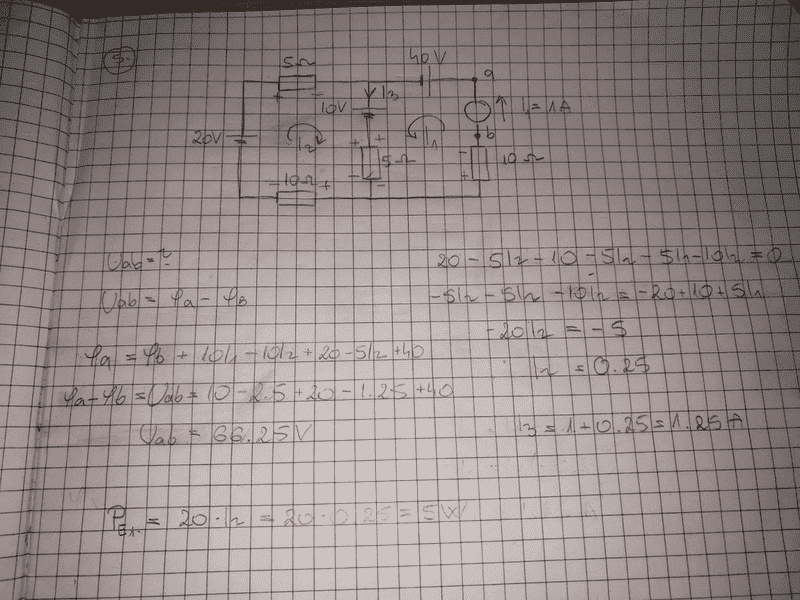
Handwritten circuit derivation on grid paper: a circuit with 5 ohm, 10 ohm and 10 V, 40 V and 20 V sources and mesh currents I1, I2, I3 with I = 1 A, followed by KVL equations and solved values for I2 = 0.25 A, I3 = 1.25 A, Uab and P.


Here's a clearer picture of the circuit.
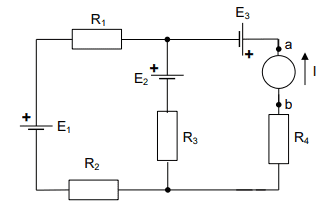
Circuit schematic with voltage sources E1, E2 and E3, resistors R1 to R4, a current source I, and nodes a and b marked for mesh current analysis.


I suspect Uab isn't right, but am not sure. Thanks!

EDIT: My work picture link was wrong, sorry.
 
Attachments
  • Circuit schematic with voltage sources E1, E2 and E3, resistors R1 to R4, a current source I, and nodes a and b marked for mesh current analysis.
    aYSEOEy.png
    2.2 KB · Views: 728
  • Handwritten circuit derivation on grid paper: a circuit with 5 ohm, 10 ohm and 10 V, 40 V and 20 V sources and mesh currents I1, I2, I3 with I = 1 A, followed by KVL equations and solved values for I2 = 0.25 A, I3 = 1.25 A, Uab and P.
    unUAKCg.png
    118.5 KB · Views: 911
Last edited:
Thanks for posting in homework, but you deleted the template. Most important, you didn't show us your work. Our rules do not allow helpers to help until you show your attempt at solution first. In other words, we don't do the problem for you. We help you to solve it.
 
anorlunda said:
Thanks for posting in homework, but you deleted the template. Most important, you didn't show us your work. Our rules do not allow helpers to help until you show your attempt at solution first. In other words, we don't do the problem for you. We help you to solve it.
Sorry, the link showing my work was somehow private, I fixed it.
 
  • Like
Likes   Reactions: berkeman
Alright, if I wanted to get P for the current source, I'd have to first get the voltage for that current source, there's no way around that, right?
 
stipan_relix said:
Alright, if I wanted to get P for the current source, I'd have to first get the voltage for that current source, there's no way around that, right?
Well, no way that's any simpler.
 
  • Like
Likes   Reactions: stipan_relix