How to find the max height a projectile can reach on a hillside

Click For Summary

Homework Help Overview

The discussion revolves around a projectile motion problem involving a hillside, where the original poster attempts to determine the maximum height a projectile can reach when launched at an angle towards a hill. The problem includes relationships between horizontal displacement, vertical height, and the launch angle, with a focus on maximizing height as a function of the launch angle.

Discussion Character

  • Exploratory, Conceptual clarification, Mathematical reasoning, Assumption checking

Approaches and Questions Raised

  • Participants discuss the relationships between horizontal displacement and vertical height, questioning how to express height as a function of the launch angle. There are attempts to derive equations involving derivatives to find maximum height, and some participants suggest substituting trigonometric identities to simplify the equations.

Discussion Status

Several participants are engaged in exploring different approaches to the problem, with some expressing uncertainty about their algebraic manipulations. There is acknowledgment of the complexity of the resulting equations, and some guidance has been offered regarding substitutions that may simplify the problem. Multiple interpretations of the projectile's trajectory and its relationship to the hill are being explored.

Contextual Notes

Participants note that the problem may become more complex depending on the distance to the base of the hill and the launch angle, with specific references to the implications of launching at angles less than or greater than 45 degrees. There is also mention of a guideline regarding posting work for clarity in the discussion.

Justinjah91
Messages
3
Reaction score
0
Homework Statement
You see an enemy archer and decide to position yourself on the side of a hill with a 60 degree grade. The enemy archer is 300 meters from the base of the hill. If the enemy's bow fires arrows at 60 m/s, how high (measured vertically) do you need to be on the hill to be out of range of the enemy archer?
Relevant Equations
Kinematics: ##x(t)=x_i+v_it+\frac 1 2 at^2##
Here's a fully typed version of the problem with a diagramMy attempt:
Given the angle of the hill, I know that the horizontal displacement of the arrow and my vertical height on the hill are related by

##Δx=d+\frac h {Tan(60)}## ...(1)​
where d is the distance of the enemy from the base of the hill (300 m). I also know that there is no acceleration in the horizontal direction, and the time of flight of the arrow is the same for the horizontal and vertical directions, leading to the following:

##Δx=v_{xi}t~~## ⇒ ##~~t=\frac {Δx} {v_xi}##​
##Δy=v_{yi}t-\frac 1 2 gt^2~~## ⇒ ##~~Δy=v_{yi}\left( \frac {Δx} {v_xi} \right) - \frac 1 2 g \left( \frac {Δx} {v_{xi}} \right)^2## ...(2)​
If I now substitute eqn (1) into (2), and let ##Δy=h##, I get:

##h=v_{yi} \left( \frac {d+ \frac h {Tan(60)}} {v_{xi}}\right)-\frac 1 2 g\left( \frac {d+ \frac h {Tan(60)}} {v_{xi}}\right)^2##​
Lastly, I know that the components of my initial velocity are related to the launch angle by:

##v_{yi}=v_isinθ##​
##v_{xi}=v_icosθ##​

Now, to find the maximum height, I need to maximize "h" as a function of theta by taking dh/dθ=0. The problem is that I'm having trouble getting "h" as a function of "θ". I'm getting stuck in the algebra somewhere. Anybody have a handy way to simplify this a little further? (I drew it as a cannon on the whiteboard, but same idea)
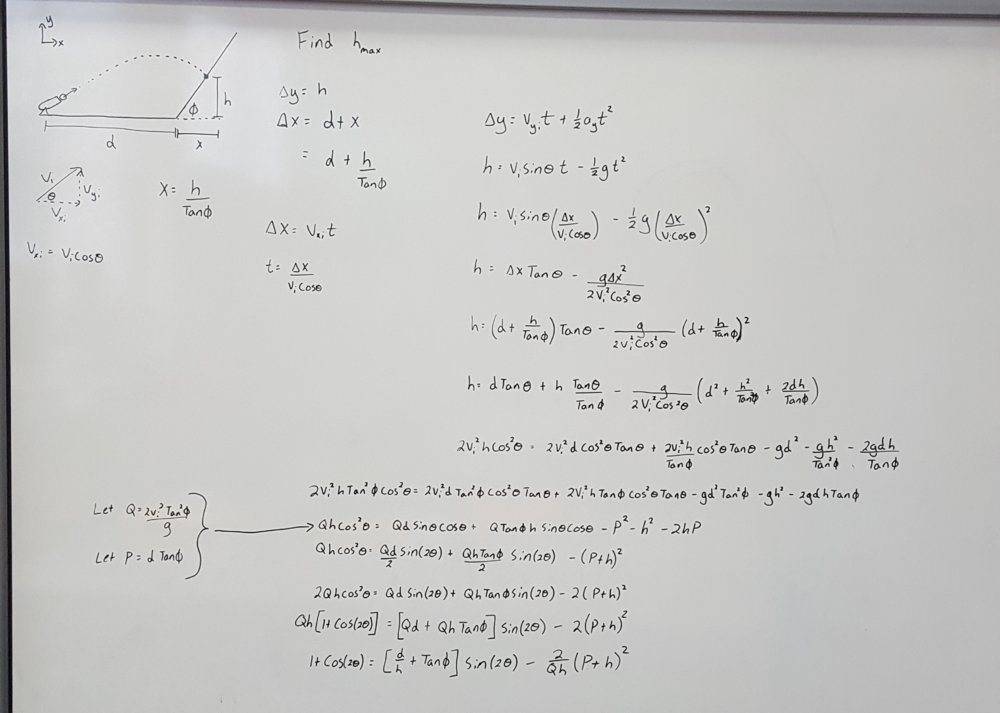
241646


I feel like there must be a trig substitution or something that I could have employed much earlier in this process to make my life easier.
 
Last edited:
Physics news on Phys.org
241653


When ##h## reaches its maximum, does ##\Delta x## also attain its maximum? If so, what does that tell you about ##\frac {dh}{d\theta}## and ##\frac {d (\Delta x)}{d \theta}## when these derivatives are evaluated at the value of ##\theta## that corresponds to maximum ##h##?
 
Yes I suppose it does. That would mean that ##\frac {dh} {dθ} = \frac {d(Δx)} {dθ} =0##.

I've gone ahead and given that a try, but the displacement I get is dependent on that optimum launch angle, and I still don't know that. I'm fairly certain that I've done the derivatives correctly, but maybe I'm missing something?

241659
 
OK. We ask that you try to avoid just posting pictures of your work. It makes it difficult for helpers to quote specific parts of your work. General guidelines are given here:
https://www.physicsforums.com/threads/guidelines-for-students-and-helpers.686781/
I agree with your result for the relation between ##\Delta x## and ##\tan \theta##.

You can use it to replace ##\tan \theta## in terms of ##\Delta x## in the first equation in the picture of your last post. Note ##\frac{1}{\cos ^2 \theta} = 1+ \tan ^2 \theta##.
 
Ah yeah that makes sense. Sorry about that!

Unfortunately, plugging that in makes it blow up into a crazy 4 order polynomial that I have no clue how to solve. I'm probably going to just use a numerical solver rather than trying for the analytical solution. I really would have expected it to be a nicer outcome than this.

Thank you so much for the help though!
 
You should find quite a bit of simplification after substituting for ##\tan \theta##. You should get a quadratic equation for ##\Delta x## (or for ##h##, if you prefer).
 
The max range for 45 deg launch is 366 metres. The halfway point is thus 183 m. Therefore, the projectile will hit the hill on its way down rather than up. Up to 45 deg, all projectile paths intersect the 45 deg trajectory behind its point of max height (or its halfway point along the x-axis). Therefore, the max point on the hill corresponds to the path of the 45 deg projectile.
 
It's actually trickier if the distance to the base is <183 m. In that case, the max height does not correspond to the 45 deg projectile path and a different approach has to be used.
 
Hello, hurreechunder.
hurreechunder said:
Up to 45 deg, all projectile paths intersect the 45 deg trajectory behind its point of max height (or its halfway point along the x-axis).
A projectile fired at less than 45o does not intersect the trajectory fired at 45o (except at the launch point, of course).

Therefore, the max point on the hill corresponds to the path of the 45 deg projectile.
Did you consider trajectories with launch angles greater than 45o?
 
  • #10
hurreechunder said:
Up to 45 deg, all projectile paths intersect the 45 deg trajectory behind its point of max height (or its halfway point along the x-axis).
Between 0 and 45 degrees, the second intersection point would be somewhere below the shooter's level. If the ground is level, that puts the second intersection point underground somewhere beyond max range.

Between 45 and 90 degrees, the second intersection point could be either on the rising portion of the 45 degree trajectory or on the falling side.

The first intersection point is at the shooter's position, obviously.
 
  • #11
TSny said:
Hello, hurreechunder.
A projectile fired at less than 45o does not intersect the trajectory fired at 45o (except at the launch point, of course).

Did you consider trajectories with launch angles greater than 45o?
Sorry, I meant from 90 deg to 45 deg, not from 0 deg to 45 deg. Hope that clarifies
 
  • #12
jbriggs444 said:
Between 0 and 45 degrees, the second intersection point would be somewhere below the shooter's level. If the ground is level, that puts the second intersection point underground somewhere beyond max range.

Between 45 and 90 degrees, the second intersection point could be either on the rising portion of the 45 degree trajectory or on the falling side.

The first intersection point is at the shooter's position, obviously.
You’re right, it’s possible for the intersection point to be on the falling side as well. I didn’t see that.
The “envelope of safety” formula should provide the answer in that case.
 
  • #13
hurreechunder said:
The “envelope of safety” formula
Didn't see that formula come by :rolleyes:
Can you show us the quadratic equation you found ?
 

Similar threads

  • · Replies 10 ·
Replies
10
Views
2K
Replies
12
Views
1K
  • · Replies 8 ·
Replies
8
Views
3K
Replies
40
Views
3K
Replies
6
Views
3K
  • · Replies 6 ·
Replies
6
Views
2K
Replies
10
Views
2K
  • · Replies 6 ·
Replies
6
Views
3K
  • · Replies 14 ·
Replies
14
Views
4K