How to predict the shape of the circle from any point of view

Click For Summary
A circle viewed at an angle appears as an ellipse, with the orientation of its major and minor axes determined by the angles ө, ∞, and €. The discussion explores predicting the ellipse's axis ratio (b/a) based on these angles, independent of the ellipse's size. It also draws parallels to a circle on a hinge casting a shadow that transforms from a circle to an ellipse as it rotates, with the horizontal axis remaining constant while the height changes based on the angle phi. The relationship between the angles and the shadow's dimensions is emphasized, suggesting that the shadow's behavior mirrors the camera's rotation. A formula to apply these principles in practical scenarios is sought for further exploration.
OFF_Smog
Messages
3
Reaction score
0
As we know a circle view at an angle appears as an ellipse ,
as you see in the picture, the center of the camera aim to the center of the circle ,
the angle between the circle axis and the camera is ө,
the azimuth between mojor axis(a) and the camera is ∞,
the rotation of the camera is €,

1. How to predict an orientation of major and minor axis and the ratio of its axes(b/a) ,if we only know these ө,∞,€ angle, regardless of size of ellipses

2. Is there any theory to apply this example?
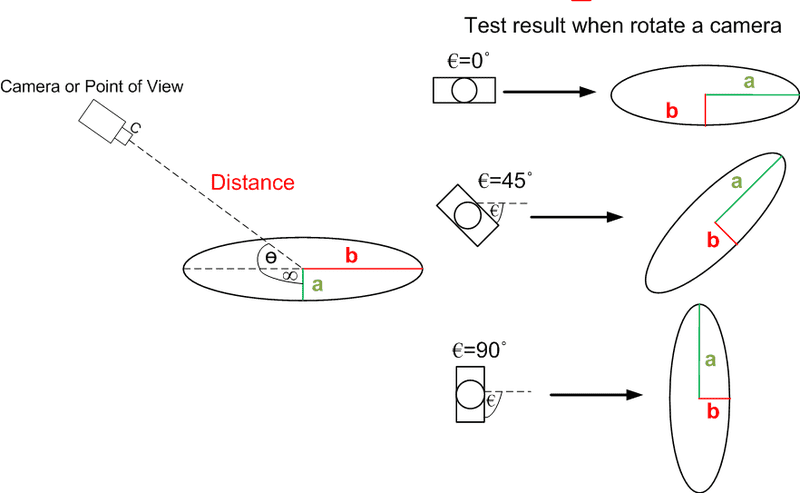
attachment.php?attachmentid=46615&d=1335275106.png
 
Physics news on Phys.org
consider the simpler problem of a circle on a hinge along its horizontal diameter. The circle is oriented so that initially its plane is vertical. Let phi be the angle the plane of the circle makes with the vertical axis as we rotate it around the hinge.

now suppose we have a light source (at infinity) and look at the shadow cast by the circle on a nearby vertical plane. Initially (phi=0) the shadow is a circle of the same radius as the circle. As we rotate the circle on its hinge, the shadow changes to an ellipse in the same manner as the camera in your diagram viewing the circle from different angles.

The horizontal axis of the shadow corresponds to a in your diagram. It is constant and always equal to the radius of the circle. The height of the shadow (b) changes with phi and a simple diagram will show you that its value is

b=a\cos\phi

I will leave you to relate phi back to the angles in your diagram.
 
Last edited:
Hi,

We can apply the light source(at infinity) theory in case a camera rotating,
Thus the shadow of ellipses will rotate the same as the camera rotation(€) right?

One thing that i concern is how to find formula to apply this circumstance?


Thank you very much
 
Thread 'What is the pressure of trapped air inside this tube?'
As you can see from the picture, i have an uneven U-shaped tube, sealed at the short end. I fill the tube with water and i seal it. So the short side is filled with water and the long side ends up containg water and trapped air. Now the tube is sealed on both sides and i turn it in such a way that the traped air moves at the short side. Are my claims about pressure in senarios A & B correct? What is the pressure for all points in senario C? (My question is basically coming from watching...

Similar threads

Replies
1
Views
2K
  • · Replies 9 ·
Replies
9
Views
2K
  • · Replies 2 ·
Replies
2
Views
1K
Replies
10
Views
3K
  • · Replies 6 ·
Replies
6
Views
31K
  • · Replies 1 ·
Replies
1
Views
2K
  • · Replies 2 ·
Replies
2
Views
3K
  • · Replies 11 ·
Replies
11
Views
3K
  • · Replies 4 ·
Replies
4
Views
2K
Replies
16
Views
2K