Huygen Wavefront: Drawing a Tangent to Wavelets

  • Context: Undergrad 
  • Thread starter Thread starter gracy
  • Start date Start date
  • Tags Tags
    Wavefront
Click For Summary
SUMMARY

The discussion centers on Huygen's principle and its application to wavefronts and wavelets. Participants debate whether tangents drawn to non-touching wavelets can produce a new wavefront, emphasizing that only tangents that are in phase with all wavelets will lead to constructive interference. The conversation references the Fermat Principle, highlighting that the direction of wave formation is dictated by the laws of reflection, which predict maximum amplitude directions while neglecting diffraction effects.

PREREQUISITES
  • Understanding of Huygen's Principle
  • Familiarity with wave interference concepts
  • Knowledge of the Fermat Principle in optics
  • Basic principles of wave reflection and diffraction
NEXT STEPS
  • Research the application of Huygen's Principle in wave optics
  • Study the relationship between wavelets and wavefront formation
  • Explore the implications of the Fermat Principle in optical systems
  • Investigate diffraction effects in wave propagation
USEFUL FOR

Students and professionals in physics, particularly those focusing on wave optics, as well as educators seeking to clarify concepts related to wavefronts and interference patterns.

gracy
Messages
2,486
Reaction score
83
One rule of huygen theory isfollowing
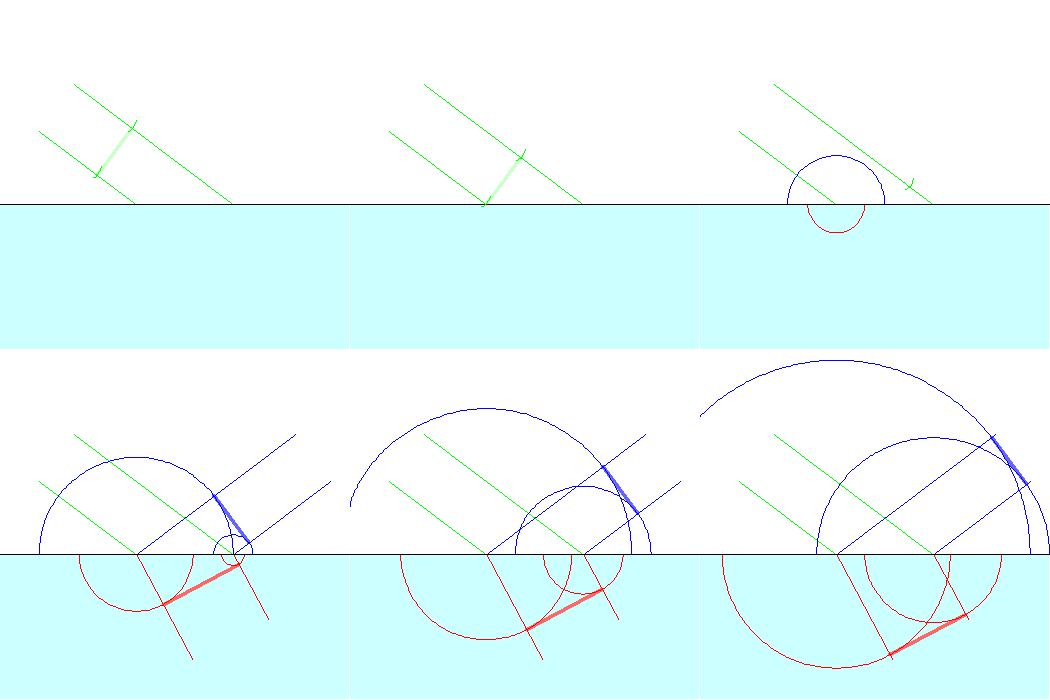
The new wavefront is https://www.boundless.com/definition/tangent/ to the wavelets.
ReflRefr.gif

If we look at reflection,to draw new wavefront we should draw tangent to the wavelets.should the two blue wavelets touch each other?Cannot we draw tangent to these blue wavelets even when they are not touching each other to get the new wavefronts?
 
Science news on Phys.org
gracy said:
Cannot we draw tangent to these blue wavelets even when they are not touching each other to get the new wavefronts?
I am saying that
upload_2015-2-17_15-20-39.png

Is it right?The two wavelets are not touching each other at any point,so will the tangent give the new wavefront?
 
It's only the tangents for both /all wavelets that tell you where you get additive interference. If you take arbitrary tangents, the wavelets will not interfere constructively to form a wavefront. (Is that what was worrying you?)
It is only another statement of the Fermat Principle.
 
sophiecentaur said:
It's only the tangents for both /all wavelets that tell you where you get additive interference
Is my tangent(the tangent I have drawn in my picture)going to give me new wavefront?
 
gracy said:
Is my tangent(the tangent I have drawn in my picture)going to give me new wavefront?
How can it, if it does not end up in phase with all the others, from the other wavelets?
There is only one direction in which this happens.
 
sophiecentaur said:
How can it, if it does not end up in phase with all the others, from the other wavelets?
But in my animation ,tangent to only two wavelets is giving new wavefront.
 
gracy said:
But in my animation ,tangent to only two wavelets is giving new wavefront.
You have not shown two tangents, parallel to each other, in your diagram. If they are not parallel, then they will be sweeping in and out of phase as they travel outwards and there will be no wave formed. The only direction which a wave will form and be sustained is in the direction that the laws of reflection predict.
I had a similar problem to you, when I fought this thing initially (way back in history).

There is another point. If you show only two wavelets then you will not get cancellation in other directions - you will have a circular resultant wavefront with amplitude variation with angle (Young Slits idea). The reflection laws only give the maximum amplitude direction and ignore diffraction effects. i.e. it assumes a very wide reflector and ignores the effect of the restricted aperture.
 
Last edited:

Similar threads

  • · Replies 5 ·
Replies
5
Views
2K
  • · Replies 10 ·
Replies
10
Views
2K
  • · Replies 25 ·
Replies
25
Views
4K
  • · Replies 2 ·
Replies
2
Views
3K
  • · Replies 7 ·
Replies
7
Views
2K
  • · Replies 16 ·
Replies
16
Views
5K
  • · Replies 3 ·
Replies
3
Views
2K
  • · Replies 22 ·
Replies
22
Views
8K
  • · Replies 7 ·
Replies
7
Views
2K
Replies
5
Views
2K