icor1031
- 24
- 1
The photography book I have talks about waveforms, but it doesn't do a good job of explaining them.
So, here's my understanding from the book and google searches (it could be unbelievably wrong.)
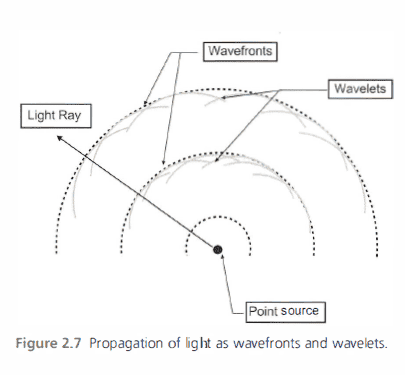
In an isotropic homogenous medium, light will spread out in all directions, essentially forming a large circle/ball. About at peak amplitude for each oscillation, new wavelets form. Those wavelets form slightly behind the wavefront, and have a slight curl to them.
When those new wavelets form, they propagate in at least a semi-circular pattern. (that is, they don't go just straight-ahead.)
This curl is how plane waves form:
That curl is why a plane wave is able to form: otherwise, the new waves which are now perpendicular to and moving in the same direction as other waves, would slightly lag its fellow waves and be out of phase. The curl makes them lag precisely the amount necessary to be in-phase.
An image from "The Manual of Photography"
So, here's my understanding from the book and google searches (it could be unbelievably wrong.)
In an isotropic homogenous medium, light will spread out in all directions, essentially forming a large circle/ball. About at peak amplitude for each oscillation, new wavelets form. Those wavelets form slightly behind the wavefront, and have a slight curl to them.
When those new wavelets form, they propagate in at least a semi-circular pattern. (that is, they don't go just straight-ahead.)
This curl is how plane waves form:
That curl is why a plane wave is able to form: otherwise, the new waves which are now perpendicular to and moving in the same direction as other waves, would slightly lag its fellow waves and be out of phase. The curl makes them lag precisely the amount necessary to be in-phase.
An image from "The Manual of Photography"