Hydraulic Modeling of Central Heating Network

Click For Summary

Discussion Overview

The discussion centers around the development of a software tool for dynamic hydraulic analysis of a central heating network, specifically focusing on closed-loop systems with supply and return pipes. Participants explore the challenges of modeling pressure distribution and temperature propagation in such networks, particularly in the context of district heating systems.

Discussion Character

  • Exploratory
  • Technical explanation
  • Debate/contested
  • Mathematical reasoning

Main Points Raised

  • One participant seeks references for hydraulic analysis of closed circuits, particularly for district heating networks with parallel loops.
  • Another participant expresses confusion regarding the mention of genetic algorithms, suggesting that the discussion may involve optimization rather than straightforward simulation.
  • A participant clarifies the need for ordinary time domain simulation to evaluate pressure distribution and thermal transients in the network.
  • Concerns are raised about the feasibility of developing such a software tool from scratch, with suggestions that it may require a team of engineers and significant resources.
  • Commercial software options are mentioned, with one participant recalling a past experience with a high-cost package, indicating that such tools are well-developed but expensive.
  • Another participant provides a specific software recommendation for hydraulic analysis.
  • There is a discussion about the potential need for a unique hydraulic model to test a new end-user substation, highlighting budget constraints for commercial software.
  • One participant notes that while the underlying equations are elementary, the complexity arises from data management and iterative methods, questioning the original poster's proficiency in numerical methods and software engineering.
  • Another participant suggests that outsourcing the analysis task could be a viable alternative to developing the software independently.

Areas of Agreement / Disagreement

Participants express differing views on the feasibility of developing a hydraulic analysis tool independently versus using commercial software. There is no consensus on the best approach, and multiple perspectives on the complexity and cost of the task are presented.

Contextual Notes

Participants highlight limitations related to the complexity of data management and the need for iterative methods in hydraulic modeling, which may not be fully addressed in simpler references.

HumanistEngineer
Messages
18
Reaction score
2
In this task of mine, I need to develop a tool/software to carry out (dynamic) hydraulic analysis of a central heating network, formed with supply and return pipes so forming a multi-parallel loops in a closed circuit, as can be seen in the below picture.

Can anyone suggest me some references especially for the hydraulics of closed circuits? I found some articles describing the graph-theory but I couldn't understand them since they are not mentioning looped formation (Fig 2 - Below Picture). Considering a large scale central heating network, such as District Heating (DH), I need to build a graphical interface together with some generic algorithm (such as in graph theory) that can handle hydraulic analysis (pressure distribution through the whole network).
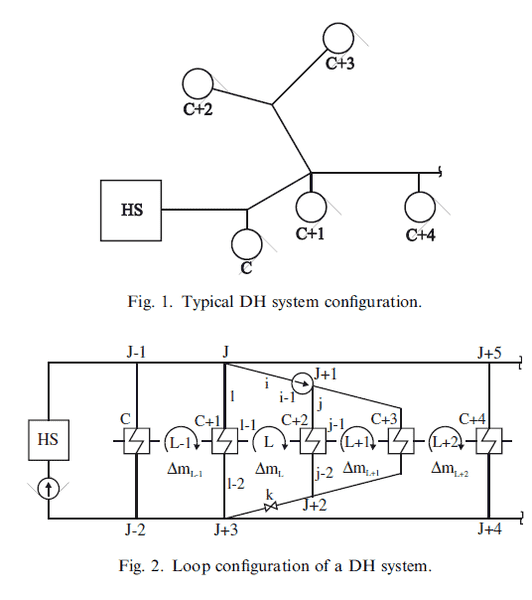
11_32_41-Efficient_numerical_method_for_district_heating_system_hydraulics.pdf_-_Adobe_Ac_k78ddn.png
 

Attachments

  • 11_32_41-Efficient_numerical_method_for_district_heating_system_hydraulics.pdf_-_Adobe_Ac_k78ddn.png
    11_32_41-Efficient_numerical_method_for_district_heating_system_hydraulics.pdf_-_Adobe_Ac_k78ddn.png
    20.8 KB · Views: 714
Engineering news on Phys.org
I thought you were asking about an ordinary time domain simulation, but when you mention genetic algorithm that implies optimization to me so I'm confused

We have been making simulations of thermal-hydraulic systems since the early 1950s. The equations are the differential equations of first principles, mass balance, energy balance, volume balance, momentum balance, plus heat transfers across boundaries. Is that what you are asking about?
 
  • Like
Likes   Reactions: russ_watters
anorlunda said:
I thought you were asking about an ordinary time domain simulation, but when you mention genetic algorithm that implies optimization to me so I'm confused

We have been making simulations of thermal-hydraulic systems since the early 1950s. The equations are the differential equations of first principles, mass balance, energy balance, volume balance, momentum balance, plus heat transfers across boundaries. Is that what you are asking about?

Sorry for my poor description. I need to model the network, as you indicated, in an ordinary time domain simulation (the demand/flow rate will change and I will see the pressure distribution through the network - to evaluate if the pressure difference across each end-user station is enough or not). In a further study, I will develop the thermal transients, in detail I will solve the convection-diffusion equation to see the temperature propagation through the network.

I have difficulty to find references about closed-loop networks; especially for this case that all end-user substations are parallel to each other. Since I will deal with modelling of a district heating network -such large scale-, I need a general tool/model that such as in graph theory to evaluate the pressure distribution through the network (such as the one shown in the below picture - ref: Termis(7T)). Can you suggest any reference or tool/code?

TermisDesign_small.png
 

Attachments

  • TermisDesign_small.png
    TermisDesign_small.png
    32.1 KB · Views: 687
HumanistEngineer said:
In this task of mine, I need to develop a tool/software to carry out (dynamic) hydraulic analysis of a central heating network, formed with supply and return pipes so forming a multi-parallel loops in a closed circuit, as can be seen in the below picture.

Can anyone suggest me some references especially for the hydraulics of closed circuits? ...

... I need to build a graphical interface together with some generic algorithm (such as in graph theory) that can handle hydraulic analysis (pressure distribution through the whole network).
You're asking for help about writing a hydraulic analysis program from scratch? This seems like an odd request for an internet forum - I would think this is a task a small team of computer and mechanical engineers might spend a year on. Commercially available software for this is highly developed and costs thousands of dollars per license. Is this really what you are asking?
 
russ_watters said:
Commercially available software for this is highly developed and costs thousands of dollars per license.

I'll second that. I wrote such a package in the 70s. The license fee back then was $35K. Alas, it no longer exists, but I'm sure others must. Be patient and some PF member will suggest one.
 
  • Like
Likes   Reactions: russ_watters
anorlunda said:
Be patient and some PF member will suggest one.
We use this in my office:

https://eng-software.com/products/pipe-flo-professional/
 
  • Like
Likes   Reactions: anorlunda
russ_watters said:
... I would think this is a task a small team of computer and mechanical engineers might spend a year on. ...

I agree on this but I need to develop in one way the hydraulic model since I need to test a unique new end-user substation so need to evaluate its effect on the DH network. I don't think that we have enough fund for such a commercial software in my project.

Any books, articles etc. that you can suggest for this hydraulic modelling?
 
HumanistEngineer said:
Any books, articles etc. that you can suggest for this hydraulic modelling?

As I said, the equations are pretty elementary, so a paper would not help much. It is the data management, abstract solutions, and iterative methods that make it expensive. How are you at numerical methods, linear algebra, and software engineering?
 
HumanistEngineer said:
I agree on this but I need to develop in one way the hydraulic model since I need to test a unique new end-user substation so need to evaluate its effect on the DH network. I don't think that we have enough fund for such a commercial software in my project.
I expect a commercial license would cost less (and take less time!) than trying to write the software yourself. Alternately you could outsource the analysis task to a company that has the appropriate software. That's what my company does for CFD.
 
  • Like
Likes   Reactions: Tom.G

Similar threads

  • · Replies 2 ·
Replies
2
Views
2K
Replies
3
Views
2K
Replies
1
Views
2K
  • · Replies 11 ·
Replies
11
Views
2K
  • · Replies 1 ·
Replies
1
Views
4K
  • · Replies 1 ·
Replies
1
Views
1K
Replies
7
Views
2K
Replies
2
Views
5K
  • · Replies 45 ·
2
Replies
45
Views
6K
  • · Replies 2 ·
Replies
2
Views
1K