Hydrostatic Equilibrium Problem Involving a Cube and two Liquids

Join the discussion
Ask a follow-up here, or get your own question answered by working scientists, mathematicians and engineers — people, not an autocomplete.
Real named experts · corrections over time · the nuance an AI answer skips
34 replies · 3K views
Chestermiller said:
Correct me if I am wrong. I integrated the vertical component of the pressure forces over the surfaces of the cube. On the portion immersed in fluid 2, I got a downward force of ##\frac{\rho_2 ga^3}{2}## and, on the portion immersed in fluid 1, I got an upward force of ##\frac{\rho_2 ga^3}{2}+\frac{\rho_1ga^3}{8}##, so the net fluid pressure force on the cube was upward, and equal to ##\frac{\rho_1ga^3}{8}##, independent of ##\rho_2##. I got the exact same result by calculating the upward force on the base of the stack, and subtracting the weights of the 4 triangular fluid wedges above.
I will try to do it by integrating too. I realized now that I really made a simple mistake and the resultant force is what you found. But now I am a little bit confused, the total force does not depend of 𝜌2 . Isnt that weird ? What should the answer for 𝜌2 be ?
 
Physics news on Phys.org
ViktorVask said:
I will try to do it by integrating too. I realized now that I really made a simple mistake and the resultant force is what you found. But now I am a little bit confused, the total force does not depend of 𝜌2 . Isnt that weird ? What should the answer for 𝜌2 be ?
Yes, it certainly sounds counterintuitive, but can't be argued with (since two completely different methods give exactly the same answer).

the answer for rho2 should be that it can be as low as zero.
 
Chestermiller said:
Yes, it certainly sounds counterintuitive, but can't be argued with (since two completely different methods give exactly the same answer).

the answer for rho2 should be that it can be as low as zero.
I just did the another solution. I will attach here. Got the same as you again.

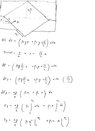
In the first photo I calculated the force due the liquid 2
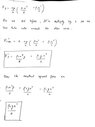
In the second one the force due the liquid 1 (taking into account the pressure that liquid 2 keeps exerting)
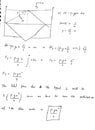
The last one I found the resultant
I think now it is okay
 

Attachments

  • 1.jpg
    1.jpg
    20.3 KB · Views: 206
  • 2.jpg
    2.jpg
    19.4 KB · Views: 195
  • 3.jpg
    3.jpg
    17 KB · Views: 203
ViktorVask said:
But now I am a little bit confused, the total force does not depend of 𝜌2 . Isnt that weird ?
At first, it does take you by surprise. But the simple explanation is given in the second paragraph of post #13 by @haruspex.
 
TSny said:
At first, it does take you by surprise. But the simple explanation is given in the second paragraph of post #13 by @haruspex.
Taking it further, if we consider starting with only the denser fluid and gradually add the lighter one, the buoyant force increases but with a negative quadratic term. It reaches a max when the fluid is half way up the face of the cube, then declines to its original value in the diagram position.
Beyond that, the buoyant forces declines linearly, eventually becoming negative overall, so a net downward force.
 
  • Like
Likes   Reactions: TSny