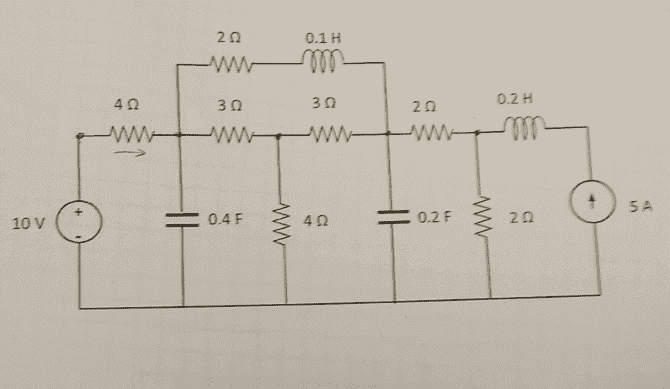
Discussion Overview
The discussion revolves around determining the capacitive and inductive resistance in a circuit using Kirchhoff's Current Law (KCL) and the implications of circuit behavior over time. Participants explore the theoretical aspects of circuit analysis, particularly focusing on the behavior of inductors and capacitors after a "sufficiently long time." The conversation includes both conceptual understanding and mathematical approaches.
Discussion Character
- Exploratory
- Technical explanation
- Conceptual clarification
- Debate/contested
- Mathematical reasoning
Main Points Raised
- One participant expresses uncertainty about their approach using KCL and Cramer's rule, questioning if they are on the right track.
- Another participant emphasizes the importance of understanding the circuit's behavior when it "is working for a sufficiently long time," suggesting that this understanding is crucial to avoid confusion.
- Some participants assert that after a "sufficiently long time," the inductor behaves like a wire and the current through the capacitor is zero, although this claim is noted as potentially misleading.
- There are repeated calls for the original poster to grasp the reasoning behind the note regarding the circuit's long-term behavior before proceeding with problem-solving.
- Participants mention the implications of constant current and voltage conditions, indicating that under constant current, voltage is zero, and under constant voltage, current is zero.
Areas of Agreement / Disagreement
Participants generally agree on the importance of understanding the circuit's long-term behavior, but there is disagreement regarding the interpretation of the note about the inductor and capacitor's behavior, with some suggesting it may be misleading.
Contextual Notes
The discussion highlights potential limitations in understanding the implications of circuit behavior over time and the need for clarity on the definitions and conditions under which the inductor and capacitor operate.