I have a question on the phase of a frequency response

Click For Summary
SUMMARY

The discussion focuses on calculating the phase of a frequency response, specifically for the transfer functions H1(w) and H2(w). The user seeks assistance in determining the individual phases of these functions to combine them for an overall phase calculation. Key points include the need to compute the argument of complex numbers, such as arg(e^{-j2ω}) and arg(4), to derive the phase information necessary for the exam question.

PREREQUISITES
  • Understanding of complex numbers and their arguments
  • Familiarity with frequency response analysis
  • Knowledge of transfer functions in control systems
  • Basic skills in trigonometry and Euler's formula
NEXT STEPS
  • Study the calculation of phase angles in complex numbers
  • Learn about the properties of transfer functions in control theory
  • Explore the concept of frequency response and its significance in system analysis
  • Review examples of combining phases from multiple transfer functions
USEFUL FOR

Students preparing for exams in electrical engineering, control systems engineers, and anyone interested in understanding frequency response analysis in signal processing.

great1122
Messages
1
Reaction score
0
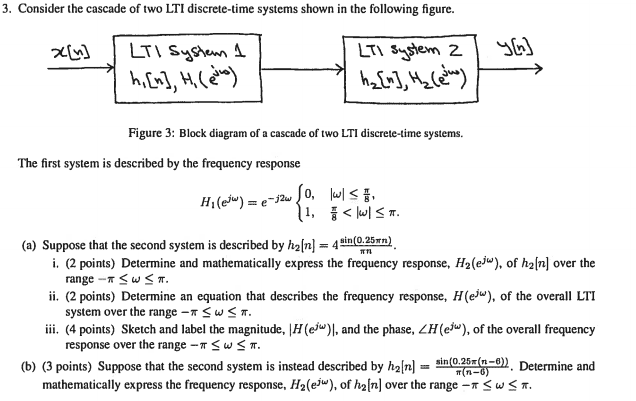
Hello, I'm currently studying for an exam and came across a question I can't seem to figure out. How exactly do we go about calculating the phase of a frequency response. Here is the question, it for part A) iii.
GW0cMMa.png

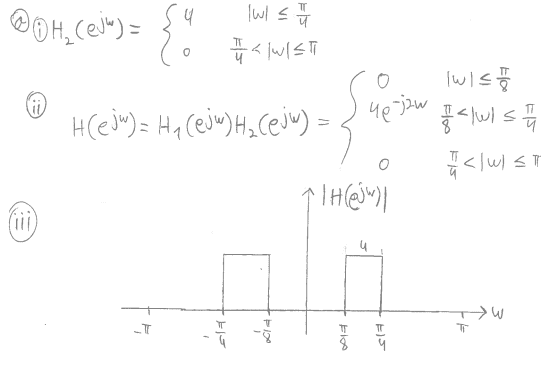
Here are the answers to the other parts and the sketch of the magnitude:
zfJSUDp.png

I know you have to add the phases of the H1(w) and H2(w) to get the overall phase but I can't seem to figure out how to get the phase of each one. Any help is appreciated thanks.
 
Engineering news on Phys.org
There's a separate forum for homework problems and the like, so, in the future, you should try to use that instead.

For some frequency ##\omega##, ##H_1(e^{j\omega})## and ##H_2(e^{j\omega})## are just a couple of complex numbers, so what is ##\arg(e^{-j2\omega})## and ##\arg(4)##?
 

Similar threads

  • · Replies 27 ·
Replies
27
Views
1K
  • · Replies 29 ·
Replies
29
Views
2K
  • · Replies 14 ·
Replies
14
Views
3K
  • · Replies 5 ·
Replies
5
Views
3K
  • · Replies 15 ·
Replies
15
Views
2K
Replies
2
Views
3K
Replies
5
Views
567
  • · Replies 2 ·
Replies
2
Views
2K
  • · Replies 3 ·
Replies
3
Views
2K
  • · Replies 27 ·
Replies
27
Views
3K