I think this should be simple, but i

  • Thread starter Thread starter ethanmuncher
  • Start date Start date
Click For Summary

Homework Help Overview

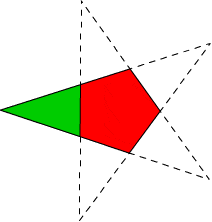
The discussion revolves around a geometry problem involving the area of a pentagon and a related triangle. The original poster seeks assistance in determining the area of the green part, given that the red part has an area of 800 square centimeters.

Discussion Character

  • Exploratory, Assumption checking, Mathematical reasoning

Approaches and Questions Raised

  • Participants explore various geometric relationships and assumptions about the shapes involved, including the properties of isosceles triangles and regular pentagons. Some question the adequacy of the provided information for solving the problem.

Discussion Status

The discussion includes multiple interpretations of the problem, with some participants providing mathematical expressions and reasoning. There is no explicit consensus, but several lines of reasoning are being explored, and some participants express enjoyment of the problem.

Contextual Notes

Participants note the lack of certain information regarding the triangles and the assumptions made about the pentagon's regularity. There are references to external resources for geometric formulas, indicating a collaborative effort to clarify the problem's context.

ethanmuncher
Messages
3
Reaction score
0
[SOLVED] i think this should be simple, but i need help!

Homework Statement


this isn't really homework, but I'm having trouble figuring this problem out...
the problem says:

In this diagram, the red part has an area of 800 square centimetres.
242_stararea.gif

What is the area of the green part, in square centimetres? Please round up to the nearest whole number.

Homework Equations


i have no idea how to solve this, since the only information they give is that the pentagon is 800 square centimeters...

The Attempt at a Solution


Well, I figured out that you could probably fold the green triangle into the pentagon, and make it 3 triangles, the 2 on the sides being congruent... but how do i figure out an area?
 
Physics news on Phys.org
i like this problem, what book did you get it from?

i sort of have an idea but i don't think I'm the best person to help.
 
I think you're missing a piece of information on the triangles... as is, you don't have any information on how the edges not part of the pentagon act, except that the triangle is isosceles, so you can't actually get an answer
 
I really enjoyed this problem

The nicest I got the area to reduce to was:
[tex]\sqrt{\phi^2 - \frac{1}{4}} * \frac{1600}{\sqrt{25 + 10\sqrt{5}}}[/tex]Where [tex]\phi[/tex] is the golden ratio.

Can anyone confirm? Is this right?
 
Last edited:
Office_Shredder said:
I think you're missing a piece of information on the triangles... as is, you don't have any information on how the edges not part of the pentagon act, except that the triangle is isosceles, so you can't actually get an answer

I don't agree.

Assuming it is a regular pentagon, the side of a pentagon is in a golden relation with the side of the triangle.
 
Diffy said:
I don't agree.

Assuming it is a regular pentagon, the side of a pentagon is in a golden relation with the side of the triangle.

I completely discounted that the diagram shows the triangles edges simply as extensions of the edges of the pentagon. Whoops
 
Diffy said:
I really enjoyed this problem

The nicest I got the area to reduce to was:
[tex]\sqrt{\phi^2 - \frac{1}{4}} * \frac{1600}{\sqrt{25 + 10\sqrt{5}}}[/tex]


Where [tex]\phi[/tex] is the golden ratio.

Can anyone confirm? Is this right?

:confused: i really don't know what that means. I'm taking a 10th grade geometry class right now. if there was like a simple whole number you could use to solve, what would you, well estimate it to be?
 
From this page on the area of a pentagon
http://mathcentral.uregina.ca/QQ/database/QQ.09.04/susan1.html
I got that a pentagon with side length "2a" has area

Area_pentagon = 5 tan(54) a^2

where 54 means 54 degrees. From that page we can also get the angles in the triangle, and then I get

Area_triangle = tan(72) a^2

And so

Area_triangle / Area_pentagon = tan(72)/(5 tan(54))

And, amazingly, this works out to something very simple, namely [itex]1/\sqrt{5}=0.447[/itex]. The triangle looks to me to have an area between 1/3 and 1/2 the pentagon, so numerically this fits as well.
 
Avodyne said:
From this page on the area of a pentagon
http://mathcentral.uregina.ca/QQ/database/QQ.09.04/susan1.html
I got that a pentagon with side length "2a" has area

Area_pentagon = 5 tan(54) a^2

where 54 means 54 degrees. From that page we can also get the angles in the triangle, and then I get

Area_triangle = tan(72) a^2

And so

Area_triangle / Area_pentagon = tan(72)/(5 tan(54))

And, amazingly, this works out to something very simple, namely [itex]1/\sqrt{5}=0.447[/itex]. The triangle looks to me to have an area between 1/3 and 1/2 the pentagon, so numerically this fits as well.

That agrees with Diffy's result as well, which could have been simplified using phi=(sqrt(5)+1)/2.
 
  • #10
Both answers work out to be around 357.7 This is good enough for me to confirm mine and Avodyne's answers are good.
 
  • #11
thanks everyone! i rounded 357.7 to 358, and apparently it was the right answer. :)
 

Similar threads

  • · Replies 24 ·
Replies
24
Views
3K
Replies
7
Views
2K
  • · Replies 8 ·
Replies
8
Views
2K
  • · Replies 8 ·
Replies
8
Views
3K
  • · Replies 5 ·
Replies
5
Views
4K
  • · Replies 2 ·
Replies
2
Views
3K
  • · Replies 5 ·
Replies
5
Views
3K
  • · Replies 3 ·
Replies
3
Views
4K
Replies
7
Views
3K
  • · Replies 6 ·
Replies
6
Views
3K