Imaginary parts of amplitues (Schwartz QFT text)

Click For Summary
SUMMARY

The discussion centers on the imaginary components of integrals in quantum field theory as presented in Schwartz's QFT text. Specifically, when the mass M exceeds twice the mass m (M > 2m), the integral in equation (24.24) transitions to an imaginary value due to the logarithmic function's inability to handle negative real numbers, necessitating the use of complex numbers. The principal value equation is confirmed in (24.25), while (24.26) and (24.27) derive from the properties of the theta step function and the integration of the step function, respectively. The correct interpretation of the Feynman integral requires adjusting the mass term to m^2 - iε to ensure real results for space-like four-momentum.

PREREQUISITES
  • Understanding of quantum field theory (QFT) principles
  • Familiarity with complex analysis, particularly logarithmic functions
  • Knowledge of the theta step function and its properties
  • Experience with Feynman integrals and their applications in QFT
NEXT STEPS
  • Study the implications of the imaginary part in quantum field theory calculations
  • Explore the properties of the theta step function in mathematical physics
  • Learn about the Feynman propagator and its role in vacuum QFT
  • Investigate the principal value of logarithmic functions in complex analysis
USEFUL FOR

Researchers, physicists, and students in theoretical physics, particularly those focusing on quantum field theory and complex analysis applications in particle physics.

Lapidus
Messages
344
Reaction score
12
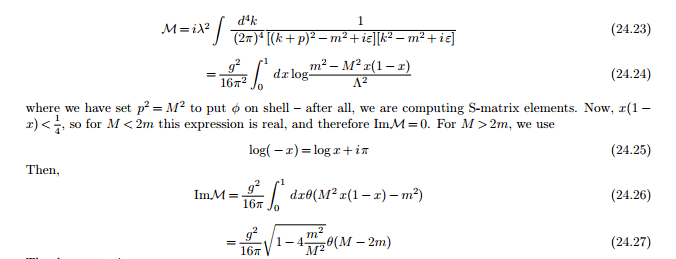
From Schwartz http://isites.harvard.edu/fs/docs/icb.topic521209.files/QFT-Schwartz.pdf p. 257 or his qft book p. 455
imaginary parts of amplitudes.PNG


1. Why and how does the integral in (24.24) go imaginary, when M > 2m? Is it because the logarithms can not take negative real numbers, thus we have to switch to complex numbers?

2. (24.25) is the principal value equation, right?

3. How does (24.26) follow from what?! Is the little theta the theta step function?

4. How does (24.27) follow from (24.26)?! Taking the integral of the theta function gives us this square root term?

thanks for any hints and help
 
Last edited:
Physics news on Phys.org
Lapidus said:
1. Why and how does the integral in (24.24) go imaginary, when M > 2m? Is it because the logarithms can not take negative real numbers, thus we have to switch to complex numbers?

2. (24.25) is the principal value equation, right?

3. How does (24.26) follow from what?! Is the little theta the theta step function?
Right.
Lapidus said:
4. How does (24.27) follow from (24.26)?! Taking the integral of the theta function gives us this square root term?
Integrating a step function just means you have to figure out where the steps are, in this case the integral starts at 0, then the function goes to 1 for a while and then goes to 0 again. The steps are at M2x(1-x) = m2, solving that for x should give this expression for the difference between the x-values.
 
  • Like
Likes   Reactions: Lapidus
Note that the correct sign has to be negative. That's because you have to take the ##\mathrm{i} \epsilon## in the propagator (which gives the correct time-ordered operator which must be used in vacuum QFT). So the ##m^2## in the Feynman integral (2.24) should be taken as ##m^2-\mathrm{i} \epsilon##, and then you have for the usual principle value of the logarithm ##\ln (-x-\mathrm{i} \epsilon)=\ln(|x|)-\mathrm{i} \pi##, and you have to use the usual principle value, because the integral must be real for space-like four-momentum, i.e., for ##p^2=M^2<0##.

Now to the integral for the imaginary part. Above threshold, ##M^2>4 m^2## the parabola ##f(x)=M^2 x(1-x)-m^2## is positive between its zeroes,
$$x_{1,2}=\frac{1}{2} (1 \pm \sqrt{1-\frac{4m^2}{M^2}}).$$
Since the square root is a monotonously growing frunction with ##M \geq 2m##, it's easy to see that both roots are in the interval ##[0,1]##, and thus you simply have
$$\int_0^1 \mathrm{d} x \Theta[M^2x(1-x)-m^2]=(x_1-x_2)=\sqrt{1-\frac{4m^2}{M^2}}.$$
This leads to the result (24.27) (which should be corrected for the subtle sign mistake mentioned above; note that it is in fact correct in the book on p. 455 Eq. (24.19)).
 
  • Like
Likes   Reactions: Lapidus and mfb

Similar threads

  • · Replies 11 ·
Replies
11
Views
3K
  • · Replies 4 ·
Replies
4
Views
3K
  • · Replies 4 ·
Replies
4
Views
3K
  • · Replies 2 ·
Replies
2
Views
2K
  • · Replies 3 ·
Replies
3
Views
4K
  • · Replies 8 ·
Replies
8
Views
4K
  • · Replies 5 ·
Replies
5
Views
2K
  • · Replies 3 ·
Replies
3
Views
4K
  • · Replies 5 ·
Replies
5
Views
2K
  • · Replies 2 ·
Replies
2
Views
2K