Indefinite Integral Homework: Get a Hint to Evaluate It

Click For Summary

Homework Help Overview

The discussion revolves around evaluating an indefinite integral, with participants seeking hints rather than complete solutions. The subject area involves calculus, particularly integration techniques.

Discussion Character

  • Exploratory, Conceptual clarification, Mathematical reasoning

Approaches and Questions Raised

  • Participants discuss using trigonometric identities and integration by parts as potential strategies. There is also a mention of the complexity of the answer, with some questioning the origin of the integral in relation to Fourier decomposition.

Discussion Status

The discussion is active, with participants sharing hints and exploring different approaches. There is no explicit consensus on a single method, but various strategies are being considered.

Contextual Notes

Some participants express uncertainty about the integral's origin and its relation to Fourier decomposition, indicating a potential gap in information regarding the problem's context.

zorro
Messages
1,378
Reaction score
0

Homework Statement


How do I evaluate this?
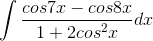
gif.latex?\int\frac{cos7x-cos8x}{1+2cos^2x}dx.gif


A hint will do.
 

Attachments

  • gif.latex?\int\frac{cos7x-cos8x}{1+2cos^2x}dx.gif
    gif.latex?\int\frac{cos7x-cos8x}{1+2cos^2x}dx.gif
    942 bytes · Views: 427
Physics news on Phys.org
Abdul Quadeer said:

Homework Statement


How do I evaluate this?

gif.latex?\int\frac{cos7x-cos8x}{1+2cos^2x}dx.gif


A hint will do.

Convert the expression using trig identities and then try by-parts integration or substitution.
 
Did you get the answer or you are just suggesting?
 
Yeah, looking at the answer, It looks like a few trig identities (particularly the denominator), and then integration by parts (many times). Be warned, the answer is rather ugly (many lines ugly...)

by any chance did this come up in a Fourier decomposition (I am looking at the graph of it)? :P
 
n1person said:
Yeah, looking at the answer, It looks like a few trig identities (particularly the denominator), and then integration by parts (many times). Be warned, the answer is rather ugly (many lines ugly...)

by any chance did this come up in a Fourier decomposition (I am looking at the graph of it)? :P

Looking at the answer? Where is it?
No it is not from Fourier decomposition.
 

Similar threads

  • · Replies 4 ·
Replies
4
Views
1K
  • · Replies 3 ·
Replies
3
Views
2K
Replies
1
Views
1K
  • · Replies 7 ·
Replies
7
Views
2K
Replies
11
Views
2K
  • · Replies 3 ·
Replies
3
Views
2K
Replies
2
Views
2K
Replies
10
Views
2K
  • · Replies 12 ·
Replies
12
Views
2K
  • · Replies 4 ·
Replies
4
Views
2K