Inductance of a coil (negative inductance?)

  • Context: Undergrad 
  • Thread starter Thread starter eehsun
  • Start date Start date
  • Tags Tags
    Coil Inductance
Click For Summary
SUMMARY

The discussion centers on the i-V relationship for a solenoid, specifically the expression VL = LdiL/dt, where V and i adhere to the passive sign convention. The participant seeks clarification on deriving this relationship and expresses confusion regarding the negative sign in the voltage drop across an inductor, which is -L dI/dt. The conversation references several educational resources, including HyperPhysics and a physics net resource, to illustrate the self-induced emf concept and its implications on the current flow within the inductor.

PREREQUISITES
  • Understanding of inductance and solenoids
  • Familiarity with Maxwell's equations
  • Knowledge of passive sign convention in electrical circuits
  • Basic principles of electromagnetism
NEXT STEPS
  • Study the derivation of the i-V relationship for inductors using Maxwell's equations
  • Explore the concept of self-induced emf in inductors
  • Investigate the implications of the negative sign in voltage across inductors
  • Review practical applications of solenoids in electrical circuits
USEFUL FOR

Electrical engineers, physics students, and anyone interested in understanding the behavior of inductors and solenoids in electrical circuits.

eehsun
Messages
9
Reaction score
0
Hi everyone,
I encountered a problem as a part of the solution of which I needed to get the i-V relation across a solenoid to gain some intution in the other parts of the problem, which is the well known expression
VL=LdiL/dt, where V and i are referenced with respect to the passive sign convention.
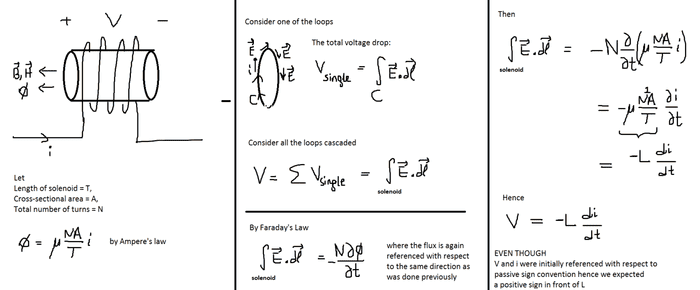
Nothing tricky here, just basic stuff - however I wanted to quickly verify this before I moved on in the problem. The following is a simple MSpaint sketch that I have just created for illustrative purposes
aaxe8o.png


The rest of the details are in the above picture. The question I had in mind is why I am not able to derive the simple relation VL=LdiL/dt for an inductor (solenoid in this case), even though I referenced everything in line with the passive sign convention?

Thanks!
 
Last edited:
Physics news on Phys.org
Any ideas? Something I may be overlooking?
 
This may help.

http://hyperphysics.phy-astr.gsu.edu/hbase/electric/farlaw.html#c2

http://hyperphysics.phy-astr.gsu.edu/hbase/magnetic/indcur.html#c1


http://faculty.wwu.edu/vawter/PhysicsNet/Topics/Inductance/Solenoid.html

Note in the last link:
This emf is called self-induced since it is the magnetic field of each loop that is creating an emf in the all the other loops including itself.

The negative sign means that the self-induced emf is opposite to the emf creating the original changing current.
 
Last edited by a moderator:
I will give this some more thought and follow it up thereafter.
Many thanks for the response!

Note: I know how an inductor should behave under a time-varying excitation current and in this context I know why it makes sense for an inductor to have the particular i-V relation that it does have, V = Ldi/dt. I just have a problem showing this through Maxwell's eqns, but I think I'll hopefully manage to see the error in my approach if I give it some more thought.
 
The voltage drop across an inductor is -L dI/dt and not L dI/dt.
Your first drawing is O.K. if dI/dt>0 and you consider the initial point is where the current enters the inductor and the output where the current exits the inductor. From that drawing you can easily see the voltage drop is negative (look at the plus and minus signs). That expalins everything.
 

Similar threads

  • · Replies 6 ·
Replies
6
Views
2K
  • · Replies 16 ·
Replies
16
Views
4K
  • · Replies 5 ·
Replies
5
Views
1K
  • · Replies 21 ·
Replies
21
Views
2K
  • · Replies 6 ·
Replies
6
Views
1K
  • · Replies 1 ·
Replies
1
Views
1K
  • · Replies 3 ·
Replies
3
Views
2K
  • · Replies 2 ·
Replies
2
Views
2K
Replies
2
Views
12K
  • · Replies 8 ·
Replies
8
Views
3K