Input/Output Voltage Class C RF Amp

Click For Summary
The discussion centers on understanding the output voltage behavior in a Class C RF power amplifier circuit, specifically regarding the collector of transistor Q7 exceeding the DC supply voltage of 12V. Participants clarify that the voltage across Q7 can be influenced by RF voltage in addition to the DC supply, and that RFC1 acts as a choke to prevent RF interference on the DC rail. The Zener diode (D7) is highlighted as a protective measure against voltage spikes, particularly when the power supply connection is interrupted or the load changes. It is noted that energy stored in the tank circuit contributes to the high voltage observed. Overall, the complexities of RF amplification and protective components are emphasized in the discussion.
shawisco
Messages
1
Reaction score
0
Hi all:

I am a new member here with my first post. I am an adult learner trying to self-teach RF electronics. I have been working through David Rutledge's Electronics of Radio, while building the NorCal 40A transceiver.
I am getting caught up on understanding the Class C RF power amplifier circuit.

I don't understand how the output voltage across the collector of Q7 can be more than twice the DC supply voltage (12VDC). I assume that the reactive components--such as RFC1--are storing energy?

Any help would be appreciated. I have included the schematic below.
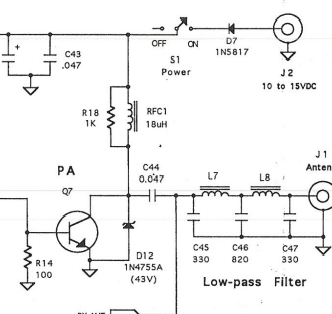
upload_2015-12-16_11-6-14.png
 
Engineering news on Phys.org
shawisco said:
I don't understand how the output voltage across the collector of Q7 can be more than twice the DC supply voltage (12VDC). I assume that the reactive components--such as RFC1--are storing energy?

hi there and welcome to PF
I cannot answer this completely
1) interesting circuit, its pretty standard except for the zener diode across the transistor ... never seen that before
2) consider that the 43V rating of the zener is just the voltage rating of the zener for when it will go into conduction and NOT the voltage that is
present across the transistor all the time and most likely none of the time
3) on the collector of the transistor, there is going to be an RF voltage as well as the DC supply voltage ... am not good enough to explain the complexities there
4) RFC1 is a choke, whose sole purpose is to isolate the DC rail from the RF voltage at the transistor collector ... We DO NOT want RF getting onto the DC rail, it will cause all sorts of bad things to happen

Dave
 
Some comments:
  • The purpose of D7 is to protect the power supply
  • When S1 breaks the connection to the power supply, it causes a voltage spike across RFC1. The Zener is there to protect Q7 when that happens.
  • If the antenna is disconnected, the load on Q7 changes drastically. The Zener may help protecting Q7 in that case.
 
A Class C amplifier is working somewhat like a switch. When a current flowing in an inductor is broken, a high voltage can be generated equal to -L dI/dt. This is where the voltage comes from, and you are correct that it comes from energy stored in the tank circuit. The Zener is used to limit the RF voltage across the transistor to a safe value. Dangerous voltage could arise if the load resistance is accidentally omitted or the load is severely mismatched.
 
I am trying to understand how transferring electric from the powerplant to my house is more effective using high voltage. The suggested explanation that the current is equal to the power supply divided by the voltage, and hence higher voltage leads to lower current and as a result to a lower power loss on the conductives is very confusing me. I know that the current is determined by the voltage and the resistance, and not by a power capability - which defines a limit to the allowable...

Similar threads

  • · Replies 16 ·
Replies
16
Views
2K
  • · Replies 28 ·
Replies
28
Views
5K
  • · Replies 32 ·
2
Replies
32
Views
4K
  • · Replies 9 ·
Replies
9
Views
5K
  • · Replies 26 ·
Replies
26
Views
3K
  • · Replies 8 ·
Replies
8
Views
2K
  • · Replies 11 ·
Replies
11
Views
3K
Replies
6
Views
4K
  • · Replies 3 ·
Replies
3
Views
4K
  • · Replies 2 ·
Replies
2
Views
4K