Instability of a 1D material due to Fermi surface nesting

Click For Summary

Discussion Overview

The discussion revolves around the instability of a one-dimensional (1D) material due to Fermi surface nesting, particularly focusing on the mathematical representation of the Lindhard response function and its implications in different dimensionalities (1D, 2D, and 3D). Participants explore the differences in behavior of the Fermi surface in these dimensions and the resulting effects on the divergence of the response function.

Discussion Character

  • Technical explanation
  • Debate/contested

Main Points Raised

  • One participant presents the Lindhard response function and notes its divergence near the wavevector ##\vec{q}=2\vec{k}_F## in 1D, attributing this to Fermi surface nesting.
  • Another participant explains that in 2D, the integration over wavevectors will not be as singular due to the spherical nature of the Fermi surface, suggesting a difference in behavior compared to 1D.
  • A participant questions the argument by pointing out that in 1D, the parallel lines restrict the wavevector direction, while in 2D, all orientations remain valid.
  • One participant clarifies that the discussion of 1D refers to materials with Fermi surfaces resembling two nearly parallel planes, rather than truly 1D materials.
  • Another participant argues that in 2D, the Fermi surface is more spherical, leading to isolated point mappings, which contrasts with the line mappings in 1D.
  • A participant expresses confusion about the differences in dimensional representations of the Fermi surface, questioning the characterization of 1D as a plane and 2D as a cylinder.
  • One participant suggests that considering a periodic array of non-interacting 1D objects is a more physical approach to understanding 3D objects, challenging the notion of true 1D materials.

Areas of Agreement / Disagreement

Participants express differing views on the nature of Fermi surfaces in various dimensions and how these affect the mathematical treatment of the Lindhard response function. There is no consensus on the characterization of the Fermi surfaces or the implications of dimensionality on the nesting phenomenon.

Contextual Notes

Participants discuss the idealized representations of Fermi surfaces and the implications of dimensionality on singularities in the response function, indicating a reliance on specific definitions and assumptions that may not be universally agreed upon.

tom8
Messages
19
Reaction score
0
Consider the Lindhard response function:
\chi(\vec{q})=\int\frac{d\vec{k}}{(2\pi)^d}\frac{f_\vec{k}-f_{\vec{k}+\vec{q}}}{\epsilon_\vec{k}-\epsilon_{\vec{k}+\vec{q}}}
where ##\vec{q}## is the wavevector, ##\epsilon## is the free electron energy and ##f## is Fermi-Dirac distribution function. For 1D near ##2k_F##, this reduces to:
\chi(q)=-e^2n(\epsilon_F)\ln\frac{q+2\vec{k}_F}{q-2\vec{k}_F}
where ##n(\epsilon_\vec{F})## is the density of states. Clearly ##\chi(\vec{q})## diverges near ##\vec{q}=2\vec{k}_F##.

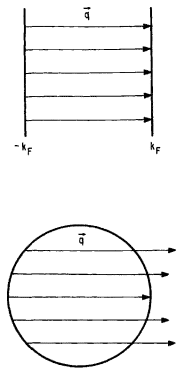
It is argued (see the picture below) that this divergence is due to Fermi surface nesting, which is represented by the arrows in the picture. What I do not understand is that why, in the 2D case, the arrows are restricted to be horizontal? I can still draw an arrow in any direction since this is a Fermi surface and all points have the same energy and are thus identical...
S2mDz.png
 
Physics news on Phys.org
Yes, but a vector is not one arrow but so to say all possible arrows which are parallel to each other. In 2d you will first integrate over all q with a given direction but different lengths and in a second step over all possible orientations. The first integral will not be as singular as in 1d due to the spherical Fermi surface. The second integration will not change this.
 
So you are saying that the divergence in 1D is more than in 2D per one nesting wavevector. If we will sum over all the possible nesting wave vectors in 2D, then so we do in 1D and it is the same.

But, if we look at the figure, the 1D case has two parallel lines. Anything other than a horizontal wavevector will be larger than ##2 k_F##, while in 2D all orientations will still be ##2 k_F##, so the argument above does not seem to hold.
 
No, what I wanted to say was something different. There are no truly 1d materials. Rather what we mean in this context is a material whose Fermi surface consists of two almost parallel planes. You may think of a bunch of almost non interacting truly 1d materials which are hardly interacting.
Then one wavevector of length 2k_F will map each point from one surface to a point on the other.
In a 2 or 3d material, the corresponding Fermi surface will be more or less spherical, so independently of the wavevector, only isolated points will be mapped to isolated points.
 
DrDu said:
...In a 2 or 3d material, the corresponding Fermi surface will be more or less spherical, so independently of the wavevector, only isolated points will be mapped to isolated points.

And how is this different? In 1D I can also say that individual points in one line are mapped to isolated points in the other. Collectively, these points constitute the line. In 2D the same is true. Sorry I can't just get it.

P.S. let's stick to ideal Fermi surface for the moment.
 
You can't compare apples and pears. So 1d, 2d and 3d, are all actually 3 dimensional objects with the following ideal Fermi-surfaces: 1d=two planes, 2d=a cylinder, 3d=a sphere. Now in the integration over k space, the singularities of de denominator are of codimension 2( a plane) , 1(a line) , 0 (a point).
 
Oh I see. Now I understand your point, but (sorry) isn't the Fermi surface for 1D a line, 2D a circle and 3D a plane, how come now it is a plane for 1D and a cylinder for 2D?
 
You can always consider a periodic array of non-interacting one dimensional objects to make up a 3d object. This is much more physical than considering a true 1d object. This is also what is implied in your graphics, as they represent the Fermi surface of a 1 d object as a line in a 2d space.
 
I see, thank you!
 

Similar threads

  • · Replies 3 ·
Replies
3
Views
4K
  • · Replies 8 ·
Replies
8
Views
2K
  • · Replies 2 ·
Replies
2
Views
2K
  • · Replies 1 ·
Replies
1
Views
3K
  • · Replies 6 ·
Replies
6
Views
6K
Replies
4
Views
3K
  • · Replies 6 ·
Replies
6
Views
2K
  • · Replies 2 ·
Replies
2
Views
2K
  • · Replies 3 ·
Replies
3
Views
3K
  • · Replies 2 ·
Replies
2
Views
2K