Integration over a part of a spherical shell in Cartesian coordinates

Click For Summary
SUMMARY

The discussion focuses on integrating the vector function f = -xj + yi over a portion of a spherical shell with radius R, specifically the projection of a circle of radius b in the x-y plane. The user seeks to perform this integration in Cartesian coordinates due to known integration intervals, despite the complexity of setting the z interval. It is confirmed that the integration can be conducted over dx dy with the area element dA = sec(γ) dx dy, where γ is the angle between the normal to the surface and the z-axis. Clarifications indicate that the integral may pertain to a surface integral rather than a volume integral, with a suggestion to multiply the surface integral result by Δr if a thickness is involved.

PREREQUISITES
  • Understanding of vector functions in Cartesian coordinates
  • Familiarity with surface integrals and volume integrals
  • Knowledge of spherical coordinates and their application in integration
  • Basic concepts of calculus, particularly Advanced Calculus techniques
NEXT STEPS
  • Study the application of surface integrals in Cartesian coordinates
  • Learn about the transformation between Cartesian and spherical coordinates
  • Research the concept of area elements in integration, specifically dA = sec(γ) dx dy
  • Explore the implications of integrating over thickness Δr in surface integrals
USEFUL FOR

Mathematicians, physicists, and engineering students involved in modeling dynamical systems or performing complex integrations in calculus.

cromata
Messages
8
Reaction score
0
I am modeling some dynamical system and I came across integral that I don't know how to solve. I need to integrate vector function f=-xj+yi (i and j are unit vectors of Cartesian coordinate system).
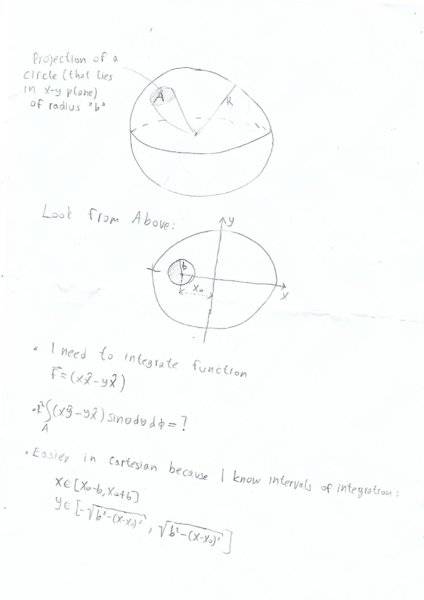
I need to integrate this function over a part of spherical shell of radius R. This part is actually projection of circle (that lies in x-y plane) of radius 'b' on this sphere. I know that it's usually easier to integrate spherical shell in spherical coordinates but it's really tricky to set the intervals of integration in this problem in spherical coordinates.
-So my question is, is it possible to integrate this in Cartesian coordinates. Because i know integration intervals: I just need to set the interval for x and y as circle in x-y plane (z interval would be little tricky)

I also posted image so you can better see what the problem is...
integration.jpg
 

Attachments

  • integration.jpg
    integration.jpg
    12 KB · Views: 1,006
Physics news on Phys.org
It can be integrated over ## dx \, dy ## with ## dA=\sec{\gamma} \, dx \, dy ##, where ## \gamma ## is the angle between the normal to the surface at any point and the z-axis. ## \\ ## It has been quite a number of years since I did such an integral in an Advanced Calculus course, but I still remember doing it this way. ## \\ ## Edit: I may have misread this: Are you doing a surface integral, or an integral over some volume? What I did is for a surface integral. If it is over a thickness of ## \Delta r ## , you might be able to multiply the surface integral result by ## \Delta r ## . ## \\ ## Additional edit: I believe in this case ## \cos{\gamma}=\frac{z}{R} ##.
 
Last edited:

Similar threads

  • · Replies 2 ·
Replies
2
Views
4K
  • · Replies 11 ·
Replies
11
Views
7K
  • · Replies 3 ·
Replies
3
Views
3K
  • · Replies 2 ·
Replies
2
Views
2K
  • · Replies 1 ·
Replies
1
Views
2K
  • · Replies 1 ·
Replies
1
Views
4K
  • · Replies 3 ·
Replies
3
Views
2K
  • · Replies 1 ·
Replies
1
Views
3K
  • · Replies 4 ·
Replies
4
Views
1K
  • · Replies 13 ·
Replies
13
Views
3K