Is it possible to increase the amps within/along a circuit?

Click For Summary

Discussion Overview

The discussion revolves around the question of whether it is possible to increase the current (amps) in a circuit, specifically within a series circuit powered by a DC battery. Participants explore various scenarios and components that could potentially alter current flow, while addressing the implications on voltage and resistance.

Discussion Character

  • Debate/contested
  • Technical explanation
  • Mathematical reasoning

Main Points Raised

  • Some participants assert that in a series circuit, the current remains constant throughout, meaning you cannot have different currents at different points in the circuit.
  • Others propose that adding a second battery could increase the overall voltage and thus the current, but emphasize that the current must remain the same at all points in a DC circuit.
  • One participant mentions that in AC circuits, using a transformer could allow for changes in current by altering voltage and resistance ratios.
  • Another viewpoint suggests that a DC to DC converter could step up the voltage, thereby increasing current through a load, but this would also require more current from the power source.
  • Some participants clarify that if a device has only two terminals, the current entering must equal the current exiting, in accordance with Kirchhoff's Current Law (KCL).
  • There are suggestions that adding resistors in parallel or using current sources could create alternative pathways for current, but these do not directly address the original question of increasing current at a specific point in a series circuit.

Areas of Agreement / Disagreement

Participants generally agree that in a series circuit, the current must remain constant throughout. However, there are competing views regarding the potential for increasing current through various means, particularly when considering different circuit configurations (DC vs. AC) and components (like converters or additional batteries).

Contextual Notes

Limitations include the assumptions about circuit configurations and the specific types of components being discussed. The discussion does not resolve the complexities of how different circuit elements interact under varying conditions.

ptownbro
Messages
60
Reaction score
0
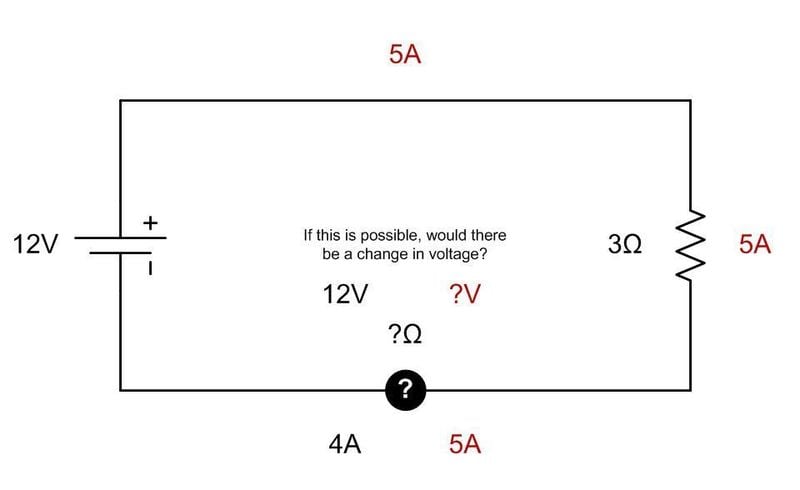
Let's say you have a basic series circuit with a battery power source that has 12 volts. You also have a load of some sort with 3 ohms of resistance. Therefore you'll have 4 amps of current throughout the circuit.

Is it possible to add some item within or along the circuit (and before the load) the could increase the amps on the output side of that item (whatever it is)?

In my question, the current coming from the power source is 4 amps, then after it passes through that item (with some unknown ohms of resistance), it increases to 5 amps (the input amps stays at 4 amps), and then stays 5 amps through the rest of the circuit.

Is this possible?

If it is possible, what would happen to voltage and what would the ohms likely be?

If not can you briefly explain why?
basic circuit example.jpg
 
Engineering news on Phys.org
A series circuit is like a bicycle chain in that the current flow move identically throughout the circuit, like the links in a bike chain. So, no, you cannot have one current flowing into a series node and a different current flowing out.
 
I'm going to disagree with Phinds. If you added a second battery, the voltage and thus the current would increase.

He is correct that the current would need to increase through the entire circuit. It could not be 4A at one point and 5A somewhere else along the same wire -- at least not in a DC circuit.
 
but you can do this in an AC circuit by using a transformer for example, where by changing the wire thickness and turn ratio you can achieve what you aim for in this circuit.
if you must use a battery which is a DC power source you could also use the age old and very common buck boost converter just google the term and you will see , but since it operates by switching current through an inductor it still isn't quite a dc circuit.
as phinds said in a true DC battery powered circuit you can;t just have different current ratings at different circuit parts.
 
Jeff Rosenbury said:
I'm going to disagree with Phinds. If you added a second battery, the voltage and thus the current would increase.

He is correct that the current would need to increase through the entire circuit. It could not be 4A at one point and 5A somewhere else along the same wire -- at least not in a DC circuit.
Then you are not disagreeing with me.
 
phinds said:
Then you are not disagreeing with me.
Perhaps not so much disagreeing as being a smartass. :devil:
 
Jeff Rosenbury said:
Perhaps not so much disagreeing as being a smartass. :devil:
I'll buy that :smile:
 
  • Like
Likes   Reactions: davenn
Salvador said:
but you can do this in an AC circuit by using a transformer for example, where by changing the wire thickness and turn ratio you can achieve what you aim for in this circuit.

if you change the turns ratio, then you change the voltage supplied to the circuit.
And it's still a ratio of the voltage over resistance that determines the current flowingDave
 
if you want to increase overall current you can add another voltage source in series or you could connect a resistor in parallel with the 4 ohm resistance. but I'm not sure you can change the current that enters and the current that leaves the source.

or the part of circuit where you want the extra 1 A to flow, connect a current source in parallel to it.
 
  • #10
jaus tail said:
or the part of circuit where you want the extra 1 A to flow, connect a current source in parallel to it.
That does not make the current look like what's shown in the diagram, it just creates a parallel path, which has nothing to do with the question being posed by the OP.
 
  • #11
davenn is right if you have a purely resistive load you can supply any amount of current at a fixed voltage and still there would be only a given amount of current flowing in the circuit which would be determined by the resistance in series with that circuit.
the only way to push more current through a fixed resistance is to increase voltage
 
  • #12
Salvador said:
davenn is right if you have a purely resistive load you can supply any amount of current at a fixed voltage and still there would be only a given amount of current flowing in the circuit which would be determined by the resistance in series with that circuit.
the only way to push more current through a fixed resistance is to increase voltage
And even more to the point of the OP's question, there is NOTHING you can do in a resistive circuit that will allow more current in one part of a serial path than in another part of the same path.
 
  • #13
Reading the OP again - I would like to point out - IF you are asking about a 2 terminal item ( only one connection "in" and one connection "out") -- then the answer is NO... the the current into that 2 terminal device MUST equal the current out.
 
  • #14
ptownbro said:
Let's say you have a basic series circuit with a battery power source that has 12 volts. You also have a load of some sort with 3 ohms of resistance. Therefore you'll have 4 amps of current throughout the circuit.

Is it possible to add some item within or along the circuit (and before the load) the could increase the amps on the output side of that item (whatever it is)?

Yes. You could add a DC to DC converter that stepped the voltage up to say 24v. Then the current in the 3 ohm would be 8A. However the current drawn from the 12v battery would be at least 16A depending on the efficiency of the converter.

In my question, the current coming from the power source is 4 amps, then after it passes through that item (with some unknown ohms of resistance), it increases to 5 amps (the input amps stays at 4 amps), and then stays 5 amps through the rest of the circuit.

Is this possible?

Not if the device only has two terminals because of KCL.

Imagine a box with four terminals. Two have a 3ohm resistor between them so 4A is still drawn from the 12v battery. The other two terminals have a 15v battery so 5A is output.
 

Similar threads

Replies
6
Views
4K
Replies
2
Views
2K
Replies
12
Views
3K
  • · Replies 3 ·
Replies
3
Views
3K
  • · Replies 9 ·
Replies
9
Views
4K
Replies
15
Views
3K
  • · Replies 2 ·
Replies
2
Views
2K
  • · Replies 20 ·
Replies
20
Views
3K
Replies
15
Views
3K
  • · Replies 8 ·
Replies
8
Views
3K