Is that field conservative? If yes, why is the work not null?

  • Thread starter Thread starter Amaelle
  • Start date Start date
  • Tags Tags
    Field Work
Click For Summary

Homework Help Overview

The discussion revolves around the properties of a vector field, specifically whether it is conservative and the implications of that on work done around a closed path. Participants are exploring the relationship between the definition of a conservative field and the conditions under which the work done is expected to be zero.

Discussion Character

  • Conceptual clarification, Assumption checking

Approaches and Questions Raised

  • Participants are examining the definition of a conservative vector field and questioning the implications of the field being undefined at certain points, such as the origin. They discuss the necessity of continuity and the conditions required for applying theorems like Stokes' theorem and the divergence theorem.

Discussion Status

The discussion is active, with participants raising questions about the continuity of the vector field and its implications for conservativeness. Some guidance has been provided regarding the conditions necessary for applying relevant theorems, but there is no explicit consensus on the resolution of the original poster's query.

Contextual Notes

Participants are considering the implications of singularities in the vector field and how these affect the application of mathematical theorems related to conservative fields. There is an acknowledgment of the need for the field to be defined and continuous in the region of interest to apply certain theorems effectively.

Amaelle
Messages
309
Reaction score
54
Homework Statement
calculate the closed path integral of the vector field
F(x,y)=(y/(2x^2+y^2) ; -x/(2x^2+y^2)) along the ellipse of equation
{(x, y) ∈ R2: 2x^2 + y^2 = 1} run in clockwise direction
Relevant Equations
x=cos(theta) /sqrt(2)
y=sin(theta)
my problem is the following: this vector field is conservative ( i checked the partial derivative) means the work around a closed path must be zero!√but still the solution says otherwise: any hints?
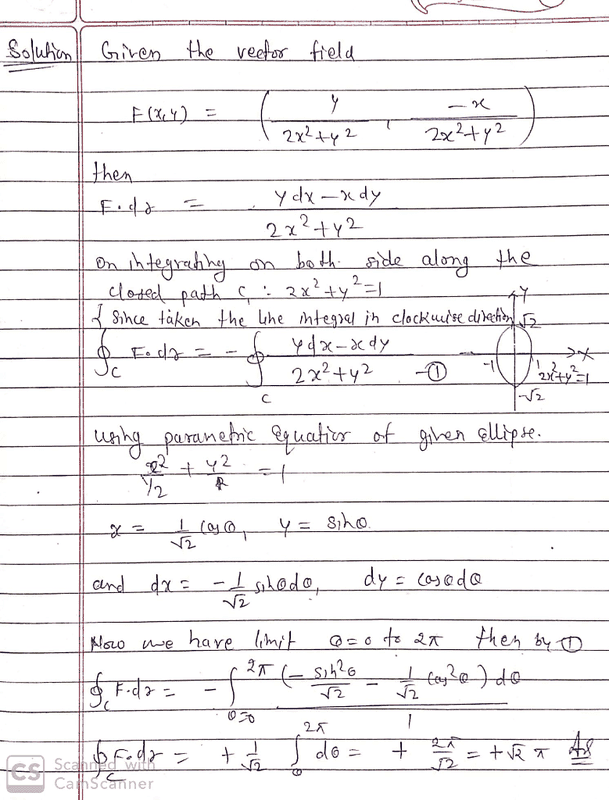
exercice math vector field solution.png
explanation? thanks a lot!

exercice math vector field solution.png
 
Physics news on Phys.org
Is your vector field defined everywhere inside the ellipse?
 
  • Like
Likes   Reactions: FactChecker
yes I guess
 
So what is F(0,0)?
 
  • Like
Likes   Reactions: Amaelle
Yes you are right it's not defined there, does this mean that this field is not conservative?
 
Do we need continuity condition to assume conservative field?
 
Stokes' theorem guarantees the path integral around a closed loop is 0 if the curl vanishes everywhere in region bounded by the loop. In this case, the curl doesn't vanish everywhere inside the loop because the field isn't defined at the origin. There's no guarantee, therefore, that the path integral is 0.
 
Last edited:
  • Like
  • Love
Likes   Reactions: Amaelle, FactChecker and etotheipi
Thanks a lot for your precious answer, and for the divergence theorem (gauss theorem) do we need to check the same condition to apply it? (the field must be defined everywhere)?
 
When I have questions like this, I look up a precise statement of the theorem, something a mathematician would write, because it will state all the conditions that must be satisfied. My calculus book, for example, says the components of the vector field need to be continuously differentiable. Consequently, if there's a singularity in the region of interest, you shouldn't expect to be able to use the theorem.
 
  • Like
Likes   Reactions: Amaelle

Similar threads

  • · Replies 3 ·
Replies
3
Views
2K
Replies
8
Views
2K
  • · Replies 14 ·
Replies
14
Views
3K
  • · Replies 3 ·
Replies
3
Views
2K
  • · Replies 3 ·
Replies
3
Views
3K
  • · Replies 2 ·
Replies
2
Views
1K
  • · Replies 9 ·
Replies
9
Views
2K
  • · Replies 1 ·
Replies
1
Views
2K
  • · Replies 6 ·
Replies
6
Views
3K