Is the Induced Electric Field Proportional to Radius in a Cylindrical Region?

Join the discussion
Registration is free. Ask a follow-up in this thread, or start your own.
4 replies · 3K views
hidemi
Messages
206
Reaction score
36
Homework Statement
A cylindrical region of radius R contains a uniform magnetic field, parallel to its axis, with magnitude that is changing linearly with time. If r is the radial distance from the cylinder axis, the magnitude of the induced electric field inside the cylindrical region is proportional to

A) R
B) r
C) r²
D) 1/r
E) 1/ r²

The answer is B.
Relevant Equations
(See better interpretation in the "Attempt at a Solution" section)
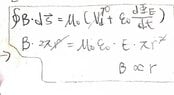
I used the equation below and the attachment to rationalize.
https://www.physicsforums.com/attachments/282163
 
Attachments
  • 1.jpg
    1.jpg
    37.5 KB · Views: 277
Physics news on Phys.org
You used Ampere-Maxwell law while you should use Faraday-Maxwell Law. The problem statement asks for the magnitude of the electric field. There is no time-varying electric flux in this problem setup (so ##\frac{d\Phi_E}{dt}=0## but there is time-varying magnetic flux (linearly time varying)).
 
\oint _{\partial \Sigma }\mathbf {E} \cdot \mathrm {d} {\boldsymbol {\ell }}=-{\frac {\mathrm {d} }{\mathrm {d} t}}\iint _{\Sigma }\mathbf {B} \cdot \mathrm {d} \mathbf {S}

E * 2πr = - B * π r²
E = B * r /2
Therefore, E is proportional to r. Is this correct?
 
hidemi said:
\oint _{\partial \Sigma }\mathbf {E} \cdot \mathrm {d} {\boldsymbol {\ell }}=-{\frac {\mathrm {d} }{\mathrm {d} t}}\iint _{\Sigma }\mathbf {B} \cdot \mathrm {d} \mathbf {S}

E * 2πr = - B * π r²
E = B * r /2
Therefore, E is proportional to r. Is this correct?
Change B to dB/dt (= constant).