MigMRF
- 15
- 0
So I've derived the rocket equation in empty space and with constant gravity. Now I am interested in adding air resistance. I'm aware that there are 2 different models as if 0<Re<1 then F_drag=k*v and if 1000<Re<30000 then F_drag=1/2*A*rho*CD*v^2. And for my purpose the second model is most fitting (my Re is around 15000. So I've come up with a differentialequation and was wondering if there actually is a solution. Here is my equation:
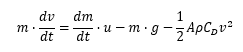
So first of all, is the equation correct. I'm kind of new to differential equations.
And if it's correct then is there an analytical solution.
I'd like some help on this one :D
So first of all, is the equation correct. I'm kind of new to differential equations.
And if it's correct then is there an analytical solution.
I'd like some help on this one :D