Discussion Overview
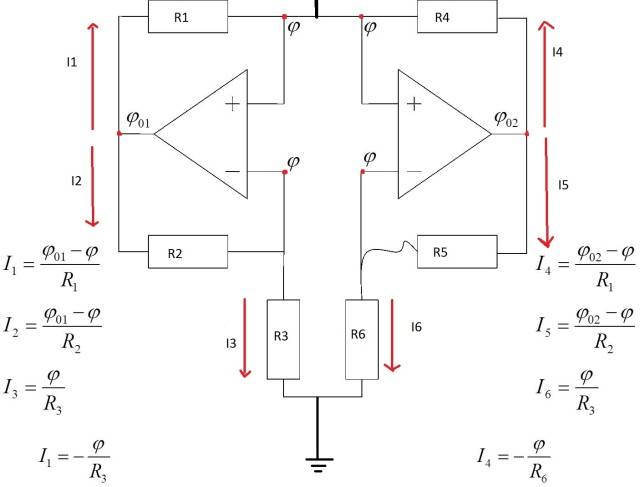
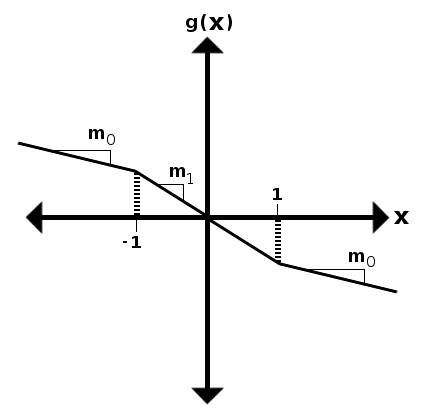
The discussion revolves around calculating the function g(x) in an op-amp circuit, specifically in the context of current versus resistance. Participants explore the circuit's configuration, equations, and the expected graph, while addressing uncertainties about the circuit's behavior and design.
Discussion Character
- Exploratory
- Technical explanation
- Debate/contested
- Mathematical reasoning
Main Points Raised
- One participant presents a circuit diagram and equations but expresses uncertainty about their correctness and how to derive g(x).
- Another participant inquires about the input voltage and the meaning of variables in the context of the circuit.
- A participant clarifies that the input voltage is represented by a specific symbol and identifies resistance as a variable in the equations.
- Concerns are raised about the clarity of the original post, with one participant requesting a clearer explanation of the circuit's purpose and derivations.
- One participant describes their intention to use the circuit in parallel with capacitors and an inductor to achieve negative resistance.
- Another participant questions the necessity of having two identical blocks in the circuit design, suggesting that one may suffice.
- A later reply suggests that the circuit may not produce the expected g(x) and emphasizes the need for non-linearity to achieve predictable oscillations.
- One participant proposes a solution involving a one op-amp negative resistance with an additional resistor to ensure positive resistance and suggests testing its frequency response.
- Another participant provides a mathematical expression related to the circuit's behavior, indicating a relationship between voltage and resistance.
- A participant claims to have resolved the issue, attributing the behavior of g(x) to the limitations of the op-amp's output voltage and the necessity of using two op-amps in parallel.
Areas of Agreement / Disagreement
Participants express various uncertainties and disagreements regarding the circuit's design, the correctness of equations, and the expected behavior of g(x). No consensus is reached on the optimal configuration or the interpretation of the circuit's function.
Contextual Notes
Limitations include unclear definitions of variables, assumptions about circuit behavior, and unresolved mathematical derivations. The discussion reflects a range of interpretations and approaches to the problem.