Learn the Basics of Anti-Derivatives: A Comprehensive Guide

  • Thread starter Thread starter groundpilots
  • Start date Start date
Click For Summary

Homework Help Overview

The discussion revolves around understanding anti-derivatives, specifically focusing on the integration of polynomial expressions. Participants are examining their attempts to solve a problem involving the integral of a quadratic function.

Discussion Character

  • Exploratory, Conceptual clarification, Mathematical reasoning

Approaches and Questions Raised

  • Participants are sharing their attempts at finding the anti-derivative of a given function, questioning where their reasoning may have gone wrong. There is a focus on substitution methods and the application of integration formulas.

Discussion Status

The discussion is ongoing, with participants providing insights and attempting to clarify their understanding of anti-derivatives. Some have offered specific substitution techniques, while others express frustration over their results, indicating a lack of consensus on the correct approach.

Contextual Notes

Participants are working under the constraints of homework guidelines, which may limit the resources they can use. There is also mention of specific values for variables within the problem, which may influence the integration process.

groundpilots
Messages
2
Reaction score
0
Anti-Derivatives Please Help!

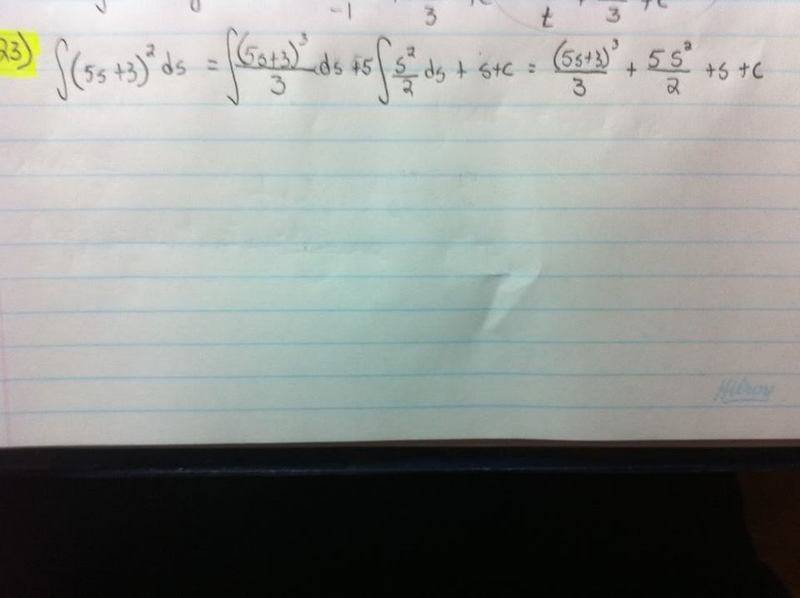
So I am having trouble understanding where I went wrong here, the question is highlighted, then it clearly states my answer, and the answer the book gave, my work is posted in the second image, care to help??
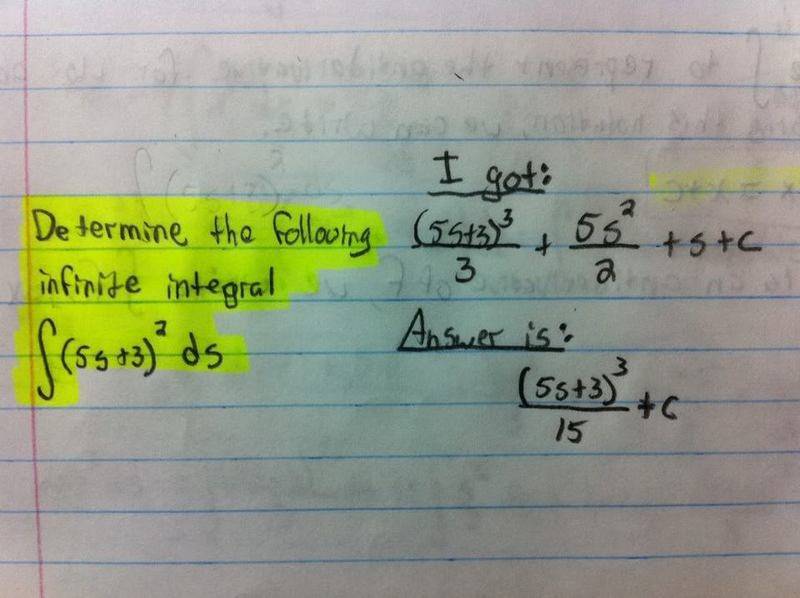
Homework Statement


193081_10150114570475418_508690417_6587379_3018337_o1.jpg


The Attempt at a Solution


191525_10150114570890418_508690417_6587380_7031413_o.jpg

 
Physics news on Phys.org


Hi groundpilots! :)

[tex]\frac{d}{ds}(a+bs)^{n+1}=(n+1)(b)(a+bs)^{n}[/tex]
<===>
[tex](a+bs)^{n+1} + c =\int(n+1)(b)(a+bs)^{n} ds[/tex]

With this can u tell me how u do the antiderivatives ?

If u notice b=5 and n=2 ...


so I tried to do the antiderivative using the formulas you gave and I still can't seem to get it...ughhhhh
here's what I tried, still not right =(

iug.jpg


[tex]\int (5s + 3)^2~ds[/tex]

Let u = 5s + 3, then du = 5ds

Using this substitution, the integral above becomes:
[tex]\frac{1}{5}\int (5s + 3)^2~5ds = \frac{1}{5}\int u^2~du[/tex]

Can you take it from here?

BTW, this is an indefinite integral, not an infinite integral.
 

Similar threads

  • · Replies 4 ·
Replies
4
Views
6K
  • · Replies 11 ·
Replies
11
Views
1K
  • · Replies 15 ·
Replies
15
Views
3K
  • · Replies 8 ·
Replies
8
Views
2K
  • · Replies 9 ·
Replies
9
Views
2K
Replies
13
Views
4K
  • · Replies 5 ·
Replies
5
Views
2K
  • · Replies 4 ·
Replies
4
Views
1K
  • · Replies 3 ·
Replies
3
Views
2K
  • · Replies 19 ·
Replies
19
Views
2K