1rel
- 43
- 3
Hello everyone
I'm new here, and currently trying to learn more about electronics. - Since my knowledge is very limited, I've decided to take apart some old devices from the garbage, and recently tried to understand a photo flash circuit from an old camera, and to trigger it with my own bench power supply. - But with no success yet.
I tried to trace out all the components, and make a schematic (in DipTrace), just as an exercise. I'm sure that there are still plenty of errors in it! (E.g. the transformers and unidentifiable SMD parts etc. - The trigger coil seems to be connected to ground on both sides, but I'm not sure, since I wasn't able to see where its pins go...)
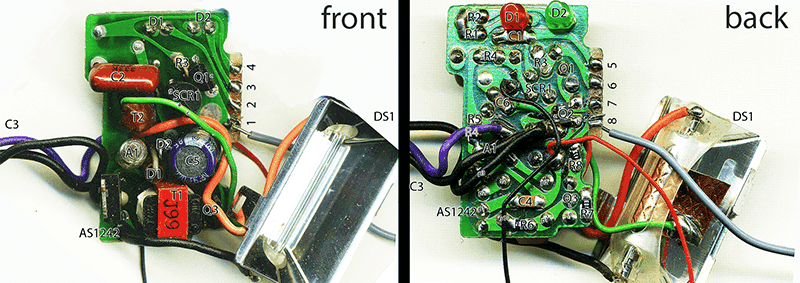
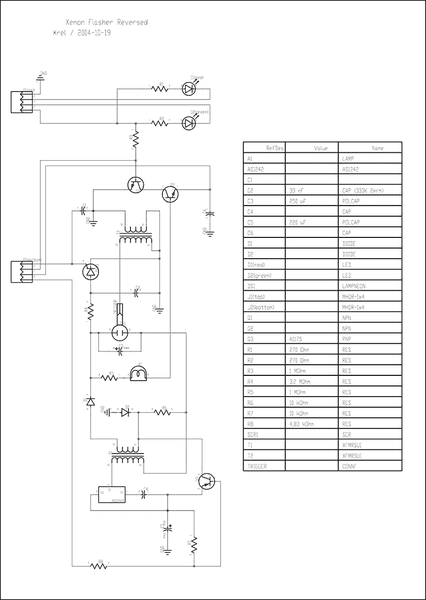
Pin 1 is ground.
Pin 2-4 seem to be for the status LEDs. I grounded pin 2/3.
I don't know the required voltage and how to test things without damaging the circuit.
I tried to apply voltage to the remaining pins (actually by trial and error) of maximum 6 volts (since the battery was about 6 volts). And I monitored the charge of the large photo capacitor (not on the picture)... - But it didn't charge at all yet.
Pin 4 seems to be for the trigger, since it goes to the SCR (which is new to me).
I'm basically lost, since I don't understand the circuit. - Search on the web didn't help much yet, since my circuit has multiple parts that I don't yet understand.I'm thankful for any advice!
I'm new here, and currently trying to learn more about electronics. - Since my knowledge is very limited, I've decided to take apart some old devices from the garbage, and recently tried to understand a photo flash circuit from an old camera, and to trigger it with my own bench power supply. - But with no success yet.
I tried to trace out all the components, and make a schematic (in DipTrace), just as an exercise. I'm sure that there are still plenty of errors in it! (E.g. the transformers and unidentifiable SMD parts etc. - The trigger coil seems to be connected to ground on both sides, but I'm not sure, since I wasn't able to see where its pins go...)
Pin 1 is ground.
Pin 2-4 seem to be for the status LEDs. I grounded pin 2/3.
I don't know the required voltage and how to test things without damaging the circuit.
I tried to apply voltage to the remaining pins (actually by trial and error) of maximum 6 volts (since the battery was about 6 volts). And I monitored the charge of the large photo capacitor (not on the picture)... - But it didn't charge at all yet.
Pin 4 seems to be for the trigger, since it goes to the SCR (which is new to me).
I'm basically lost, since I don't understand the circuit. - Search on the web didn't help much yet, since my circuit has multiple parts that I don't yet understand.I'm thankful for any advice!
Last edited: