Lever Rule: Determining Amount of Liquid & Solid

  • Thread starter Thread starter jmex
  • Start date Start date
  • Tags Tags
    Doubt Lever
Click For Summary
SUMMARY

The discussion clarifies the application of the Lever Rule in determining the amounts of liquid and solid phases in a cooling mixture. Specifically, it addresses the confusion regarding the identification of the liquidus and solidus lines in phase diagrams, as illustrated in Fig 3 from Tulane University's website. The example provided demonstrates how to calculate the fractions of liquid (L) and solid (S) using the equations LxBliq + SxBsol = xB and L + S = 1, confirming the validity of the Lever Rule.

PREREQUISITES
  • Understanding of phase diagrams and their components
  • Familiarity with the concepts of liquidus and solidus lines
  • Basic algebra for solving equations
  • Knowledge of concentration terms in materials science
NEXT STEPS
  • Study phase diagrams in materials science
  • Learn about the Lever Rule and its applications in thermodynamics
  • Explore the concept of liquidus and solidus lines in detail
  • Practice solving problems involving the Lever Rule and phase compositions
USEFUL FOR

This discussion is beneficial for materials scientists, chemical engineers, and students studying phase equilibria and thermodynamics, particularly those interested in the behavior of mixtures during cooling processes.

jmex
Messages
59
Reaction score
3
Hello,

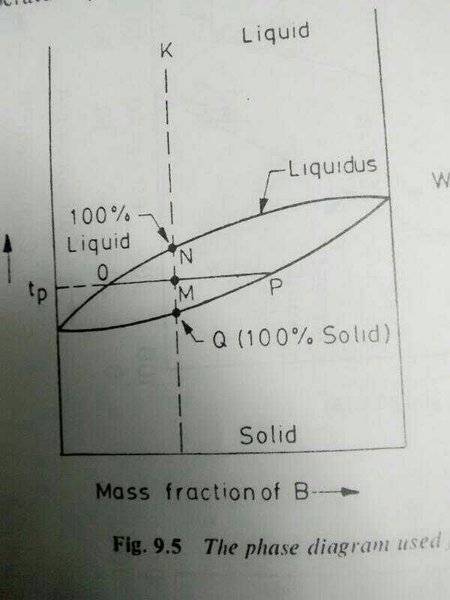
From the figure how is it possible to say that this line shows amount of liquid while other is amount of solid. In the figure they showed MP is amount of liquid while OM is amount of solid. How?
uploadfromtaptalk1404596350450.jpg
 
Engineering news on Phys.org
Seems backwards, doesn't it.

But, if you read the explanation regarding Fig 3 on this site, as a mixture cools,
http://www.tulane.edu/~sanelson/eens211/2compphasdiag.html
your understanding will be enhanced.

As an example wuich may be more intuitive to understand, for your picture as the composition K cools it will reach the liquidus line at N. Taking a horizontal line at this point N, and using the point similar to that for the horizontal line through N, we have O'N and NP' where the line meets the liquidus and solidus. You can see that O'N = 0 so there should not be any solid forming yet, after all everything started as a liquid. All of the commposition should still be liquid represented by length NP'. The first solid though, as we cool just a tiny bit more will be of the composition where a vertical line from P' on the solidus meets the horizontal x-axis.

Hope that helps.
 
This is usually done algebraically. Let L be the fraction liquid, and S be the fraction solid, so that L+S=1. Let \bar{x}_B be the overall concentration of species B, corresponding to the vertical line through point M, let x_{Bliq} correspond to the concentration of B in the liquid at point O (along the liquid equilibrium line), and let x_{Bsol} correspond to the concentration of B in the solid at point P (along the solid equilibrium line). Then,
Lx_{Bliq}+Sx_{Bsol}=\bar{x}_B
This can be combined with the equation L+S=1 to solve for L and S. From this, you will see that that the lever rule follows.

Chet
 

Similar threads

  • · Replies 21 ·
Replies
21
Views
4K
  • · Replies 1 ·
Replies
1
Views
3K
  • · Replies 20 ·
Replies
20
Views
2K
  • · Replies 6 ·
Replies
6
Views
3K
  • · Replies 9 ·
Replies
9
Views
2K
  • · Replies 4 ·
Replies
4
Views
1K
Replies
4
Views
4K
Replies
8
Views
3K
  • · Replies 4 ·
Replies
4
Views
3K
  • · Replies 12 ·
Replies
12
Views
2K