Light Cone in Rindler Coordinates: Visualization & Reasoning

Click For Summary

Discussion Overview

The discussion focuses on visualizing light cones in Rindler coordinates, exploring the implications of the Rindler horizon on null geodesics. Participants examine the relationship between geodesics and the Rindler horizon, addressing both outgoing and ingoing null geodesics and their behavior in these coordinates.

Discussion Character

  • Exploratory
  • Technical explanation
  • Debate/contested

Main Points Raised

  • One participant seeks to visualize light cones in Rindler coordinates and questions the correctness of their diagram.
  • Another participant notes that the diagram appears acceptable but references a complex derivation of null geodesics from a Wikipedia article.
  • There is a discussion about the Rindler horizon being a coordinate singularity, with some participants asserting that outgoing null geodesics cannot cross it, while ingoing null geodesics can approach it asymptotically.
  • Participants clarify that the equations used by one contributor are not incorrect and relate to solving geodesic equations for null geodesics, specifically in a restricted radial context.
  • Concerns are raised about the implications of the past light cone of a particle, suggesting that there are events that will never intersect with the particle's world line due to the Rindler horizon.
  • A comparison is made between the Rindler horizon and the event horizon of a Schwarzschild black hole, emphasizing the limitations on the past light cone of observers in both scenarios.

Areas of Agreement / Disagreement

Participants express differing views on the behavior of null geodesics in relation to the Rindler horizon, particularly regarding the crossing of outgoing and ingoing geodesics. The discussion remains unresolved regarding the implications of these observations on the visualization of light cones.

Contextual Notes

Participants note the complexity of the equations involved and the specific conditions under which the geodesics are analyzed, highlighting the dependence on the chosen coordinate system and the limitations of the visual representation.

kent davidge
Messages
931
Reaction score
56
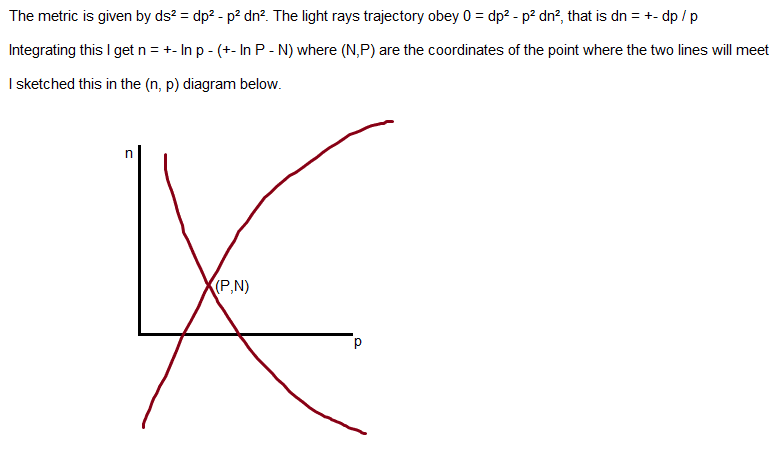
Im trying to visualize what form the light cones take in Rindler coordinates. Below is my drawing + reasoning. Is it right?
yP4Lv2H.png
 
Physics news on Phys.org
It looks ok to me. Wiki has a derivation of the null geodesics in <<link>>, but it's unnecessarily complex for what you want to do.

p=0 is a coordinate singularity, usually called the Rindler horzion, because the metric coefficient of dn^2 vanishes. I don't believe that the null geodesics should be able to cross the Rindler horizon, and in your diagram they don't.
 
pervect said:
Wiki has a derivation of the null geodesics in <<link>>
So it seems like I have obtained the correct diagram from wrong equations.
It seems that I should have considered the geodesic equations first.
 
pervect said:
I don't believe that the null geodesics should be able to cross the Rindler horizon

"Outgoing" ones (the ones going in the same direction as the Rindler observers' proper acceleration) can't, but "ingoing" ones (the ones going in the opposite direction) certainly can. However, this won't be visible in Rindler coordinates because they don't cover the Rindler horizon; instead, an ingoing null geodesic will look like it asymptotically approaches ##p = 0## as ##n \rightarrow \infty## but never reaches it.

Also, the above is assuming that we are looking at where geodesics go, but we also need to look at where they come from. That's just the time reverse of the above: outgoing null geodesics can come from below the Rindler horizon while ingoing null geodesics can't. An outgoing null geodesic will asymptotically approach ##p = 0## in Rindler coordinates but never reach it as ##n \rightarrow - \infty##.
 
  • Like
Likes   Reactions: vanhees71
kent davidge said:
So it seems like I have obtained the correct diagram from wrong equations.
It seems that I should have considered the geodesic equations first.

Your equations aren't wrong. What you did, for this simple case, is equivalent to solving the geodesic equations for null geodesics. In the Wikipedia article, that corresponds to setting ##P = Q = 0## and ##y = z = 0##.

In the more general case where we put back the other two spatial dimensions, what you did is equivalent to solving the restricted set of null geodesic equations that only apply to "radial" geodesics--geodesics that only move in the ##n - p## plane, not in the other two coordinate directions.
 
  • Like
Likes   Reactions: vanhees71
PeterDonis said:
Your equations aren't wrong. What you did, for this simple case, is equivalent to solving the geodesic equations for null geodesics. In the Wikipedia article, that corresponds to setting ##P = Q = 0## and ##y = z = 0##.

In the more general case where we put back the other two spatial dimensions, what you did is equivalent to solving the restricted set of null geodesic equations that only apply to "radial" geodesics--geodesics that only move in the ##n - p## plane, not in the other two coordinate directions.
Ah, ok. What seems weird to me is that if you let ##n \rightarrow \infty## the past light cone of the particle will cover only half of the space. Is that right? So it seems that there are events that will never cross the particles world line.
 
kent davidge said:
So it seems that there are events that will never cross the particles world line.
Yes, there are events that will never be in the past light cone of the accelerating observer. That’s the Rindler horizon at work.
[Edit: “past light cone of the accelerated observer” is sloppy wording. “Past light cone of any event on the worldline of the accelerated observer” might be better]

Compare with the event horizon around a Schwarzschild black hole: events on the inside of the horizon will never be in the past light cone of an observer outside.
 
Last edited:
  • Like
Likes   Reactions: kent davidge and vanhees71

Similar threads

  • · Replies 4 ·
Replies
4
Views
2K
  • · Replies 12 ·
Replies
12
Views
1K
  • · Replies 8 ·
Replies
8
Views
2K
  • · Replies 8 ·
Replies
8
Views
2K
  • · Replies 18 ·
Replies
18
Views
2K
  • · Replies 10 ·
Replies
10
Views
3K
  • · Replies 21 ·
Replies
21
Views
2K
  • · Replies 8 ·
Replies
8
Views
2K
  • · Replies 13 ·
Replies
13
Views
2K
  • · Replies 57 ·
2
Replies
57
Views
6K