Undergrad Line integral for work done by gravity

Click For Summary
SUMMARY

The discussion focuses on the calculation of the line integral representing work done by gravitational force, specifically the expression $$-GMm\int_{r_A}^{r_B} \frac{\hat{r}\cdot \text{d}\vec{s}}{r^2}$$. The key argument is that the scalar product $$\hat{r}\cdot \text{d}\vec{s}$$ simplifies to $$\text{d}r$$ when expressed in spherical coordinates. This simplification is valid in the context of conservative vector fields, where the path integral's result is independent of the path taken, depending solely on the endpoints.

PREREQUISITES
  • Understanding of line integrals in vector calculus
  • Familiarity with spherical coordinates
  • Knowledge of conservative vector fields
  • Basic principles of gravitational force, specifically Newton's law of gravitation
NEXT STEPS
  • Study the properties of conservative vector fields in detail
  • Learn about parametrization of integrals and Riemann integrals
  • Explore the implications of path independence in physics
  • Investigate applications of line integrals in physics beyond gravitational force
USEFUL FOR

Students and professionals in physics, particularly those studying mechanics and vector calculus, as well as educators seeking to explain the concept of work done by gravitational forces through line integrals.

bottle_shadow
Messages
2
Reaction score
0
TL;DR
Lack of understanding of the technique used to calculate the line integral.
Dear Physics Forums people,

My problem lies in understanding how the following line integral, which represents work done by the gravitational force, was calculated

244166

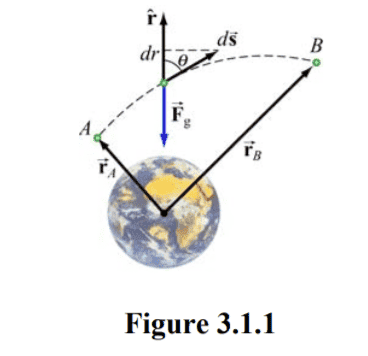
Specifically, in the integral after the 2nd = sign, they implicitly used \hat{r}\cdot d\vec{s} = dr

I wish to understand what is the argumentation for that.

Following is the picture that ought to provide the argumentation (but doesn't do it for me).
244167
 
Physics news on Phys.org
Gravitational force is ##\vec{F}=-\frac{GMm}{r^2}\hat{r}##. So the integral is $$-GMm\int_{r_A}^{r_B} \frac{\hat{r}\cdot \text{d}\vec{s}}{r^2}$$. Now, you can think of ##\text{d}\vec{s}## as a very little change in position, since it's a vector you can write it in spherical coordinates: ##\text{d}r\hat{r}+r\text{d}\theta \hat{\theta}+r\sin{\theta}\text{d}\phi\hat{\phi}##. When you do the scalar product $$\hat{r}\cdot \text{d}\vec{s}=\text{d}r$$.

Of course, this is not completely rigorous, you should parametrize the integral to reduce it to a Riemann integral, but at the end, this is a not completely wrong way to visualise it.
 
  • Like
Likes bottle_shadow
Gaussian97 said:
Gravitational force is ##\vec{F}=-\frac{GMm}{r^2}\hat{r}##. So the integral is $$-GMm\int_{r_A}^{r_B} \frac{\hat{r}\cdot \text{d}\vec{s}}{r^2}$$. Now, you can think of ##\text{d}\vec{s}## as a very little change in position, since it's a vector you can write it in spherical coordinates: ##\text{d}r\hat{r}+r\text{d}\theta \hat{\theta}+r\sin{\theta}\text{d}\phi\hat{\phi}##. When you do the scalar product $$\hat{r}\cdot \text{d}\vec{s}=\text{d}r$$.

Of course, this is not completely rigorous, you should parametrize the integral to reduce it to a Riemann integral, but at the end, this is a not completely wrong way to visualise it.

Thank you! I appreciate your answer :)
 
bottle_shadow said:
Specifically, in the integral after the 2nd = sign, they implicitly used \hat{r}\cdot d\vec{s} = dr

I wish to understand what is the argumentation for that.
Static gravity is an example of a conservative vector field. The result of a path integral in a conservative field is independent of the path and is dependent only on the end points.

So use a path that swings from A over to a point at distance ##|\vec{r_a}|## along ##\vec{r_S}## (the integral over that part of the path is obviously zero since the path is always at right angles to the force) and then follows a path on out to B (that part is the simple scalar integral).
 

Similar threads

  • · Replies 2 ·
Replies
2
Views
2K
  • · Replies 1 ·
Replies
1
Views
1K
  • · Replies 7 ·
Replies
7
Views
3K
  • · Replies 1 ·
Replies
1
Views
2K
Replies
31
Views
2K
Replies
5
Views
2K
  • · Replies 3 ·
Replies
3
Views
1K
  • · Replies 6 ·
Replies
6
Views
2K
  • · Replies 5 ·
Replies
5
Views
3K