Line integral for work done by gravity

Click For Summary

Discussion Overview

The discussion revolves around understanding the calculation of the line integral representing the work done by gravitational force. Participants explore the mathematical formulation and the reasoning behind the use of the expression \(\hat{r}\cdot d\vec{s} = dr\) within the context of gravitational fields, particularly in spherical coordinates.

Discussion Character

  • Technical explanation
  • Conceptual clarification
  • Debate/contested

Main Points Raised

  • One participant seeks clarification on the argumentation for using \(\hat{r}\cdot d\vec{s} = dr\) in the line integral for work done by gravity.
  • Another participant reiterates the gravitational force as \(\vec{F}=-\frac{GMm}{r^2}\hat{r}\) and presents the integral formulation, suggesting that \(\text{d}\vec{s}\) can be expressed in spherical coordinates, leading to the conclusion that \(\hat{r}\cdot \text{d}\vec{s}=\text{d}r\).
  • It is noted that while this approach is not completely rigorous, it serves as a visualization of the concept.
  • A later reply emphasizes that static gravity is a conservative vector field, indicating that the result of a path integral in such fields is independent of the path taken and depends only on the endpoints.
  • Participants discuss the implications of choosing specific paths for the integral, suggesting that certain paths yield zero contribution due to their orientation relative to the force.

Areas of Agreement / Disagreement

Participants express differing views on the rigor of the argumentation regarding the line integral and the use of spherical coordinates. There is no consensus on the best approach to fully justify the use of \(\hat{r}\cdot d\vec{s} = dr\), and the discussion remains unresolved regarding the completeness of the explanation provided.

Contextual Notes

Some participants acknowledge that the argumentation presented lacks complete rigor and that further parametrization may be necessary to reduce the integral to a Riemann integral. Additionally, the discussion touches on the nature of conservative fields and the implications for path independence.

bottle_shadow
Messages
2
Reaction score
0
TL;DR
Lack of understanding of the technique used to calculate the line integral.
Dear Physics Forums people,

My problem lies in understanding how the following line integral, which represents work done by the gravitational force, was calculated

244166

Specifically, in the integral after the 2nd = sign, they implicitly used \hat{r}\cdot d\vec{s} = dr

I wish to understand what is the argumentation for that.

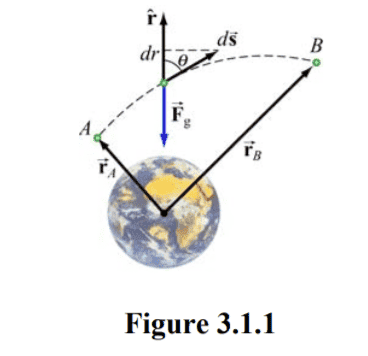
Following is the picture that ought to provide the argumentation (but doesn't do it for me).
244167
 
Physics news on Phys.org
Gravitational force is ##\vec{F}=-\frac{GMm}{r^2}\hat{r}##. So the integral is $$-GMm\int_{r_A}^{r_B} \frac{\hat{r}\cdot \text{d}\vec{s}}{r^2}$$. Now, you can think of ##\text{d}\vec{s}## as a very little change in position, since it's a vector you can write it in spherical coordinates: ##\text{d}r\hat{r}+r\text{d}\theta \hat{\theta}+r\sin{\theta}\text{d}\phi\hat{\phi}##. When you do the scalar product $$\hat{r}\cdot \text{d}\vec{s}=\text{d}r$$.

Of course, this is not completely rigorous, you should parametrize the integral to reduce it to a Riemann integral, but at the end, this is a not completely wrong way to visualise it.
 
  • Like
Likes   Reactions: bottle_shadow
Gaussian97 said:
Gravitational force is ##\vec{F}=-\frac{GMm}{r^2}\hat{r}##. So the integral is $$-GMm\int_{r_A}^{r_B} \frac{\hat{r}\cdot \text{d}\vec{s}}{r^2}$$. Now, you can think of ##\text{d}\vec{s}## as a very little change in position, since it's a vector you can write it in spherical coordinates: ##\text{d}r\hat{r}+r\text{d}\theta \hat{\theta}+r\sin{\theta}\text{d}\phi\hat{\phi}##. When you do the scalar product $$\hat{r}\cdot \text{d}\vec{s}=\text{d}r$$.

Of course, this is not completely rigorous, you should parametrize the integral to reduce it to a Riemann integral, but at the end, this is a not completely wrong way to visualise it.

Thank you! I appreciate your answer :)
 
bottle_shadow said:
Specifically, in the integral after the 2nd = sign, they implicitly used \hat{r}\cdot d\vec{s} = dr

I wish to understand what is the argumentation for that.
Static gravity is an example of a conservative vector field. The result of a path integral in a conservative field is independent of the path and is dependent only on the end points.

So use a path that swings from A over to a point at distance ##|\vec{r_a}|## along ##\vec{r_S}## (the integral over that part of the path is obviously zero since the path is always at right angles to the force) and then follows a path on out to B (that part is the simple scalar integral).
 

Similar threads

  • · Replies 4 ·
Replies
4
Views
3K
  • · Replies 1 ·
Replies
1
Views
1K
  • · Replies 2 ·
Replies
2
Views
3K
  • · Replies 2 ·
Replies
2
Views
3K
  • · Replies 3 ·
Replies
3
Views
2K
  • · Replies 7 ·
Replies
7
Views
3K
Replies
31
Views
2K
  • · Replies 1 ·
Replies
1
Views
2K