Line Integral Homework: How to Solve for the Total Length of a Curve

Click For Summary

Homework Help Overview

The discussion revolves around understanding line integrals, particularly in the context of calculating the total length of a curve. Participants are exploring the definition and implications of line integrals, especially when the function involved varies.

Discussion Character

  • Conceptual clarification, Mathematical reasoning, Assumption checking

Approaches and Questions Raised

  • Participants express uncertainty about the definition of line integrals and whether they represent the total length of a curve. Some inquire about the implications of different functions in the context of line integrals, while others question the meaning of specific variables used in the equations.

Discussion Status

The discussion is active, with participants questioning assumptions and definitions related to line integrals. Some guidance has been offered regarding the interpretation of functions and the relationship between the integral and physical quantities, but no consensus has been reached on the broader implications.

Contextual Notes

There appears to be confusion regarding the meaning of certain variables and the conditions under which line integrals yield specific results. Participants are also navigating the complexities of defining curves in three-dimensional space.

chetzread
Messages
798
Reaction score
1

Homework Statement


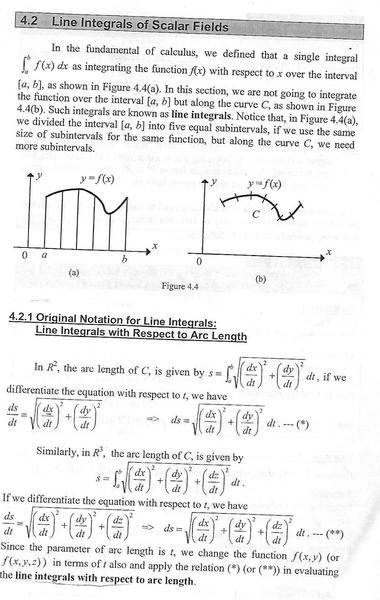
i'm not sure what is line integral...
pcE0VBo.jpg


Homework Equations

The Attempt at a Solution


Does it mean total length of line under the curve?
 
Physics news on Phys.org
chetzread said:

Homework Statement


i'm not sure what is line integral...
pcE0VBo.jpg


Homework Equations

The Attempt at a Solution


Does it mean total length of line under the curve?
If f(x,y,z) = 1, then the line integral of this function over the curve C will give the arc length between a and b. If f(x,y,z) is some other function, this won't be the case.
 
  • Like
Likes   Reactions: chetzread
SteamKing said:
If f(x,y,z) = 1, then the line integral of this function over the curve C will give the arc length between a and b. If f(x,y,z) is some other function, this won't be the case.
If f(x,y,z) is some other function , what would it be?
 
chetzread said:
If f(x,y,z) is some other function , what would it be?
Who knows?

Not every line integral is imbued with deep physical meaning.
 
If for example ##f(x,y,z)## is the density per unit length of a wire, say in kg/m, then the integral ##\int_C f(x,y,z)~ds## would represent the total kg for the wire.
c
 
  • Like
Likes   Reactions: chetzread
LCKurtz said:
If for example ##f(x,y,z)## is the density per unit length of a wire, say in kg/m, then the integral ##\int_C f(x,y,z)~ds## would represent the total kg for the wire.
c
Then, how about s( in the first photo in first post) only ? It represents the total length of curve?
 
chetzread said:
Then, how about s( in the first photo in first post) only ? It represents the total length of curve?
No. s is the cumulative distance along the curve, starting from a specified location.

What they are doing here is defining the locus of points along a curve in space by specifying each of the three coordinates x, y, and z as a continuous parametric function of a parameter t.
x = x(t)
y = y(t)
z = z (t)
Specifying a value for t determines the coordinates of any particular point along the curve.

Consider two closely neighboring points along the curve that are situated at t and at t + dt. The differences in the x, y, and z coordinates of these two points are given by:
##dx = x(t+dt)-x(t)=\frac{dx}{dt}dt##
##dy = y(t+dt)-y(t)=\frac{dy}{dt}dt##
##dz = z(t+dt)-z(t)=\frac{dz}{dt}dt##
The spatial distance ds between the two neighboring points along the curve is given by the Pythagorean Theorem:
$$(ds)^2=(dx)^2+(dy)^2+(dz)^2=\left[\left(\frac{dx}{dt}\right)^2+\left(\frac{dy}{dt}\right)^2+\left(\frac{dz}{dt}\right)^2\right](dt^2)$$
If you want to find the contour integral of a function f(x,y,z) between two points along the space curve, you want to be integrating f ds. This is the same as$$\int_{t_1}^{t_2}{f\left(x(t),y(t),z(t)\right)\sqrt{\left(\frac{dx}{dt}\right)^2+\left(\frac{dy}{dt}\right)^2+\left(\frac{dz}{dt}\right)^2}dt}$$
 
  • Like
Likes   Reactions: chetzread

Similar threads

Replies
6
Views
1K
Replies
9
Views
3K
  • · Replies 5 ·
Replies
5
Views
2K
Replies
2
Views
2K
  • · Replies 12 ·
Replies
12
Views
2K
Replies
12
Views
5K
Replies
2
Views
2K
  • · Replies 1 ·
Replies
1
Views
2K
  • · Replies 4 ·
Replies
4
Views
2K
  • · Replies 3 ·
Replies
3
Views
2K