Linear combinations of atomic orbitals

Click For Summary
SUMMARY

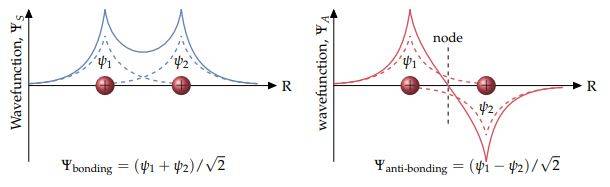
The discussion focuses on the linear combinations of atomic orbitals (LCAO) method used to approximate the molecular orbital of the hydrogen molecule ion (H+2). It establishes that the bonding and anti-bonding orbitals arise from summing two 1s orbitals, with the anti-bonding orbital incorporating a negative wavefunction from one of the summed orbitals. The conversation clarifies that this method involves a change of basis from atomic to molecular orbitals, allowing for the selection of linearly independent combinations of hydrogen 1s orbitals.

PREREQUISITES
  • Understanding of molecular orbital theory
  • Familiarity with atomic orbitals, specifically 1s orbitals
  • Knowledge of wavefunctions in quantum mechanics
  • Concept of linear independence in vector spaces
NEXT STEPS
  • Study the principles of molecular orbital theory in detail
  • Explore the mathematical formulation of linear combinations of atomic orbitals
  • Investigate the properties of bonding and anti-bonding orbitals
  • Learn about the implications of wavefunction symmetry in quantum chemistry
USEFUL FOR

Chemistry students, quantum mechanics enthusiasts, and professionals in theoretical chemistry seeking to deepen their understanding of molecular bonding and orbital theory.

Avardia
Messages
6
Reaction score
0
So I've been looking at covalent bonds and come across the approx you can do of the molecular orbital for ##H^+_2## by just summing two 1s orbitals, the method is called the linear combinations of atomic orbitals, and you get what is below which I believe is exact in this case since the 1s orbital is all there is. And the orbital is just the wavefunction of electron.
241690


So one is the bonding and the other is anti-bonding orbital. My question is why in the anti-bonding orbital do we have one of the summed 1s wavefunctions as negative?
 
Physics news on Phys.org
Avardia said:
My question is why in the anti-bonding orbital do we have one of the summed 1s wavefunctions as negative?
You don't have to. You're essentially doing a change of basis from the atomic orbitals to the molecular orbitals, so you can choose any two combinations of hydrogen 1s orbitals, as long as the combinations are linearly independent. It so happens that the fully symmetric and fully antisymmetric linear combinations of atomic orbitals closely approximate the bonding and antibonding molecular orbitals. You could choose a different basis, but you'd have much more complicated looking functions for your molecular orbitals.
 
  • Like
Likes   Reactions: DrClaude

Similar threads

  • · Replies 2 ·
Replies
2
Views
1K
  • · Replies 1 ·
Replies
1
Views
3K
  • · Replies 4 ·
Replies
4
Views
4K
  • · Replies 3 ·
Replies
3
Views
2K
  • · Replies 1 ·
Replies
1
Views
2K
  • · Replies 4 ·
Replies
4
Views
3K
  • · Replies 3 ·
Replies
3
Views
4K
Replies
5
Views
2K
  • · Replies 4 ·
Replies
4
Views
5K
  • · Replies 2 ·
Replies
2
Views
5K