Undergrad Linearization of Lagrange equations

Click For Summary
The discussion focuses on the linearization of Lagrange equations, particularly the expansion of the A matrix and its inverse. The user seeks clarification on how to derive the function f and the order of magnitude for small displacements, using q0 as a center. There is a debate on whether the quadratic form G is linear in terms of the velocities and if the matrix A can be assumed to be symmetric and diagonalizable. The kinetic energy matrix is emphasized as a key component in the Lagrangian formulation, with the user interested in expanding the inverse of A. Understanding these concepts is crucial for mastering Lagrange mechanics.
stefano77
Messages
20
Reaction score
8
TL;DR
linearization lagrange equation
l am italian student from Milan university, so sorry for my bad english.
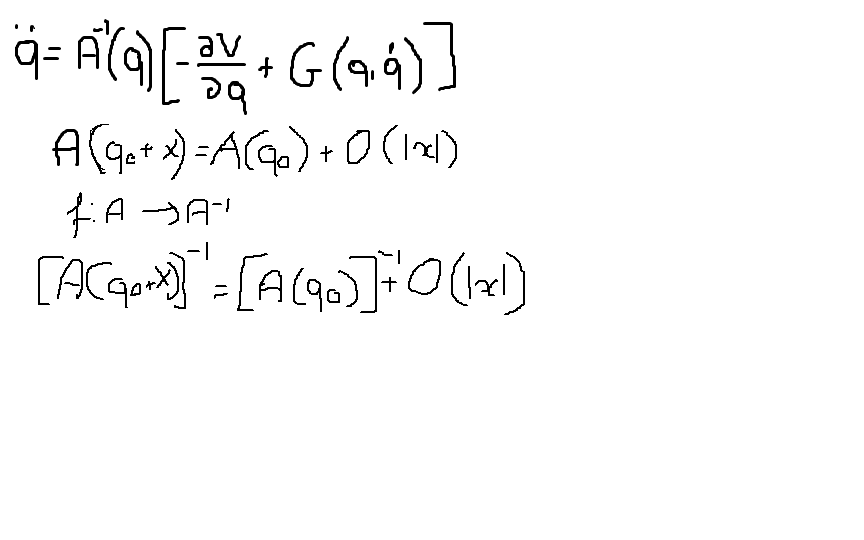
l am studying lagrange meccanics. We are linearizating lagrange equations. Here l don't understand how you can expand A matrix, how the function f is derivable, how the inverse matrix A is expanded? l am expanding with q0 center, x is the small displacement . G is a quadratic form.
O(|x|) is order of magnitude
1604917727355.png
 

Attachments

  • 1604917007307.png
    1604917007307.png
    6.6 KB · Views: 204
  • Like
Likes Delta2
Physics news on Phys.org
Do you mean, $$G(q,\dot q)=\sum_{ij}A_{ij}~q_i\dot q_j,$$ is linear in ##\dot{q}_i##? Or,
$$G=\sum A_{ij}(q)\dot{q}_i\dot{q}_j$$
 
  • Like
Likes PhDeezNutz
Can we assume anything about ##A##? Is it symmetric?
 
L = T - V ## T = \sum a_{ij}(q) q'_i q'_j## $$ A= [a_{ij}] $$

## G_h(q,q')= \sum_{jl} \frac {\partial\a_{hj}} {\partial q_l} q'_l q'_j + \sum_{ij} \frac {\partial\a_{ij}} {2 \partial q_h} q'_l q'_j##
but l am interestin how to expand ## [A(q)]^{-1}## with ##q_0## as center
 
  • Like
Likes PhDeezNutz
A is symmetri...
it is kinetic energy matrix
L is a natural lagrangian
 
  • Like
Likes PhDeezNutz
stefano77 said:
A is symmetri...
it is kinetic energy matrix
L is a natural lagrangian

I think it's also diagonalizable. In which case

##A^{-1}_{ii} = \frac{1}{A_{ii}}##
 
Thread 'What is the pressure of trapped air inside this tube?'
As you can see from the picture, i have an uneven U-shaped tube, sealed at the short end. I fill the tube with water and i seal it. So the short side is filled with water and the long side ends up containg water and trapped air. Now the tube is sealed on both sides and i turn it in such a way that the traped air moves at the short side. Are my claims about pressure in senarios A & B correct? What is the pressure for all points in senario C? (My question is basically coming from watching...

Similar threads

  • · Replies 3 ·
Replies
3
Views
3K
  • · Replies 11 ·
Replies
11
Views
681
Replies
1
Views
2K
  • · Replies 8 ·
Replies
8
Views
2K
  • · Replies 0 ·
Replies
0
Views
4K
  • · Replies 7 ·
Replies
7
Views
4K
  • · Replies 4 ·
Replies
4
Views
2K
  • · Replies 1 ·
Replies
1
Views
2K
  • · Replies 15 ·
Replies
15
Views
2K