Logarithm and statistical mechanics

Click For Summary

Discussion Overview

The discussion revolves around the appearance and significance of logarithmic dependence in statistical mechanics, particularly in relation to probabilities and entropy. Participants explore how logarithms facilitate calculations and represent statistical properties within the framework of statistical mechanics.

Discussion Character

  • Exploratory
  • Technical explanation
  • Mathematical reasoning

Main Points Raised

  • Some participants note that logarithmic dependence is linked to probabilities, suggesting that it simplifies calculations in statistical mechanics.
  • One participant mentions the probability function of a normal distribution, highlighting its exponential decay as a function of standard deviations from the mean.
  • Another participant points out that entropy is often expressed as a logarithmic function of multiplicity, specifically stating that entropy is defined as \( S = k \ln \Omega \).
  • It is proposed that transforming products of probabilities into sums via logarithms is a key reason for their prevalence in statistical physics, with the formula \( \ln p = \sum_i \ln p_i \) being cited.
  • One participant provides an example involving the entropy of a system, stating that the probability of finding particles in a volume leads to an expression for entropy in terms of logarithms.

Areas of Agreement / Disagreement

Participants express varying degrees of understanding regarding the role of logarithms in statistical mechanics, with some agreeing on their utility for simplifying calculations, while others raise questions about specific applications and interpretations. The discussion does not reach a consensus on all points raised.

Contextual Notes

Some statements rely on specific definitions of terms like multiplicity and entropy, which may not be universally agreed upon. Additionally, the discussion includes assumptions about the nature of probabilities and their mathematical treatment that remain unexamined.

guma1204
Messages
1
Reaction score
0
Hello, I'll try to get right to the point.

Why and how does logarithmic dependence appear in statistical mechanics? I understand that somehow it is linked with probabilities, but I can not quite understand.
 
Physics news on Phys.org
guma1204 said:
Hello, I'll try to get right to the point.

Why and how does logarithmic dependence appear in statistical mechanics? I understand that somehow it is linked with probabilities, but I can not quite understand.
I am not sure exactly what you are referring to. But I think this is an example of what you are asking about:

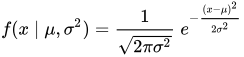
The function for the probability function of a normal distribution is shown here:

ffe7c5cbdecda556bf2170e31f1f9a127b74e239


It decreases exponentially as |(x-u)/sigma| increases.
It's easy to see why. Every increase in a standard deviation from mean compounds the unlikelihood - an exponential process.
 
What logarithm are you talking about?

In some cases, it is simply a question of convenience. Instead of working with the multiplicity ##\Omega##, we most often use entropy instead, ##S = k \ln \Omega##.
 
guma1204 said:
Why and how does logarithmic dependence appear in statistical mechanics? I understand that somehow it is linked with probabilities, but I can not quite understand.
If ##p_i## are probabilities of independent events, then the total probability is
$$p=\prod_i p_i$$
However, products are not easy to compute, especially if ##i## is a continuous label. Therefore we transform the product into a sum via
$$\ln p=\sum_i \ln p_i$$
That's the origin of most logarithms in statistical physics.
 
Last edited:
Take statistical mechanics entropy : S = k ln w. Where w is probability that system is in present state relative to all other possible states
The probability of finding N particles in volume V is w = (cV)N So S = kN(ln c + ln V)
 

Similar threads

  • · Replies 1 ·
Replies
1
Views
2K
  • · Replies 4 ·
Replies
4
Views
2K
  • · Replies 6 ·
Replies
6
Views
2K
  • · Replies 9 ·
Replies
9
Views
2K
  • · Replies 4 ·
Replies
4
Views
2K
  • · Replies 5 ·
Replies
5
Views
2K
  • · Replies 20 ·
Replies
20
Views
2K
  • · Replies 10 ·
Replies
10
Views
2K
  • · Replies 4 ·
Replies
4
Views
2K