Magnetization of a Helical coil in a Reservoir of parrafin

Click For Summary
SUMMARY

The discussion centers on the experimental investigation of magnetizing a 50-liter reservoir of paraffin using a helical copper coil. The objective is to enhance thermal conductivity for applications in car radiators. Key considerations include the type of magnetic field (AC vs. DC), field strength, and the theoretical basis for melting paraffin with magnetic fields. Participants emphasize the importance of understanding the properties of paraffin, including thermal conductivity, viscosity, and specific heat, as well as potential misunderstandings related to the terminology of "paraffin" in different English dialects.

PREREQUISITES
  • Understanding of solenoid design and calculations for AC and DC fields.
  • Knowledge of thermal properties of materials, specifically thermal conductivity and viscosity.
  • Familiarity with magnetic field applications in mechanical engineering.
  • Basic principles of electromagnetism and energy transfer in non-magnetic materials.
NEXT STEPS
  • Research the theoretical basis for melting paraffin with magnetic fields, including necessary field strengths and configurations.
  • Investigate the differences in thermal properties between paraffin and other fluids, such as water with antifreeze.
  • Learn about solenoid design calculations, focusing on ampere-turns and inductance for AC applications.
  • Examine the implications of using paraffin in varying temperature conditions, including cold weather effects on thermal expansion.
USEFUL FOR

Mechanical engineers, researchers in thermal management systems, and anyone involved in experimental physics or materials science related to magnetic applications.
puya
Messages
2
Reaction score
0
To test an Experimental Model , my advisor said to make this investigation;

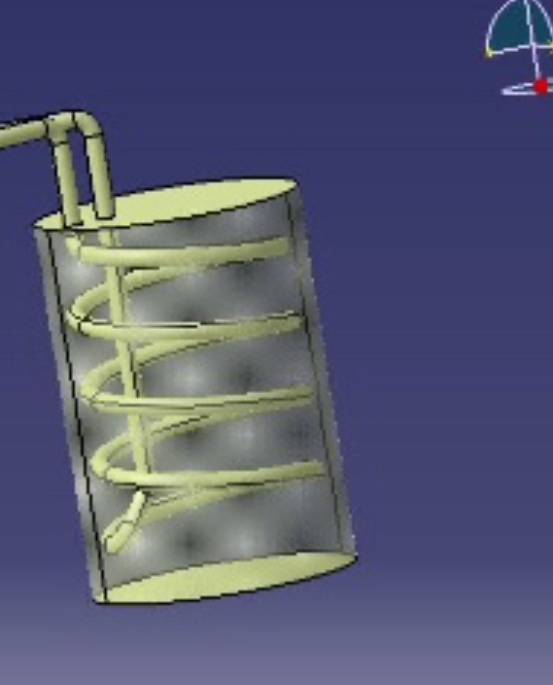
I have a Reservoir of parrafin,
Capacity is 50 liters,
Around this Reservoir there is a Helical copper Pipe, I have to magnetize the Reservoir by using Helical coil .
Many thanks For your assistance
B1B967BE-9EBB-4FD6-B373-86120586004C.jpeg
 

Attachments

  • B1B967BE-9EBB-4FD6-B373-86120586004C.jpeg
    B1B967BE-9EBB-4FD6-B373-86120586004C.jpeg
    20 KB · Views: 547
Physics news on Phys.org
Hi and welcome to PF. What level of magnetic field were you planning on? What are your thoughts on this and what research have you done into solenoids?
 
  • Like
Likes   Reactions: puya
sophiecentaur said:
Hi and welcome to PF. What level of magnetic field were you planning on? What are your thoughts on this and what research have you done into solenoids?

Thanks to respond,
I want to use magnetic as much as it’s going to melt paraffin !
My field is mechanical engineering, in this case I don’t know how to complete this experimental test.

I want to model it for using in radiator of car to increase thermal conductivity
 
Last edited:
You are working on a PhD in mechanical engineering, so you should be able to find the theoretical basis for melting paraffin with magnetic fields. That includes alternating vs constant field, frequency if alternating, and field strength. From that, the equations for a solenoid are easily found. It's a simple matter of ampere-turns for DC, and ampere-turns plus inductance for AC. If you design an AC solenoid, part of the calculation is the voltage required to drive the peak current. You will need this to select a power supply.

Make sure that paraffin can be melted with magnetic fields before spending much time building an experimental setup to do what (possibly) cannot be done.

Keep in mind that there is more to consider than just thermal conductivity. You might also do some calculations to compare paraffin vs water with 50% antifreeze. Compare:
1) Thermal conductivity (heat transfer coefficients).
2) Viscosity (for pumping).
3) Specific heat and density (thermal capacity) as it affects pumping.
4) Check what happens at the maximum temperature in the engine, which is higher than the temperature seen by the temperature gauge.
5) Consider what happens in cold weather, such as cold soaked at -40 deg C.
6) Calculate thermal expansion over the full temperature range.
 
  • Like
Likes   Reactions: Asymptotic
How is a magnetic field going to transfer energy to paraffin? It is a non magnetic material.
Even electric fields penetrate paraffin wax very well and I have used it to make a prism at 10GHz.
 
Everyone posting to this thread should be warned that the word "paraffin" has different meanings in British English and American English. The Americans use "paraffin" to name a type of candle wax, and use the word "kerosene" for the petroleum-derived flammable liquid that the British call "paraffin".

I suspect that the original poster is using British English while the people talking about melting the stuff are assuming american English.
 
The OP is talking about melting, so doesn't that mean we should conclude it's the wax-like substance?
 
Has there been a more fundamental misunderstanding by the OP ?
This appears an immersed heating element, a resistive 'kettle whatsit', rather than a copper coil of inherently very low resistance...
 
  • Like
Likes   Reactions: sophiecentaur

Similar threads

  • · Replies 1 ·
Replies
1
Views
2K
  • · Replies 5 ·
Replies
5
Views
2K
  • · Replies 6 ·
Replies
6
Views
2K
  • · Replies 3 ·
Replies
3
Views
2K
  • · Replies 27 ·
Replies
27
Views
3K
  • · Replies 12 ·
Replies
12
Views
3K
  • · Replies 5 ·
Replies
5
Views
2K
  • · Replies 10 ·
Replies
10
Views
3K
  • · Replies 43 ·
2
Replies
43
Views
7K
  • · Replies 42 ·
2
Replies
42
Views
3K