Magnitude and direction of k vector

Click For Summary

Homework Help Overview

The discussion revolves around understanding the magnitude and direction of the wave vector, denoted as k, in a physics context. Participants are examining the calculations related to the magnitude expressed in radians per centimeter and the implications of angles in vector representation.

Discussion Character

  • Exploratory, Conceptual clarification, Mathematical reasoning, Assumption checking

Approaches and Questions Raised

  • Participants are attempting to clarify the calculation of the magnitude of k and its representation in terms of angles. Questions arise regarding the interpretation of the angle and its impact on the direction of the vector. There is also discussion about the significance of the numerical value obtained for the magnitude.

Discussion Status

There is an ongoing exploration of the relationship between the magnitude and direction of the vector k, with some participants providing insights into the angle's role. Guidance has been offered regarding the representation of the direction as a unit vector, although no consensus has been reached on the interpretation of the magnitude value.

Contextual Notes

Participants note potential confusion regarding the angle measurements and the relationship between different representations of the vector. There is mention of misreading angles and the significance of the calculated values, which may reflect specific requirements or expectations in the homework context.

jaus tail
Messages
613
Reaction score
48
Homework Statement
A light wave of wavelength 800 nm is directed in the x-y plane at 45o. For this propagating wave, 1) what is the magnitude of the k-vector?_________rads/cm
2) what is the magnitude of the k-vector?_________rads/cm
Relevant Equations
magnitude = 2(pie)/(wavelength)
I didnt understand the question. The magnitude is 2(pie)/wavelength. I get 78500 rad/cm which is pretty wrong as guess. Where would angle come into picture?
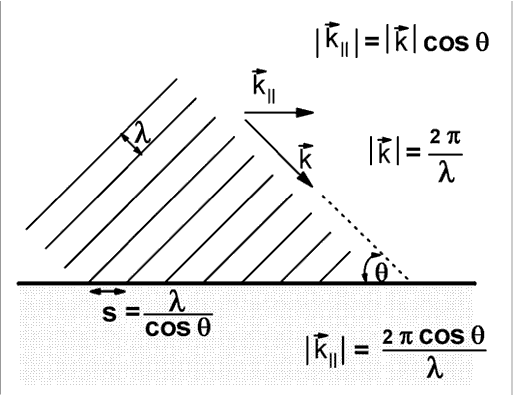
1612172278995.png

Ref: https://www.millersville.edu/physics/experiments/062/index.php

Shouldn't direction be like i + j + k ?
So will it be like:
|k|cos30 i + |k| sin30 j + 0 k ?
 
Physics news on Phys.org
jaus tail said:
I didnt understand the question.
And misread the 45 degrees ? And the fact that 1) and 2) are identical ?
jaus tail said:
I get 78500 rad/cm which is pretty wrong as guess
Says who ? I get the same. Perhaps they want to see 78540 ?
jaus tail said:
|k|cos30 i + |k| sin30 j + 0 k ?
Yes, but ##\pi/4## instead of 30.

jaus tail said:
Where would angle come into picture?
Picture has ##\vec k## pointing in ##-{\pi\over 4}## direction.
 
  • Like
Likes   Reactions: jaus tail
To be honest this is all so maths. Thanks for this. What does 78540 signify. I mean so much radians / cm.
 
Shouldn't direction be unit vector like
The vector you mentioned divided by |k|?
 
jaus tail said:
What does 78540 signify. I mean so much radians / cm.
I get ##2\pi/##(8*10-5 cm) = 78539.82 rad/cm

jaus tail said:
Shouldn't direction be unit vector like
The vector you mentioned divided by |k|?
If you want. One can also say that is the unit vector in that direction.
 
  • Like
Likes   Reactions: jaus tail
Thanks for the guidance.
 
  • Like
Likes   Reactions: BvU
You are welcome.
 

Similar threads

  • · Replies 8 ·
Replies
8
Views
4K
Replies
3
Views
1K
  • · Replies 1 ·
Replies
1
Views
3K
Replies
1
Views
3K
  • · Replies 6 ·
Replies
6
Views
10K
  • · Replies 2 ·
Replies
2
Views
10K
  • · Replies 13 ·
Replies
13
Views
2K
  • · Replies 4 ·
Replies
4
Views
2K
  • · Replies 9 ·
Replies
9
Views
10K
  • · Replies 2 ·
Replies
2
Views
4K