Making a battery cigarette lighter

  • Thread starter Thread starter CrimpJiggler
  • Start date Start date
  • Tags Tags
    Battery
Click For Summary

Discussion Overview

The discussion revolves around the creation of a battery-operated cigarette lighter, particularly focusing on the materials and principles involved in its construction and operation. Participants explore the properties of heating elements, the behavior of electricity in circuits, and the specifics of a practical experiment involving tissue paper and aluminum foil.

Discussion Character

  • Exploratory
  • Technical explanation
  • Debate/contested
  • Experimental/applied

Main Points Raised

  • Some participants propose that a heating element should be made from materials that are less conductive than metals like copper or aluminum, suggesting that nichrome or kanthal could be suitable due to their high resistance.
  • Others question the assumption that tissue paper is completely non-conductive, suggesting that its resistance might be too high to allow enough current to ignite it.
  • One participant describes an experiment where they felt a burning sensation when holding aluminum foil to battery terminals, speculating whether the sensation was due to electricity passing through their skin.
  • Concerns are raised about the nature of the circuit being completed, with some participants noting that a short circuit would generate more heat than a circuit with higher resistance.
  • There is a discussion about the source of the heating element in a kettle, with questions regarding the specific wire used in the construction of the lighter.

Areas of Agreement / Disagreement

Participants express differing views on the conductivity of tissue paper and the nature of the sensations experienced when completing circuits. There is no consensus on the effectiveness of the tissue paper in the experiment or the exact materials used in the heating element of the lighter.

Contextual Notes

Limitations include the lack of visual evidence for the heating element and the assumptions made about the conductivity of tissue paper. The discussion also does not resolve the effectiveness of various materials in creating a heating element or the specifics of the circuit configurations used in experiments.

CrimpJiggler
Messages
141
Reaction score
1
I read an article in prison inventions and was impressed by some of the things the inmates MacGyvered. A very simple invention I saw though was a cigarette lighter made from a battery:
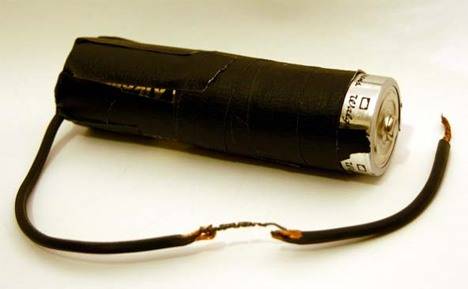
prison-battery-lighter.jpg

I have an understanding of basic electronics theory but I have very little practical experience. I can see a piece of thin wire connected to the insulated copper wire, obviously that's the heating element but what material would you say that is? Am I right in assuming that a material for a heating element needs to be far less conductive than conductive metals like copper or aluminum?

I did an experiment in which I made a broken circuit with some aluminum foil. I completed the circuit with a piece of tissue paper (a single width) and was expected the tissue to go on fire but it didn't. I know tissue is completely non conductive but I thought that 1.5V would overcome the resistance the tissue is about a micrometer wide. I accidentally completed the circuit at one point and I was holding the foil to each terminal with fingers and I rapidly felt a burning sensation on my fingers so I know the battery has voltage in it. Why didn't the tissue ignite?
 
Last edited:
Engineering news on Phys.org


CrimpJiggler said:
Am I right in assuming that a material for a heating element needs to be far less conductive than conductive metals like copper or aluminum?

Well, less conductive than a normal sized wire, yes, but one COULD achieve that with a REALLY thin strand of copper. Of course it would likely melt immediately. But yes, your basic thought is correct.

I did an experiment in which I made a broken circuit with some aluminum foil. I completed the circuit with a piece of tissue paper (a single width) and was expected the tissue to go on fire but it didn't. I know tissue is completely non conductive but I thought that 1.5V would overcome the resistance the tissue is about a micrometer wide. I accidentally completed the circuit at one point and I was holding the foil to each terminal with fingers and I rapidly felt a burning sensation on my fingers so I know the battery has voltage in it. Why didn't the tissue ignite?

Why would you expect even thin tissue to conduct electricity at 1.5 volts? If you had maybe a molecule's thickness, yes, or if you had enough voltage to overcome the resistance, yes (although in that case I could expect a spark, not real conduction)


Thanks, that clears up my questions. One thing I'm still wondering though is why my fingers heat up if I hold a strip of aluminum foil to both terminals of the battery. The burning sensation on my fingers gets very intense in a matter of seconds. I don't feel any burning if I complete a circuit by holding two pieces of wire together with my fingers. I'm guessing what I'm feeling is electricity itself, not heat generated by the circuit. Is some of the current traveling through my skin (and thus heating the skin up)?

Also, do you know what material the heating element in that prison lighter could be made of? In this video:

the guy makes the same type of battery lighter but I don't understand where he gets the heating element from. I see that he disassembles a kettle but where does that piece of wire come from? All the kettles I've seen have heating elements like this:
http://www.sciencephoto.com/image/221343/530wm/H1300610-Kettle_electric_heating_element-SPL.jpg
I don't understand what that piece of wire he salvaged from the kettle is.
 
Last edited by a moderator:


CrimpJiggler said:
Thanks, that clears up my questions. One thing I'm still wondering though is why my fingers heat up if I hold a strip of aluminum foil to both terminals of the battery. The burning sensation on my fingers gets very intense in a matter of seconds.

.

well you are shorting out the battery and the foil is conducing all the current that the battery is able to supply. The foil is getting hot as a result and transferring that heat to your fingers

I don't feel any burning if I complete a circuit by holding two pieces of wire together with my fingers. I'm guessing what I'm feeling is electricity itself, not heat generated by the circuit. Is some of the current traveling through my skin (and thus heating the skin up)?

if you hold a bit of copper wire between the terminals of the battery , the same thing will happen. But you didnt specify that

what sort of circuit were you completing ? if its anything more than one that's close to a short circuit, then no, you won't feel the wire joint getting hot
( will qualify that by saying that it may get warm/hot if really high currents are involved)
That is because there would be a small amount of resistance in a mechanical joint that wouldn't be there in say a soldered joint

Dave


I am always intrigued by innovative and resourceful solutions, especially when they are created with limited resources. The invention of a battery cigarette lighter by inmates is a prime example of this.

In terms of the heating element material, it is difficult to determine without further information or a visual of the invention. However, based on your description, it is possible that the inmates used a resistive wire such as nichrome or kanthal, which are commonly used in heating elements due to their high resistance and ability to withstand high temperatures. These materials have a much higher resistance compared to conductive metals like copper or aluminum, making them ideal for heating elements.

As for your experiment, it is important to note that tissue paper is not completely non-conductive. It has a certain level of resistance, which may have been too high to allow for enough current to pass through and ignite. Additionally, tissue paper is a poor conductor of heat, so even if it did ignite, it may not have been able to sustain the flame. It is also possible that the tissue paper was not in direct contact with the aluminum foil, creating a gap in the circuit and preventing the flow of current.

Overall, the invention of a battery cigarette lighter is a creative and practical solution, but it is important to consider the safety and potential hazards associated with using homemade electrical devices. I would recommend further experimentation and research to ensure the safety and effectiveness of such inventions.
 

Similar threads

  • · Replies 22 ·
Replies
22
Views
4K
  • · Replies 3 ·
Replies
3
Views
3K
  • · Replies 28 ·
Replies
28
Views
46K
  • · Replies 20 ·
Replies
20
Views
8K
  • · Replies 5 ·
Replies
5
Views
16K
  • · Replies 18 ·
Replies
18
Views
4K
  • · Replies 6 ·
Replies
6
Views
3K
  • · Replies 5 ·
Replies
5
Views
3K
  • · Replies 3 ·
Replies
3
Views
45K
  • · Replies 14 ·
Replies
14
Views
5K