Man on a railroad car rounding a curve

  • Thread starter Thread starter LCSphysicist
  • Start date Start date
  • Tags Tags
    Car Curve
Click For Summary
The discussion centers on the dynamics of a man standing on a railroad car rounding a curve, analyzing the forces acting on his feet. Participants present equations to determine the weight distribution on each foot, with differing opinions on the necessity of including friction in the calculations. One argument suggests that the book's simplified equations are valid under certain conditions, while another emphasizes a more comprehensive approach that accounts for additional variables. The conversation also touches on the implications of the man's center of mass and angular momentum in relation to his stability during the turn. Overall, the participants seek to reconcile their differing methodologies to arrive at a correct understanding of the forces involved.
LCSphysicist
Messages
644
Reaction score
162
Homework Statement
.
Relevant Equations
The friction equations
"A man of mass M stands on a railroad car which is rounding an
unbanked turn of radius R at speed v. His center of mass is height L
above the car, and his feet are distance d apart. The man is facing the
direction of motion. How much weight is on each of his feet?"
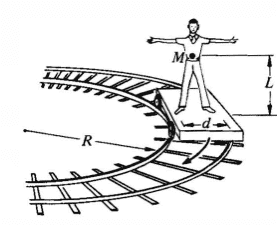
1586536364992.png


I came five equations, and five incognits:
Call the inside side with index i, outside with o

Ni + No = Mg
Ni*μ = mi*v²/R
No*μ = mo*v²/(R+d)

mi + mo = M
No*d/2 = No*μ*l + Ni*d/2 + Ni*μ*l

I will not develop, but you know that we can came to a answer to both N without μ.

The book came to this equations:

Ni + No = Mg
No*μ + Ni*μ = Mv²/R
No*d/2 = No*μ*l + Ni*d/2 + Ni*μ*l

The bold equations is where we desagree, if i could say, i'd say that book's solution is summarized, but justified if d is small in comparation, while my solution is more complete, but in some cases desnecessary. Example, F = Gmm/(r+d)² is the right, but F = m*g is a nice aproximation.

But, i don't know...
 
Physics news on Phys.org
Let ##S## be the center of mass and ##\boldsymbol F_l, \boldsymbol F_r## are the reactions from the trolley to the left and right leg respectively:
$$M\boldsymbol a_S=M\boldsymbol g+\boldsymbol F_l+\boldsymbol F_r.$$

The angle momentum equation
$$0=\boldsymbol r_l\times \boldsymbol F_l+\boldsymbol r_r\times \boldsymbol F_r,$$
here
##\boldsymbol r_r## is a vector from the center of mass to the right sole,
##\boldsymbol r_l## -- respectively

Introduce a coordinate frame moving with the trolley and expand the equations
 
  • Like
Likes etotheipi
Yes I agree with @wrobel, for an extended body the net radial force is proportional to the centre of mass radial acceleration, and the COM is performing circular motion at speed ##v## and radius ##R + \frac{d}{2}##. For this NII equation, it doesn’t matter where the force is applied on the extended body.

I assume ##d << R## so we can essentially ignore the ##\frac{d}{2}##.

If you hypothetically knew the net force on e.g. his foot, you could write down an equation for the circular motion of the centre of mass of his foot and this would evidently be at a different radius.
 
Last edited by a moderator:
Substitute ##\boldsymbol F_l## from the first equation to the second one:
$$\boldsymbol F_l=M\boldsymbol a_S-M\boldsymbol g-\boldsymbol F_r;$$
$$(\boldsymbol r_r-\boldsymbol r_l)\times \boldsymbol F_r=M\boldsymbol r_l\times(\boldsymbol g-\boldsymbol a_S)$$
From the last equation ##\boldsymbol F_r## is determined up to additional horizontal vector directed radially. The vertical component of ##\boldsymbol F_r## is determined correctly
 
LCSphysicist said:
The book came to this equations:

Ni + No = Mg
No*μ + Ni*μ = Mv²/R
No*d/2 = No*μ*l + Ni*d/2 + Ni*μ*l

The bold equations is where we desagree, if i could say, i'd say that book's solution is summarized, but justified if d is small in comparation, while my solution is more complete, but in some cases desnecessary. Example, F = Gmm/(r+d)² is the right, but F = m*g is a nice aproximation.

But, i don't know...

I agree with the book's solution, except:

1) ##R \rightarrow R + \frac d 2##, as pointed out above.

2) The specific friction force on each foot is indeterminate. ##\mu N## is the maximum possible force of static friction, but it's only the sum of the friction forces that matters.
 
  • Like
Likes jbriggs444
I believe this problem still needs some extra explanation.

Actually the angular momentum equation for a rigid body (for the man here) is written as follows
$$J_S\boldsymbol{\dot \omega}+\boldsymbol\omega\times J_S\boldsymbol\omega=\boldsymbol r_l\times\boldsymbol F_l+\boldsymbol r_r\times\boldsymbol F_r.\qquad (*)$$
Here ##J_S## is man's inertia operator about his center of mass. By the conditions of the problem the angular velocity is constant: ##\boldsymbol{\dot \omega}=0##. This kills the first term in the left side of (*).

Further we implicitly assume that the man stands as a symmetric sculpture: the vertical axis passing through his center of mass is a principal axis for ##J_S## that is ##J_S\boldsymbol\omega=\lambda\boldsymbol\omega.## This assumption kills the second term in the left side of (*)

If the man takes down one hand or inclines aside or takes nonsymmetric pose somehow else then ##\boldsymbol\omega\times J_S\boldsymbol\omega\ne 0##.
 
Last edited:
  • Informative
Likes etotheipi
The book claims the answer is that all the magnitudes are the same because "the gravitational force on the penguin is the same". I'm having trouble understanding this. I thought the buoyant force was equal to the weight of the fluid displaced. Weight depends on mass which depends on density. Therefore, due to the differing densities the buoyant force will be different in each case? Is this incorrect?

Similar threads

  • · Replies 20 ·
Replies
20
Views
3K
Replies
17
Views
5K
  • · Replies 9 ·
Replies
9
Views
7K
Replies
4
Views
2K
Replies
3
Views
4K
  • · Replies 7 ·
Replies
7
Views
4K
Replies
2
Views
3K
  • · Replies 3 ·
Replies
3
Views
3K
Replies
1
Views
4K
Replies
3
Views
4K