Discussion Overview
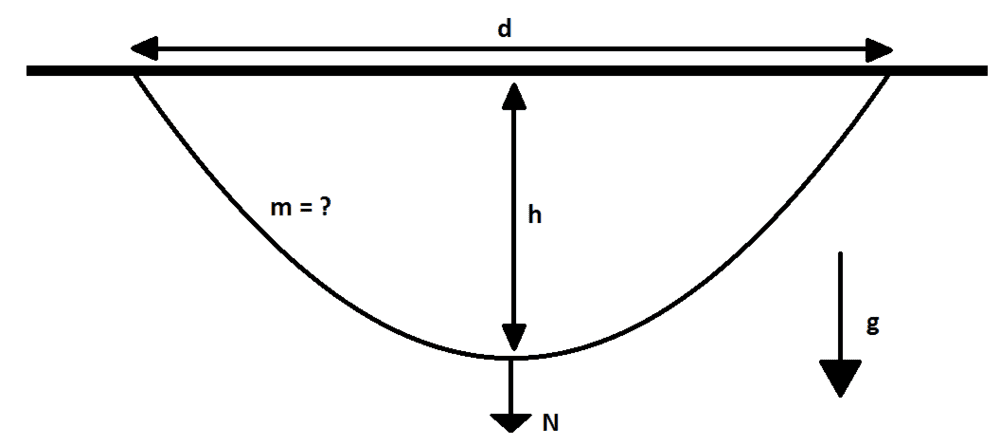
The discussion revolves around calculating the mass of a hanging rope, particularly in the context of catenary shapes. Participants explore the mathematical and physical principles involved, including the need for additional information such as tension to determine mass accurately.
Discussion Character
- Exploratory
- Technical explanation
- Debate/contested
- Mathematical reasoning
Main Points Raised
- One participant questions how to find the mass of a hanging rope, mentioning advanced calculus and catenary functions.
- Another participant asserts that without additional information, such as tension, the mass cannot be determined since different ropes can have the same catenary shape despite varying mass densities.
- A third participant agrees that the catenary shape is independent of mass, assuming uniform mass distribution, and notes that non-uniform mass would not yield a catenary shape.
- Several participants inquire about calculating mass if the tension at the lowest point is known, suggesting that this could lead to a weighted catenary scenario.
- One participant advises the original poster to clarify whether their inquiry is theoretical or practical, suggesting consulting a structural engineer for practical applications.
- A detailed method is proposed for calculating mass using the catenary equation, free body diagrams, and relationships between tension and weight per unit length.
Areas of Agreement / Disagreement
Participants generally agree that additional information is necessary to determine the mass of the rope, particularly the tension at the lowest point. However, there are competing views on the implications of mass distribution and the nature of the catenary shape.
Contextual Notes
Limitations include the dependence on specific definitions of mass density and tension, as well as unresolved mathematical steps in the proposed calculations.