Math Foundations -- Sign conventions in this soil pressure graph

Click For Summary

Discussion Overview

The discussion revolves around the sign conventions used in a soil pressure graph related to a raft design. Participants explore the implications of these conventions on the calculated soil pressure values at specific points, particularly focusing on the mathematical formulation and its interpretation.

Discussion Character

  • Technical explanation
  • Debate/contested
  • Mathematical reasoning

Main Points Raised

  • One participant expresses confusion about the sign convention in the soil pressure graph and requests clarification on how the positive and negative signs are determined.
  • Another participant suggests that the sign convention may relate to the X and Y directions from the origin, proposing a specific equation for soil pressure.
  • A participant questions the interpretation of the X direction at point C, suggesting that it should be positive as it moves to the right.
  • Some participants note that while pressure increases from point A to point C, it generally decreases from left to right, leading to a negative sign for the X term in the equation.
  • Concerns are raised about the reliability of the equation used to calculate soil pressure, with one participant highlighting discrepancies between calculated values and expected pressures based on column loads.
  • Another participant clarifies that the values previously mentioned were axial loads rather than soil pressures, providing specific soil pressure values for points A, B, and C.
  • A participant describes the process of deriving the soil pressure formula, indicating that it involves calculating total column loads and applying specific equations.

Areas of Agreement / Disagreement

Participants express differing views on the interpretation of the sign conventions and the reliability of the soil pressure formula. There is no consensus on the correct application of the sign conventions or the validity of the calculated pressures.

Contextual Notes

Some participants indicate uncertainty regarding the assumptions underlying the calculations and the definitions of terms used in the equations. There are unresolved questions about the accuracy of the formula in relation to actual soil pressures.

DavidLee24
Messages
10
Reaction score
1
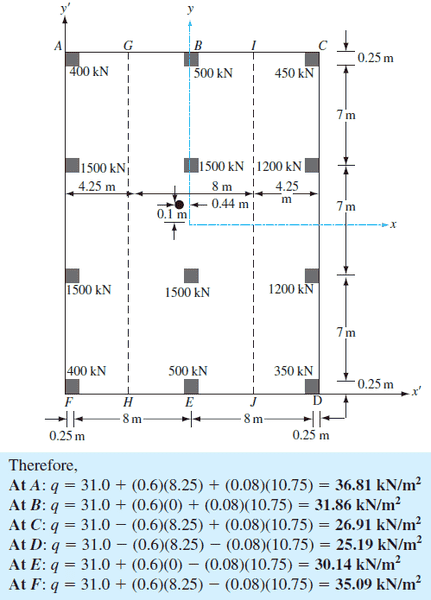
Hey guys, so I stumbled across this, and I'm kinda confused on how do they get the sign convention of the value. I've attached the figure and also the soil pressure for better reference. Take for example at C, how do they get the minus and positive sign convention? Thanks a bunch.

P/S : Please do elaborate your answers, thanks!
PP/S : I'm using this example to try to design an actual raft, so please do advice.
QQ.png
 
Last edited:
Physics news on Phys.org
Hi DavidLee. I think it would help if you elaborated on what exactly this is, what q represents, etc. :smile:
 
Last edited:
  • Like
Likes   Reactions: sophiecentaur
Thanks for the reply, Drakkith. I'm sorry for providing minimal info. I shall edit my post.

EDIT : Not so sure why I couldn't edit my original post, but here's the additional information;

q is the soil pressure; with the formula q = 31 ± 0.6x ± 0.08y (kN/m²) <--- computed
x and y is the direction of moment

I knew how to obtain the distance, eg 8.25m, but not for the sign convention though, which I do believe I'm confusing myself.
 
Last edited:
Looks to me like the sign convention corresponds to the X and Y directions from the origin. Since there is a negative sign for the ##x## term for all points to the right of the origin, your equation is:
##q=31-0.6x+0.08y##
 
Thanks again, for the reply. But as for X direction at C, if we divide them into X-Y axis, aren't it be in positive as the X-dir going to the right? I see that for +0.08y <--- it is at above, therefore positive, is it right?
 
DavidLee24 said:
But as for X direction at C, if we divide them into X-Y axis, aren't it be in positive as the X-dir going to the right?

Nope. You can see that the force in the middle decreases as you go from left to right from 1500 to 1200.

Edit: Hold on. Let me take a closer look at this.
 
Last edited:
Okay, this is a bit more complicated than I thought. Notice that from point A to point C the pressure actually has a net increase from 400 to 450, but everywhere else the pressure has a net decrease as you move from left to right. Hence the equation that was solved for has a negative sign for the ##x## term.

The pressure in the ##y## direction has no net increase or decrease except for in the far right edge where it has a net increase, hence the positive sign.

Note that I wouldn't trust this equation. The pressure just under the origin is 1500kN but the equation predicts a pressure only 3% of that.
 
Hi Drakkith, but the value you mentioned eg. 400kN, 450kN ..that isn't the soil pressure as that is the axial load from above into the column. So the soil pressure at A is 36.81 kN/m² and at B, 31.86 kN/m² and finally at C is decrease to 26.91 kN/m² .. The soil pressure is obtained from the formula..
 
DavidLee24 said:
Hi Drakkith, but the value you mentioned eg. 400kN, 450kN ..that isn't the soil pressure as that is the axial load from above into the column.

My mistake.

DavidLee24 said:
So the soil pressure at A is 36.81 kN/m² and at B, 31.86 kN/m² and finally at C is decrease to 26.91 kN/m² .. The soil pressure is obtained from the formula..

I'm not a structural engineer or something, but, like I said, I have my doubts about this formula. It's difficult to trust such a simple formula when the column loads in the middle exceed the edges by a factor of 3 or more yet the calculated soil pressure is often less. Where did you get it?
 
  • #10
Drakkith said:
Where did you get it?

Oh, regarding the formula, it is calculated. I will go briefly on how the formula is obtained. Firstly, we calculated the total column load ..Q = Q1 + Q2 + Q3 + ... then, determine the pressure on the soil, q, below the mat at points A, B, C, etc..using the equation q= (Q/A) ± (Myx/Iy) ± (Mxy/Ix) ... and then proceed to calculate the My, Mx, Iy, Ix ..to conclude, that the formula q=31−0.6x+0.08y is obtained by q= (Q/A) ± (Myx/Iy) ± (Mxy/Ix)..
 
  • Like
Likes   Reactions: Drakkith

Similar threads

  • · Replies 69 ·
3
Replies
69
Views
5K
  • · Replies 4 ·
Replies
4
Views
6K
  • · Replies 1 ·
Replies
1
Views
2K
  • · Replies 9 ·
Replies
9
Views
6K
  • · Replies 2 ·
Replies
2
Views
2K
  • · Replies 7 ·
Replies
7
Views
4K
  • · Replies 2 ·
Replies
2
Views
6K
  • · Replies 2 ·
Replies
2
Views
5K
  • · Replies 9 ·
Replies
9
Views
8K
  • · Replies 4 ·
Replies
4
Views
3K