Discussion Overview
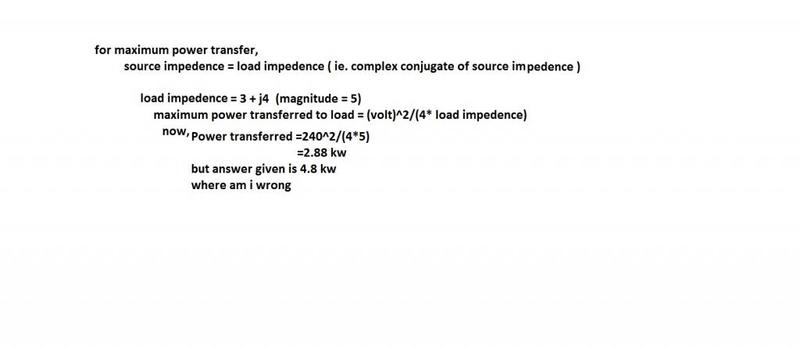
The discussion revolves around the Maximum Power Transfer Theorem in the context of a homework problem involving a voltage source with internal impedance supplying power to a complex load impedance. Participants explore how to determine the maximum power transferred to the load, considering the implications of complex impedances.
Discussion Character
- Homework-related
- Mathematical reasoning
- Technical explanation
Main Points Raised
- One participant emphasizes the importance of focusing on the real power delivered to the load and suggests ignoring the imaginary parts of the impedances to use their magnitudes.
- Another participant points out that without a numerical definition of the load impedance, the problem lacks a solution.
- A different participant reiterates that the load impedance does not need to be defined numerically to find the maximum power, indicating a focus on theoretical understanding.
- There is a suggestion that if the load impedance is the complex conjugate of the source impedance, it simplifies the calculation of current and voltage across the load.
- One participant notes a misunderstanding regarding the visibility of the term "maximum" in the problem statement, which led to confusion.
Areas of Agreement / Disagreement
Participants express differing views on the necessity of defining the load impedance numerically, with some arguing it is essential for a solution while others believe it is not required for the purpose of finding maximum power.
Contextual Notes
The discussion highlights the dependence on definitions of impedance and the assumptions made regarding the relationship between the source and load impedances. There are unresolved mathematical steps related to calculating current and total circuit impedance.