Treating Voltage Sources in Mesh Analysis: Clockwise Drop or Rise Positive?

Click For Summary
SUMMARY

The discussion centers on the treatment of voltage sources in Mesh Analysis, specifically regarding the sign conventions for voltage drops and rises. The textbook "Fundamentals of Electric Circuits 4e" states that the algebraic sum of independent voltage sources should be taken clockwise, yet examples in lecture slides create confusion. The consensus is that whether treating clockwise with rises as positive or counterclockwise with drops as positive, the results should remain consistent if applied correctly. Participants recommend creating simple test cases to verify understanding and application of Kirchhoff's Voltage Law (KVL).

PREREQUISITES
  • Understanding of Kirchhoff's Voltage Law (KVL)
  • Familiarity with Mesh Analysis techniques
  • Basic knowledge of voltage sources and their polarities
  • Experience with circuit analysis software or manual calculations
NEXT STEPS
  • Create simple test cases to practice KVL with different voltage source orientations
  • Research the differences between clockwise and counterclockwise analysis in Mesh Analysis
  • Explore the implications of sign conventions in circuit analysis
  • Study the matrix method for Mesh Analysis to enhance understanding of voltage relationships
USEFUL FOR

Electrical engineering students, circuit designers, and anyone involved in circuit analysis who seeks to clarify the application of voltage source conventions in Mesh Analysis.

SuperCat
Messages
26
Reaction score
1
1.
I have a question regarding the treatment of voltage sources in Mesh Analysis by inspection. I hope this is the correct place to post.

In my course textbook (Fundamentals of Electric Circuits 4e p. 101) it says that the voltage is the algebraic sum taken clockwise of all independent voltage sources in the related mesh. Yet in an example problem they do not stay consistent with this.

I found the same example problem in some lecture slides online:
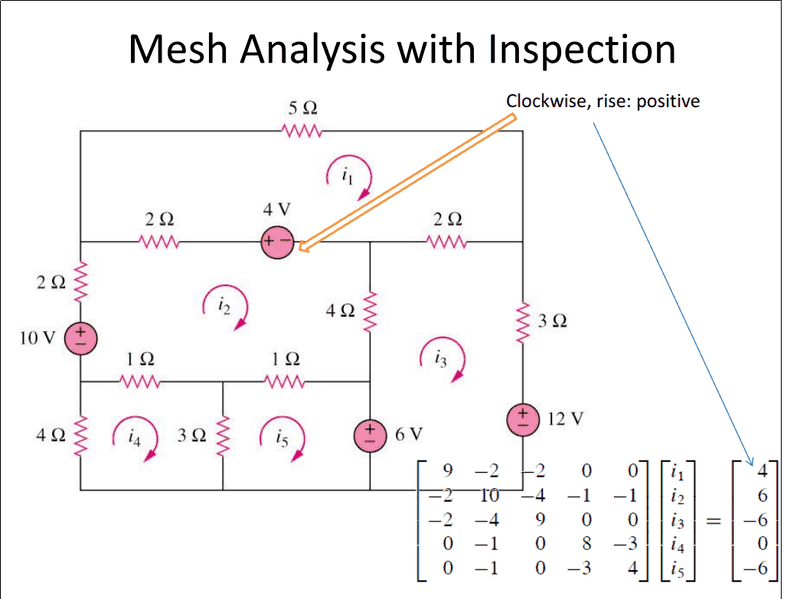
64c5d045795fc82d6e97b0fcbd2cefb3.png


So I'm left wondering:
- Does the example have an error and they actually meant to do clock wise drop is positive? My textbook makes no mention of treating a drop as positive for Mesh analysis by inspection.
- If it isn't an error, and they did CW with rise positive, is that any different than just taking it CCW with drop being positive?
 
Physics news on Phys.org
In loop ##i_1## going clockwise you "walk" from - to + though the 4 V source. So that's a rise of 4 V going in that direction and the voltage vector reflects this with a "4" entry.

In loop ##i_2## again going clockwise, there's a rise of 10 V followed by a drop of 4 V for a net of 6 V, again reflected in the voltage vector.

So, no mistake there.

P.S. Please be sure to retain the formatting template headings in future. The template is required for threads in the homework areas.
 
  • Like
Likes gracy
Apologies for not using the template. It just didn't seem to fit my question.
So instead of viewing it as CW with rise being positive can I take it as CCW with drop being positive?
 
SuperCat said:
Apologies for not using the template. It just didn't seem to fit my question.
So instead of viewing it as CW with rise being positive can I take it as CCW with drop being positive?
[Sorry for the delay in responding ... we had a power failure here that lasted several hours]

You need to respect the potential change that occurs in the direction of your "KVL walk", just as you must respect the rise/drop across resistors that occurs in the direction of the walk. The latter depends upon the assumed current direction. So if you're "walking with the current", resistors show a potential drop. If you're "walking against the current" then resistors show a potential rise.

Consider that by placing the source potential changes in a separate vector on the other side of the equals sign, this implicitly changes the sign of the entries already. So if you are summing potential drops as positive values on the LHS, then a potential rise through a source would have a negative entry on the LHS. Moved to the RHS it becomes positive.

Why don't you create a very simple one-loop test case to play with, say two sources with different orientation and a couple of resistors. Write the KVL loop equation manually and verify the results, then apply the "mesh by inspection" rules to do write the equation. You should end up with the same solution. Then you can try out your CW/CCW rise/drop theories to see what happens.
 
  • Like
Likes SuperCat and gracy
I'm very sorry for replying so late to you. I really appreciate you taking your time to provide me with such a detailed response. I got ill after I posted this question, and that caused me to have very limited time for extra activities like the internet.

Thanks again for taking the time to solve this. I completely understand it now. Once I took the time to understand what the matrix of inspection meant it hit me what I needed to do.
 
No worries, glad I could help. Hope you're feeling better!
 
  • Like
Likes SuperCat

Similar threads

  • · Replies 9 ·
Replies
9
Views
6K
Replies
11
Views
4K
Replies
15
Views
2K
  • · Replies 2 ·
Replies
2
Views
7K
  • · Replies 1 ·
Replies
1
Views
2K
  • · Replies 1 ·
Replies
1
Views
1K
  • · Replies 2 ·
Replies
2
Views
3K
Replies
3
Views
2K
  • · Replies 1 ·
Replies
1
Views
2K