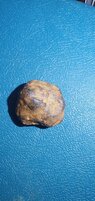
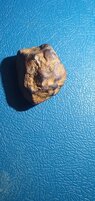
Looking at the pictures shows a patina with polished corners. If it is a rock, it has either been handled by people for a long time, or has remained on the surface in a gibber stone desert. The lenticular notches suggest weathering of rock containing fossil shells.
Does it contain one rock or many particles of grit?
You have a "rattle stone", google it.
Rocks that rattle can be made from selectively weathered chemical concretions, geodes, or can be based on fossils in sandstone. Consider a bivalve shell, filled with sand and buried in sand. Groundwater, temperature and time, fossilise the shell and sand to a solid. The calcium carbonate from the shell, and silica from the sand, cement the near sandstone. When the rock comes to the surface, it may be differentially weathered chemically, to remove the calcium shell, resulting in a rattling rock.
There are a few other possibilities. It could be a concretion from an animal's gut, like a gall stone or a bezoar stone. Or a stone swallowed by an animal, a gastrolith, like a grindstone in the gizzard of a bird or reptile, from a dinosaur fossil or recently employed.
You will need to open it to identify the origin.
https://en.wikipedia.org/wiki/Gastrolith
https://en.wikipedia.org/wiki/Bezoar