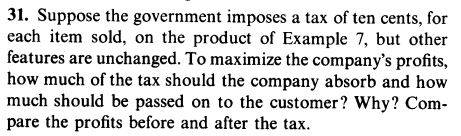
Min max: how much of the tax to absorb
- Thread starter Karol
- Start date
-
- Tags
- Max
Click For Summary
Homework Help Overview
The discussion revolves around a problem involving the pricing of items in relation to tax absorption and its impact on sales volume. The subject area includes concepts from economics and calculus, particularly focusing on profit maximization and the relationship between price, quantity sold, and costs.
Discussion Character
- Exploratory, Conceptual clarification, Mathematical reasoning, Problem interpretation, Assumption checking
Approaches and Questions Raised
- Participants explore the relationship between price adjustments due to tax and the resulting changes in the quantity of items sold. There are attempts to define new variables and their implications on the pricing model. Questions arise regarding the interpretation of these variables and the effects of tax on pricing strategies.
Discussion Status
The discussion is active with multiple interpretations being explored regarding how to incorporate tax into the pricing model. Participants are questioning the definitions and roles of various variables, particularly the coefficient representing tax, and how these affect the overall profit equation. Some guidance has been offered regarding the relationship between price and quantity sold, but no consensus has been reached.
Contextual Notes
There are constraints regarding the definitions of variables and assumptions about market behavior. Participants express uncertainty about how to accurately represent the impact of tax on pricing and sales, indicating a need for clearer definitions and relationships among the variables involved.
- 11,987
- 1,584
What do your "new" variables represent?Karol said:Homework Statement
View attachment 230408

![]()
View attachment 230409
![]()
Homework Equations
Minimum/Maximum occurs when the first derivative=0
The Attempt at a Solution
$$y=20,000+60x,~~P=200-Ax$$
$$N=xP-Y=200x-Ax^2-20,000-60x,~~N'=140-2Ax$$
Two variables
Attachments
- 1,380
- 22
A<0.01 since P must be higher now.
But maybe P=B-0.01x, i don't know.
Or may be even P=B-Ax
- 1,047
- 337
- 1,380
- 22
I don't think you can modify ##~P=200-0.01x~## because it depends only on the customers that are ready to buy x items if the price is P.
The formula ##~P=200-0.01x~## doesn't depend at all on the firm, only on the free market, as i understand it, so i can't change it at all. if P is higher x is lower but according to the same ##~P=200-0.01x~##.
- 11,987
- 1,584
That leaves lots of questions (in my mind).Karol said:x is the same, items sold per week, and A is the new coefficient instead of 0.01.
A<0.01 since P must be higher now.
But maybe P=B-0.01x, i don't know.
Or may be even P=B-Ax
In the Example problem, I see:
##P\ ## : price at which each item will be sold.
##y\ ## : total cost to put x items on market each week.
That leaves at least 2 more, ##\ N\ ## and ##\ Y\ ##, plus now you mention ##\ B\ ##.
I suppose that ##\ N\ ## is the profit for selling ##\ x\ ## items per week and perhaps ##\ Y\ ## should be ##\ y\ ##.
I think you need to handle ##A\ ## differently. I see some problems with the way you handle the amount of tax to be passed on in the price.
2) You seem use ##A\ ## to replace the 0.01 or combine the two. The 0.01 is a factor which reduces the price per item depending on the number of item sold each week. ##A\ ## should not be multiplied by ##x\ ## in the formula for ##P\ ##.
3) ##A\ ## has only a limited range of possible values. This range depends on how you define it (in a detailed way)
I suggest that ##A\ ## is simply the actual amount of tax passed on in the price. So it would have a range from 0 to 10 cents.
Also, keep the ##\ -0.01x\ ## as part of ##P \ ##.
I seems that now you have two variables to use in optimizing, ##x\ ## and ##A\ ## .
- 1,047
- 337
Right. You are raising the price by passing some of the tax on to the customer, so that should lower the number of items you sell in a week. You have to somehow represent that in an equation to solve this problem. What would be the new price on the item if you add some amount of tax T?Karol said:if P is higher x is lower
- 1,380
- 22
$$\left\{ \begin{array}{l} P=200-0.01x+a \\ y=(60-a)x+20,000 \end{array} \right. $$SammyS said:I suggest that A is simply the actual amount of tax passed on in the price. So it would have a range from 0 to 10 cents.
$$N=xP-y=...=2(70+a)x-0.01x^2-20,000$$
$$N'=2(70+a)-0.02x,~~N'=0~\rightarrow~x=100(70+a)$$
- 11,987
- 1,584
Now what should the value of ##\ a\ ## be?Karol said:##N'=2(70+a)-0.02x,~~N'=0~\rightarrow~x=100(70+a)##
- 1,047
- 337
Assuming that ##P## remains constant, will a positive value of ##a## result in more items sold or less? Does your equation make sense in that context?Karol said:$$\left\{ \begin{array}{l} P=200-0.01x+a \\ y=(60-a)x+20,000 \end{array} \right. $$
$$N=xP-y=...=2(70+a)x-0.01x^2-20,000$$
$$N'=2(70+a)-0.02x,~~N'=0~\rightarrow~x=100(70+a)$$
- 1,380
- 22
$$N=xP-y=...=2(70-a)x-0.01x^2-20,000$$
$$N'=2(70-a)-0.02x,~~N'=0~\rightarrow~x=100(70-a)$$
It still is with 2 variables.
And i see that ##~P=200-0.01x~## represents the ability of the firm to charge the price P if x items are produced and sold. that i understand from the fact you modify this equation. why then is ##~y=50x+20,000~##? isn't it doubling the information, about the firm?
I thought ##~P=200-0.01x~## represents the readiness of the market. if it costs P then only x items will be purchased. this interpretation of mine is completely disconnected from the firm. i wouldn't touch P and also the tax doesn't influence this equation, to my interpretation.
Instead i would change the cost, y. it is more expensive now to produce an item.
- 1,047
- 337
P is the price of one item. y is the cost of making x items. The question is asking how much of the tax you will add to the price and how much of it you will add to the cost. How would you represent that?Karol said:$$\left\{ \begin{array}{l} P=200-0.01x-a \\ y=(60-a)x+20,000 \end{array} \right.$$
$$N=xP-y=...=2(70-a)x-0.01x^2-20,000$$
$$N'=2(70-a)-0.02x,~~N'=0~\rightarrow~x=100(70-a)$$
It still is with 2 variables.
And i see that ##~P=200-0.01x~## represents the ability of the firm to charge the price P if x items are produced and sold. that i understand from the fact you modify this equation. why then is ##~y=50x+20,000~##? isn't it doubling the information, about the firm?
I thought ##~P=200-0.01x~## represents the readiness of the market. if it costs P then only x items will be purchased. this interpretation of mine is completely disconnected from the firm.
- 1,380
- 22
$$\left\{ \begin{array}{l} P=200-0.01x-a \\ y=(60-a)x+20,000 \\ x=7500 \end{array} \right.$$
$$N'=0~\rightarrow~x=100(70-a)~\rightarrow~7500=100(70-a)~\rightarrow~a=-5$$
- 1,047
- 337
I am having a hard time getting from your problem set up to your answer. You can take either P or x as an independent variable. I have been trying to get you to use P as the independent variable, but I think I have only made the problem harder that way. My apologies. It seems simpler to use x. ThenKarol said:The answer to the original question, no' 7, is x=7500. If "all other features are unchanged" then x=7500.
$$\left\{ \begin{array}{l} P=200-0.01x-a \\ y=(60-a)x+20,000 \\ x=7500 \end{array} \right.$$
$$N'=0~\rightarrow~x=100(70-a)~\rightarrow~7500=100(70-a)~\rightarrow~a=-5$$
##P = 200 - 0.01x##
##y = (50 + 10 - a)x + 20,000## (I edited this to correct an error.)
Then the net profit is ##N = (P-a)x - y## because you don't get to count the collected tax as profit.
This seems to be equivalent to your formulation. But how are you getting from there to ##N'=0~\rightarrow~x=100(70-a)##?
- 11,987
- 1,584
@Karol ,tnich said:I am having a hard time getting from your problem set up to your answer.
...
I too am having trouble understanding what you are doing and/or trying to do.
I've asked before, but Please !
Please explain in some detail:What does each and every variable represent and how are you using each?
Well at least, tell us more about you intentions for the variable, ##\ a\ ##.
- 1,380
- 22
$$N = (P-a)x - y=...=140x-0.01x^2+20,000$$tnich said:##P = 200 - 0.01x##
##y = (50 + 10 - a)x + 20,000##
Then the net profit is ##N = (P-a)x - y## because you don't get to count the collected tax as profit.
a disappeared
- 1,047
- 337
Yes. So how much of the tax should be passed on to the customer?Karol said:a are the cents that are absorbed by the firm.
$$N = (P-a)x - y=...=140x-0.01x^2+20,000$$
a disappeared
- 1,380
- 22
So a is passed to the customer. every item is more expensive by a. if we already want to use ##~N = (P-a)x - y~## then it should be ##~N = (P+a)x - y##
But it's not logical. if ##~P=200-0.01x~## represents, as i interpret it, the forces of the market, meaning what are people ready to pay, then ##~N=xP-y~## should be changed in a different way.
I think ##~y=60x+20,000~## only, because each item is more expensive by 10. what we do later with the price we charge is an other thing.
Maybe i should change a to be positive and represent the decrease in the number of people who are buying, so ##~P=200-0.01(x+a)~##, but i don't know to do it this way either
- 1,047
- 337
##P = 200- 0.01x## is the demand curve, and in micro-economic theory the demand curve is the relationship between the price the firm charges and the number of units it can sell. If the firm decides to pass an amount ##a## of the tax on to the customers in the price of each unit, then it can only keep ##P-a## of the income on each unit because it has to hand the rest over to the government. So your equation in post #16 is correct (except for the sign on 20,000). What it is telling you is that it does not matter how much of the tax you charge to the customer - all values of ##a## give the same result. What does matter is the total price that you charge the customer.Karol said:##y = (50 + 10 - a)x + 20,000~## says (10-a) is absorbed by the firm. every item is more expensive to "produce" by (10-a). i shouldn't write ##~N=(P-a)x-y~## since the loss to the firm has already been taken into account in y.
So a is passed to the customer. every item is more expensive by a. if we already want to use ##~N = (P-a)x - y~## then it should be ##~N = (P+a)x - y##
But it's not logical. if ##~P=200-0.01x~## represents, as i interpret it, the forces of the market, meaning what are people ready to pay, then ##~N=xP-y~## should be changed in a different way.
I think ##~y=60x+20,000~## only, because each item is more expensive by 10. what we do later with the price we charge is an other thing.
- 1,380
- 22
$$N=(140-a)x-0.01x^2-20,000$$
$$N'=0~\rightarrow~140-a=0.02x$$
I have to express x in terms of a, x=x(a)
- 1,047
- 337
You did not include the remaining part of the tax in the cost.Karol said:$$\left\{ \begin{array}{l} y=60x+20,000 \\ P=200-0.01x \\ N=(P-a)x-y \end{array} \right.$$
$$N=(140-a)x-0.01x^2-20,000$$
$$N'=0~\rightarrow~140-a=0.02x$$
##x = 7000 + 0a##?Karol said:I have to express x in terms of a, x=x(a)
- 1,047
- 337
- 4,973
- 3,226
- 1,380
- 22
$$\left\{ \begin{array}{l} P-(10-a)=200-0.01x \\ y=(50+a)x+20,000 \\ N=xP-y \end{array}\right.$$
$$N'=0:~0.01x=80-a$$
I don't seem to get rid of a so i will use the result for the original question:
$$\left\{ \begin{array}{l} P=200-0.01x \\ y=50x+20,000 \\ N=xP-y \end{array}\right.$$
$$N'=0:~x=7500$$
If i insert this x into the new equation with a ...
- 11,987
- 1,584
After exchanging pm.s with @Karol , I learned that this problem comes from a textbook on Calculus and Analytic Geometry.Karol said:a are cents absorbed by the firm. P is the price presented to the customers, is what they are asked to pay
$$\left\{ \begin{array}{l} P-(10-a)=200-0.01x \\ y=(50+a)x+20,000 \\ N=xP-y \end{array}\right.
$$$$N'=0:~0.01x=80-a
$$I don't seem to get rid of a so i will use the result for the original question:
The following set of equations is correct for the initial "Example 7" problem.
In the statement of that problem, ##\ P\ ##, as the function given below, represents the price (per item). and at this price, ##\ x\ ## number of items can be sold per week.
Similarly, ##\ y\ ##, as given below represents the cost, in cents, of making ##\ x\ ## number of items.
Karol has used the variable, ##\ N\ ##, to represent the profit for selling ##\ x\ ## number of items.$$\left\{ \begin{array}{l} P=200-0.01x \\ y=50x+20,000 \\ N=xP-y \end{array}\right.$$
$$N'=0:~x=7500$$
Substituting for ##\ P\ ##, and ##\ y ##, then simplifying gives the following.
Problem 31, which is a modification of the above example problem, is the topic of this thread. Obviously, there has been some difficulty interpreting this problem, and some differences of opinion.
One change is that the government now imposes a 10 cent tax on each item sold, other features remain the same,
except, (it then states that) we should determine how much of the tax the company should absorb, (and presumably the rest of the tax is) how much to pass on to the customer. The latter does imply that ##\ P\ ## and/or ##\ y\ ## need some modification.
Here is my understanding of the problem.
Since this is a fixed tax, not a percentage of the price, it is not like the familiar 'sales tax', so may be paid directly to the gov't by the company. I consider that it is an added cost per item which is to be included in ##\ y\ ## by adding the term ##\ 10x\ ##.
The price function, poses another difficulty. It is implied that some of the tax may be passed on to the customer. It seems to me that this amount must be added to the price function.
So introducing the variable, ##\ a\ ##, as the portion of the 10 cent tax to be absorbed by the company, as Karol has done, we then have that the customer pays the remaining ##\ 10 - a\ ## cents, where of course, ##\ 0 \le a\ \le 10 \ ##. This amount is to be added to the price function.
Therefore, I suggest that we use the following for ##\ P\ ## and ##\ y\ ##.
##y = 50x +20,000 +10x ##
This gives a profit function, ##\ N(x,a)\ ## with dependence on two variables.
To find critical values for min/max of a two variable function, consider where the partial derivative of each is zero or undefined or where a derivative along any of the boundaries of constraints is zero or undefined.
- 1,047
- 337
It is difficult to interpret the intent of the problem's author, and I think it is commendable that you dug deeper for the background on the problem. I would point out that in your formulation of the problem, there is nothing to prevent the firm from passing on all 10 cents of the tax per item to the customer (that is, setting ##a =0##). In that case we would end up with the original optimal solution, ##x=7,500##. That makes me wonder if your interpretation is what the author really intended.SammyS said:Therefore, I suggest that we use the following for ##\ P\ ## and ##\ y\ ##.
## P = 200 - 0.01x + (10 - a) ##
##y = 50x +20,000 +10x ##
This gives a profit function, ##\ N(x,a)\ ## with dependence on two variables.
To find critical values for min/max of a two variable function, consider where the partial derivative of each is zero or undefined or where a derivative along any of the boundaries of constraints is zero or undefined.
- 11,987
- 1,584
Good point(s).tnich said:It is difficult to interpret the intent of the problem's author, and I think it is commendable that you dug deeper for the background on the problem. I would point out that in your formulation of the problem, there is nothing to prevent the firm from passing on all 10 cents of the tax per item to the customer (that is, setting ##a =0##). In that case we would end up with the original optimal solution, ##x=7,500##. That makes me wonder if your interpretation is what the author really intended.
Not only is the number sold, ##\ x\ ##.\, the same as for Ex. 7, but so is the resulting profit.
I agree. That doesn't make much sense as an example prob.
There still is the question for OP as to what to do with the ##\ a\ ## parameter.
- 4,973
- 3,226
When the author states "A company can sell x items per week at a price P", this is a statement of a demand function i.e. a relationship between the price of an item and how much of the item consumers will buy. So at a price P, x items are sold for a total revenue of Px. You are given how much it costs to make x items so can write an equation for the amount of profit which is conventionally called Π:
## \Pi = x(200-0.01x) - 50x + 20,000 ##
You solve the problem by finding the value of x which maximises profit, and then substituting this into the equation for P to find the corresponding price.
When in Q.31 the author states that "the government imposes a tax of ten cents for each item sold", this changes the equation for profit which now becomes
## \Pi' = x(200-0.01x) - 50x + 20,000 - 0.1x ##
Maximising Π' and substituting in gives a new price P'.
The amount of tax passed on to the consumer is P' - P.
Edit: LaTeX formatting
- 1,380
- 22
$$\Pi\prime = x(200-0.01x) - 50x + 20,000 - 10x$$
- 1,380
- 22
$$\Pi\prime = x(200-0.01x) - 50x + 20,000 - 0.1x$$
i think it should be:
$$\Pi\prime = x(200-0.01x) - 50x - 20,000 - 10x$$
Similar threads
- · Replies 7 ·
- Replies
- 7
- Views
- 2K
- Replies
- 5
- Views
- 1K
- Replies
- 1
- Views
- 2K
- · Replies 7 ·
- Replies
- 7
- Views
- 2K
- Replies
- 4
- Views
- 2K
- Replies
- 10
- Views
- 3K
- · Replies 10 ·
- Replies
- 10
- Views
- 3K
- Replies
- 7
- Views
- 2K
- · Replies 3 ·
- Replies
- 3
- Views
- 5K
- Replies
- 9
- Views
- 2K