Mirau White Light Interferometer. Light Source?

Click For Summary
SUMMARY

The discussion centers on selecting an appropriate white light source for a Mirau white light interferometer setup. The user initially sought a high-power white light laser (100-200 Watts) but was informed that such lasers are rare and unnecessary for interferometry. Instead, white light interferometry typically employs white light LEDs, which are suitable for surfaces with micrometer variations. The user was directed to specific components, including the MCWHL5-C2 light source and EBS1 beam splitter from Thorlabs, as well as a Nikon interferometry objective from Edmund Optics.

PREREQUISITES
  • Understanding of white light interferometry principles
  • Familiarity with optical components such as beam splitters and objectives
  • Knowledge of light sources, specifically white light LEDs
  • Basic skills in optical setup and alignment
NEXT STEPS
  • Research the specifications and applications of white light LEDs for interferometry
  • Explore the setup and functionality of the MCWHL5-C2 light source
  • Learn about the role of beam splitters in optical systems, particularly the EBS1 model
  • Investigate the design and implementation of Mirau objectives in optical setups
USEFUL FOR

Optical engineers, researchers in metrology, and anyone involved in the design and implementation of interferometric systems will benefit from this discussion.

adamjts
Messages
24
Reaction score
0
Hi everyone,
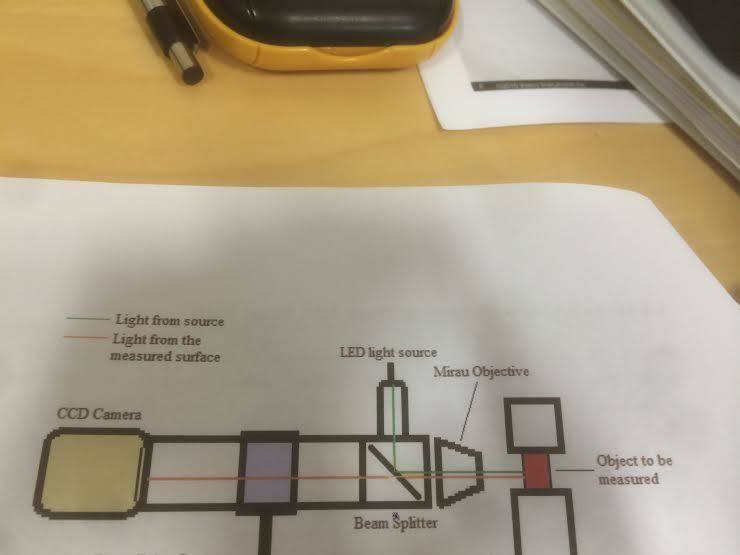
I'm building a white light interferometer and need help choosing and finding a white light source.

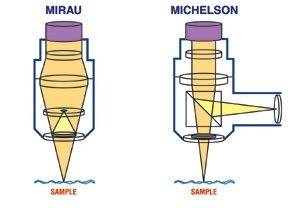
I'm using this mirau objective:
http://www.edmundoptics.com/microsc...ectives/nikon-interferometry-objectives/59312
Interferometry%201.jpg


Here is the setup:

unnamed.jpg


I know that the light source will have to be collimated and go through an aperture stop, field stop, bandpass, etc. I was hoping that there was a white light laser that does these steps already so that I don't have to work with several different lenses and build a setup for them. Such a laser must exist, no? Does anyone know where I can find one? Ideally one that is 100-200 Watts? I've looked all over but am having trouble finding an manufacturer that makes what I'm looking for.

Are there any important steps that I'm missing? Should a collimated white light beam do the job?

THANKS!
 
Engineering news on Phys.org
200 Watts? (!) are you doing interferometry on the moon? That level of power on a laser is used to cut steel. Further, white lasers are a special purpose rarity. I've not heard of anyone using them for interferometry. Its not necessary. Why do you want to use white?
 
I'm not sure about the wattage but i know that white light interferometry is a common practice.

http://fp.optics.arizona.edu/jcwyan.../Optical_Testing/WhiteLightInterferometry.pdf
http://www.micromanufacturing.com/content/understanding-scanning-white-light-interferometry
http://www.laserfocusworld.com/articles/print/volume-37/issue-9/features/interferometry/interferometric-approaches-each-have-advantages.html

White light is more suited to rougher surfaces which would be appropriate for my purpose because the surface I'm looking at will have µm variations.
 
Last edited by a moderator:
oh and yes I was totally off with the power of the laser
 
from what I've seen, white light interferometry is not done with a laser. And that includes your sources that you posted. reread the first page of your document from fp.optics. White lasers are a relatively recent invention. And I believe it is a much more complicated solution.
 
Last edited:
I was under the impression that the steps described in the diagram (before the light even reaches the beam splitter) were steps that were typical of those carried out in a laser before it exits the laser.
photo.jpg
 
adamjts said:
I was under the impression that the steps described in the diagram (before the light even reaches the beam splitter) were steps that were typical of those carried out in a laser before it exits the laser.
View attachment 70494

most of that is totally unnecessary if your light starts out monochromatic and coherent. For laser interferometry, all you need is the laser, a beam splitter, a lens, and a mirror.
 
  • Like
Likes   Reactions: 1 person
  • #10
  • #11
White Light Interferometry

Hi adamjts,

I'm a Product Support Engineer who works at Edmund Optics. I've been following your posts above and noticed that you're interested in White Light Interferometry. In terms of the setup that would go with the interferometry objective above, you're definitely on the right track. You would need an illumination source and a way to mount it inline. We have suggested parts for the illumination, inline mechanics, and the mounting. This would make sure that you don't have to build everything from scratch. If you're interested to discuss this further, please feel free to email me at this address. I look forward to working with you on your application.

Thanks,
PD
 
  • #12
hi adamjts

on pages 18 and 19 of that document in your post #6

its shows their setup, they are using a white light LED ( Light Emitting Diode)

Dave
 

Similar threads

  • · Replies 6 ·
Replies
6
Views
2K
  • · Replies 33 ·
2
Replies
33
Views
3K
  • · Replies 1 ·
Replies
1
Views
837
  • · Replies 4 ·
Replies
4
Views
6K
  • · Replies 19 ·
Replies
19
Views
5K
  • · Replies 2 ·
Replies
2
Views
1K
  • · Replies 5 ·
Replies
5
Views
6K
  • · Replies 14 ·
Replies
14
Views
3K
  • · Replies 3 ·
Replies
3
Views
7K
  • · Replies 152 ·
6
Replies
152
Views
11K